5 Big Past the Bots updates: Your Own Applications Already Know Why You're Not Getting Callbacks
July 15, 2026 · 6 min read · Rod Trent
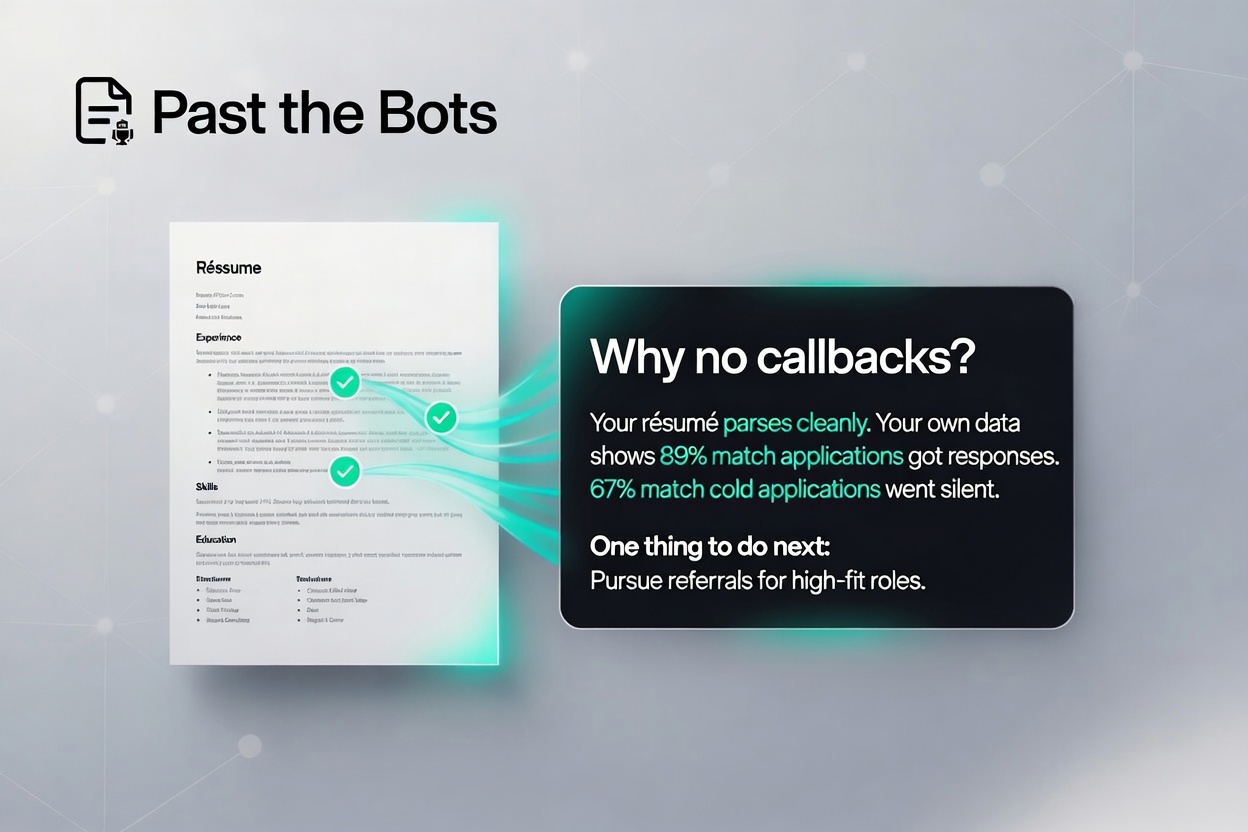 This whole product started from one idea: a machine reads your résumé before a human ever does, and you never get to see what it saw. So we made that visible.
But there's a question that comes after that one, and it's the question people actually ask me. Not "what does the bot see?" It's: "I've applied to sixty jobs and heard nothing back. Why?"
For a long time my honest answer was that I didn't know. Now, if you've been tracking your applications, we do. Here's what shipped, starting with that.
Why no callbacks?
This is the one I'm proudest of.
If you've been saving scans and setting a status on them (applied, interviewing, offer, rejected), you've been quietly building a dataset about your own job search without meaning to. Why no callbacks? reads it and finds the pattern.
It looks for the things that actually cost people interviews: a résumé the parser is choking on, applications you sent while critical issues were still flagged, a job-match score that's too low across the board, one résumé variant quietly out-performing another, applications that have gone silent with nobody following up.
Then it gives you one thing to do next. Not a list of ten. The entire value of a diagnosis is that it refuses to hand you a menu.
Two things I want to call out.
First, the best finding it can give you is that your résumé is fine. If your file parses cleanly, matches the roles you're applying to, and still gets nothing back, the problem isn't the document. It's that you're cold-applying into a queue. It says exactly that, and points you toward referrals instead of letting you rewrite your bullets for another week. A tool that always finds something wrong with your résumé is a tool that's selling you something.
Second, it never quotes an industry benchmark at you. There's a very popular statistic about résumé screening that nobody can actually source, and we've refused to repeat it since day one. So the only comparison here is against your own numbers. If the applications that got responses averaged an 89% match and the ones that went quiet averaged 67%, then 89 is your floor, and it came from your search rather than somebody's blog post.
The read itself is free. The AI write-up on top is part of the Pass.
The State of the ATS
Speaking of statistics nobody can source.
Every résumé checked here contributes its parse-health score, and its match score when a job description was supplied, to an anonymous histogram. Counts only. No résumé text, no identity, ever.
We'd never published any of it. Now we have: The State of the ATS. Real distributions, real medians, the share of résumés that don't read cleanly, and how all of it shifts by role family.
There's a methodology section, and it does something most reports won't: it tells you what the sample isn't. These are people who chose to check a résumé, which skews hard toward active job seekers who already suspected something was wrong. It is not a random sample of all résumés and we don't pretend otherwise. We also won't publish a role family until it clears a minimum sample size.
That's the entire point. You can cite it precisely because it doesn't overclaim.
Your hire-me page
A résumé is a file you submit. It isn't a link you can send someone.
So: /me. Claim a handle and you get a clean, hosted one-pager at pastthebots.com/me/your-name. The version of you a human reads. For your bio link, your email signature, the DM where someone asks "got anything I can look at?"
We prefill it from your most recent scan, so you're not staring at an empty form. It publishes with proper structured data, so search engines understand there's a person here.
Because the page is public, the defaults are deliberately cautious. Nothing goes live until you press publish. There's no phone field at all. Your email appears only if you type it in yourself, and we never copy it over from your account. Take the page down and it's gone immediately, handle and all.
References
The last thing anyone prepares and the fastest thing they get asked for.
/references tracks who's agreed to vouch for you, from "to ask" through "asked" to "confirmed." It's free, and it catches the failure nobody notices: a confirmed reference whose contact details you never actually wrote down. You discover that at the worst possible moment, roughly ninety seconds after someone asks you for the list.
It'll also write the ask. Being a reference is a genuine favor, and asking for one is the most awkward message in a job search. There are four flavors: asking someone to be a reference, asking for a LinkedIn recommendation, asking for a written letter, and the courtesy heads-up to someone who already said yes that a call is probably coming.
Every draft is required to give the person an easy, explicit out. That isn't politeness for its own sake. A reference who felt cornered into saying yes is a bad reference.
Interview Brief
And then you actually get the interview.
/interview-brief builds the dossier for one specific conversation: what the posting is really hiring for, the themes you'll get asked about, how your real experience maps to them, the gaps to be ready for honestly, and sharp questions to ask back.
Here's a decision I want to be upfront about.
The obvious version of this feature generates a company snapshot. Ours doesn't. An AI writing about a real employer from memory will produce something confident, plausible, and occasionally wrong. Being confidently wrong about a company in the room is considerably worse than knowing nothing. So the brief only reasons from what it genuinely has: the job description, your résumé, and any company notes you paste in yourself.
Everything it doesn't know becomes a research checklist instead. Go find out how the team is structured. Go look up who's interviewing you. Go read the last announcement they made. It tells you what to look for and why it matters, rather than inventing it.
Less magical. Considerably more useful.
The same line, again
Every one of these holds the rule the rest of the product holds. The callbacks read uses your numbers instead of borrowed ones. The report states what its own sample isn't. The hire-me page publishes nothing you didn't type. The brief refuses to invent an employer.
We've never been the tool that tells you what you want to hear.
Go see what your applications have been trying to tell you: pastthebots.com/history.
Past the Bots is the ATS résumé toolkit at pastthebots.com. The audit, the ATS directory, and the State of the ATS report are always free, no signup.