7 Signs Your Workplace Culture Is Toxic (And How to Start Your Exit Strategy Today)
June 19, 2026 · 4 min read · Past the Bots
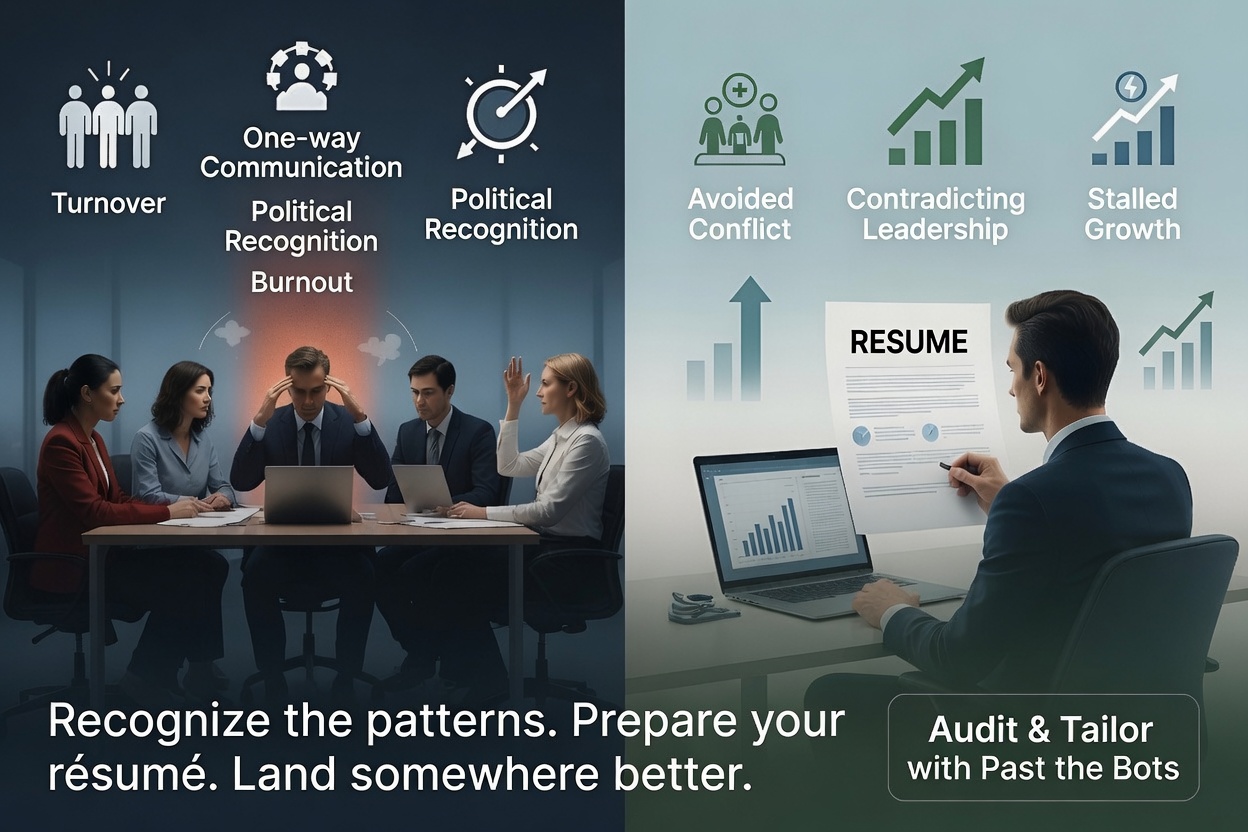 You've probably felt it before you could name it. Meetings that leave you drained, feedback that feels more like a gotcha than guidance, or a creeping sense that leadership says one thing and does another. Toxic workplace culture rarely announces itself. It shows up in patterns.
If any of the signs below feel familiar, it might be time to stop waiting for things to get better and start quietly getting your résumé ready.
The 7 Warning Signs Worth Taking Seriously
1. High turnover that nobody talks about. When good people leave and leadership shrugs it off or spins it as "not a culture fit," that's a signal. If you're regularly training someone new every few months, the problem isn't the people leaving.
2. Communication flows one direction: down. Healthy teams share information openly. Toxic ones hoard it. If you're always the last to know about decisions that affect your work, leadership doesn't trust the team, and that dynamic rarely reverses.
3. Recognition is inconsistent or political. When the same few people get praised regardless of results, or when credit quietly gets redistributed upward, it erodes motivation fast. You shouldn't have to play politics to get acknowledged for solid work.
4. Burnout is worn like a badge. Cultures that glorify overwork don't reward effort, they just consume it. If "I slept four hours" is a flex at your company, that's a sustainability problem with your name on it eventually.
5. Conflict gets avoided instead of resolved. No conflict at all isn't healthy, it usually means people have given up. When real disagreements get buried under forced positivity or passive-aggressive silence, nothing actually improves.
6. Leadership behavior contradicts stated values. The company website talks about "integrity" and "work-life balance" while your manager emails you at 11 p.m. and expects a response. Words and actions that don't align are one of the clearest signals that culture is broken at the top.
7. Your growth has quietly stalled. This one sneaks up on people. You're busy, but are you actually developing? If you can't point to meaningful skills, responsibilities, or accomplishments from the past year, your current environment may be costing you more than just happiness.
What to Do When You're Seeing These Signs
First, don't panic-apply. One of the most common mistakes people make when they realize they need to leave is blasting out the same old résumé to 50 jobs overnight. That approach almost always underperforms because most job applications go through an Applicant Tracking System before a human ever sees them.
Instead, treat your job search like a project with actual steps.
Start with a résumé audit. Before you send anything out, find out how your résumé actually reads to an ATS. Tools like the Audit the Bots feature on Past the Bots show you exactly what different parsers extract from your file, including your name, contact info, skills, and section headers. You might be surprised what gets mangled or missed entirely.
Check your match score against real job descriptions. When you find a role you want, paste the job description and see how your résumé scores against it. Look at the matched keywords, the missing ones, and especially any knockout gaps. Those are the requirements an ATS might use to filter you out automatically before a recruiter ever sees your name.
Rewrite your bullets for the jobs you actually want. Your current role, even in a toxic environment, probably has accomplishments worth highlighting. The key is framing them in language that matches what your target employers are looking for. AI tailoring can help you rewrite those bullets to fit a specific job description without inventing experience you don't have.
Get your format right. A lot of résumés fail the ATS before the content even matters. Fancy two-column layouts, text boxes, and headers in unusual fonts often break parsing entirely. A clean, single-column format is almost always the safer choice when you're applying through an online portal.
Leaving Smart Beats Leaving Fast
If your workplace checks more than a couple of those boxes, your instincts are probably right. But leaving well means leaving prepared. A targeted résumé that actually gets read, a cover letter that sounds human, and a clear sense of what you're looking for will land you somewhere better faster than a frantic spray-and-pray approach.
You've already done the hard part by recognizing what's wrong. Now let's make sure the next place actually sees what you bring to the table.