700,000 Skilled Trade Jobs Are Open Right Now. Here's Why You're Not Getting Callbacks.
June 20, 2026 · 4 min read · Past the Bots
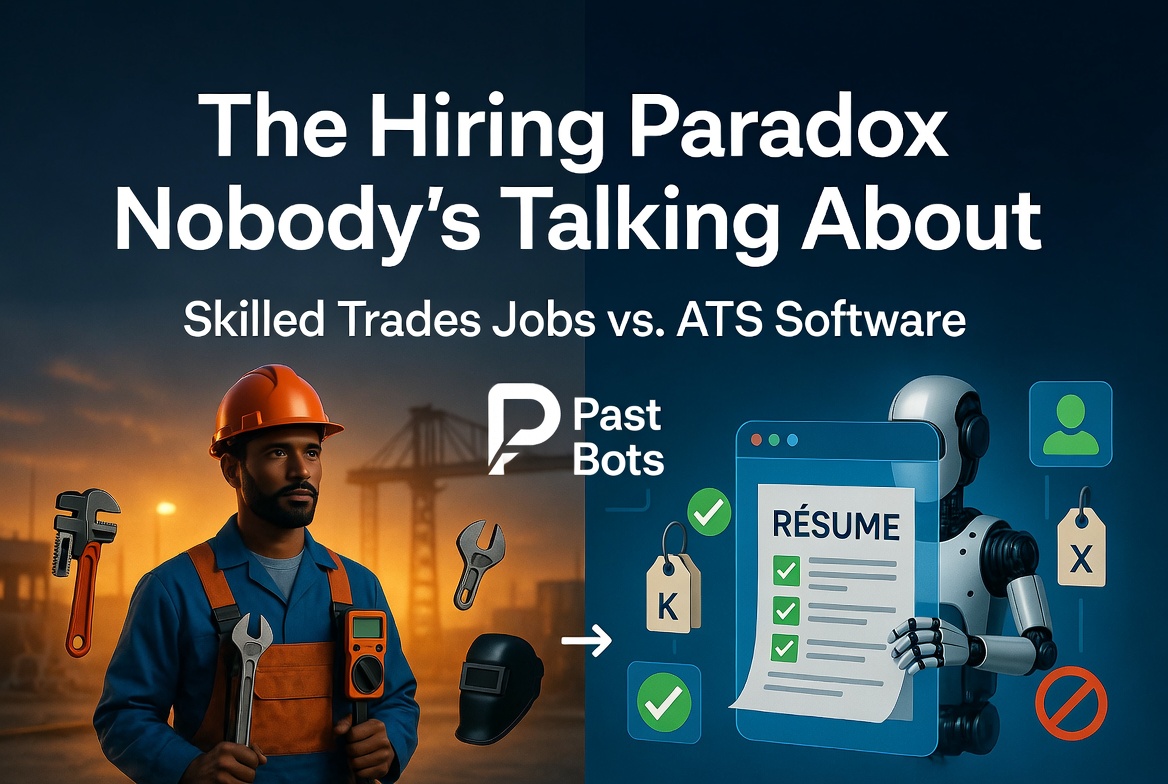
The Hiring Paradox Nobody's Talking About
Right now, U.S. employers are sitting on roughly 700,000 unfilled skilled trade positions, everything from electricians and HVAC technicians to welders, plumbers, and construction project managers. Companies are desperate. Some are offering signing bonuses, higher wages, and flexible schedules just to get qualified people in the door.
So why are skilled tradespeople still getting ghosted after applying?
A big part of the answer is the same software that was built for office jobs: Applicant Tracking Systems (ATS). These tools were designed to screen thousands of white-collar applications, and they're now being used to filter résumés for jobs that involve hands-on, technical work. The problem is that a lot of trade workers write their résumés the way they learned the trade, through experience and word of mouth, not by studying what a bot wants to see.
The result? Qualified candidates get filtered out before a human ever looks at their application.
What ATS Actually Does to Your Résumé
When you submit a résumé online, it usually gets parsed by software that pulls out your name, contact info, job titles, dates, and keywords. The system then scores your résumé against the job description and ranks candidates.
Here's where trade workers run into trouble:
- Abbreviations and certifications get missed. You might write "OSHA 30" or "NFPA 70E" but the system is looking for the full phrase, or vice versa.
- Job titles don't match. Your last employer called you a "Field Tech" but the posting says "Service Technician." The ATS may not connect those dots.
- Skills buried in a paragraph. If your résumé reads like a job description written in dense prose, the parser may not extract the individual skills it's scanning for.
- Formatting issues. Tables, text boxes, and graphics look great as a PDF but can cause parsers to scramble or skip entire sections.
None of this reflects your actual ability to do the job. It's just the reality of how automated screening works right now.
How to Fix It Before You Apply
The good news is that these are solvable problems. Here's what actually helps:
Mirror the job posting's language. If the posting says "Journeyman Electrician," use that exact phrase, even if your license or previous employer used slightly different wording. ATS systems are often doing literal keyword matching.
Spell out certifications the first time. Write "Occupational Safety and Health Administration (OSHA) 30-Hour" before you abbreviate. That way you cover both versions.
Use a clean, single-column format. No tables, no text boxes, no columns. It feels boring, but it parses cleanly. Every word you write actually gets read.
Quantify your work where you can. "Installed electrical systems in 40+ residential units per quarter" tells both the ATS and the hiring manager more than "responsible for electrical installation."
Add a skills section. Make it a simple bulleted list of your core competencies: certifications, tools, software (yes, if you use estimating software or fleet management systems, list those), and specialty skills.
How Past the Bots Can Help
If you're not sure whether your résumé is actually getting read the way you wrote it, Past the Bots has a few tools that are genuinely useful here.
The ATS scan shows you exactly what a parser extracts from your résumé, your name, contact info, skills, and section headers. If something isn't being picked up, you'll see it.
The job match score lets you paste in a job description and see how your résumé stacks up. It shows you which keywords matched, which are missing, and flags any knockout gaps (requirements that are critical and nowhere on your résumé).
The ATS-safe rebuild reformats your résumé into a clean single-column layout that parses correctly, without changing your actual experience.
And if you want to tailor your résumé to a specific posting, the AI tailoring tool rewrites your bullets to better reflect the language of the job. It doesn't fabricate anything, it just helps you present what you've actually done in a way that lands.
The Bottom Line
There are 700,000 jobs sitting open in the skilled trades right now. Employers want to hire. The gap isn't your experience, it's often just the layer of software standing between your application and a human who can actually appreciate what you bring.
A few targeted fixes to your résumé can make a real difference. Start with understanding what the bots are seeing, and go from there.