Are You Doomjobbing? Here's How to Break the Cycle and Actually Land Interviews
June 19, 2026 · 4 min read · Past the Bots
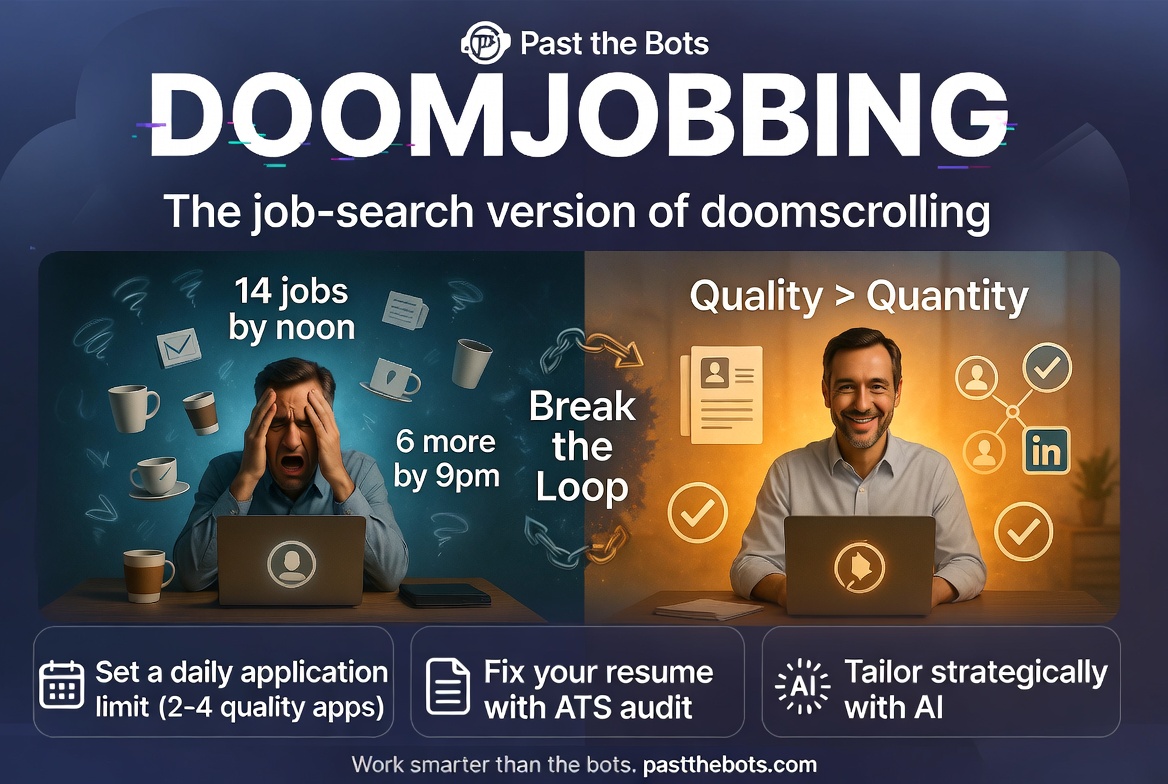
You open your laptop at 7am to check for new postings. By noon you've applied to 14 jobs. By 9pm you've sent out six more, your eyes are glazed, and you're not even sure what half of those companies do. Sound familiar?
Welcome to doomjobbing -- the job-search version of doomscrolling. It's what happens when anxiety takes the wheel. You know deep down that blasting out generic applications probably isn't working, but stopping feels impossible because at least you're doing something.
Here's the hard truth: volume is not a strategy. And the good news is that a smarter approach actually requires less time, not more.
Why Doomjobbing Feels Productive (But Isn't)
When we're stressed, our brains crave action. Refreshing Indeed and hitting "Easy Apply" delivers a tiny hit of "I did something today." But most of those applications go straight into an Applicant Tracking System and never surface to a human being -- especially if your resume isn't formatted and tailored to match what the ATS is actually looking for.
Research consistently shows that most jobs are filled through referrals and networking, not cold applications. And among cold applications, the ones that get through tend to be carefully targeted, not frantically submitted.
More applications without more intention just means more silence in your inbox, which feeds more anxiety, which feeds more doomjobbing. It's a loop.
Break the Loop: A Calmer, More Effective Approach
Set a daily application limit
Seriously. Cap yourself at two to four quality applications per day. That's it. Use the rest of your job-search time for networking, research, and actually improving your materials. This feels counterintuitive when you're panicking, but it works.
Fix your resume once, for real
One well-optimized resume will do more for you than 50 rushed submissions. Before you apply anywhere else, find out what an ATS actually sees when it reads your file. You might be surprised -- sometimes a fancy template, a header stuck in a text box, or a missing skills section means the system can't even parse your name correctly.
Past the Bots' Audit the Bots tool shows you exactly how different parsers read your resume: what they extract, what they miss, and where things break. The ATS scan flags critical issues, warnings, and quick wins so you know what to fix first. This kind of one-time audit pays off across every application you send afterward.
Tailor for the role, not for your ego
You don't need to rewrite your entire resume for every job. But you do need to make sure the language on your resume reflects the language in the job description. ATS systems score resumes partly by how well the keywords match, and a resume written entirely in your own vocabulary can score poorly even if you're genuinely qualified.
A tool like Past the Bots' skill-weighted match score shows you exactly which keywords from a job description appear on your resume, which ones are missing, and whether any gaps are potential knockout criteria. Spend 20 minutes closing those gaps before you apply instead of spending 20 minutes finding yet another job to shotgun.
Use AI tailoring to rewrite, not fabricate
One reason people send generic applications is that rewriting bullets for every role is exhausting. AI tailoring can speed this up significantly -- but only if it's done responsibly. The goal is to reframe real experience using the language the employer is actually looking for, not to invent things you haven't done.
Past the Bots' AI tailoring rewrites your bullets to match a job description without adding anything that isn't already there. It's the difference between strategic framing and making stuff up.
Protect your off hours
Doomjobbing often bleeds into evenings and weekends, which destroys your ability to show up well for interviews when they do come. Set job-search hours and stick to them. When the window closes, close the tabs. Your mental state during an interview matters enormously, and it's hard to be present and confident when you've been in a spiral for three weeks.
A Simple Daily Structure That Actually Works
- Morning (1 hour): Review new postings, select one or two worth pursuing
- Midday (1-2 hours): Tailor your resume for those specific roles, check keyword match, apply
- Afternoon (1 hour): One networking touchpoint -- a LinkedIn message, a coffee chat request, a follow-up email
- Done. Seriously. Close the laptop.
The Bottom Line
Job searching is genuinely stressful, and it makes sense that anxiety pushes you toward doing more. But more applications sent poorly is not the same as more opportunities created. Slow down, fix your foundation, target deliberately, and protect your energy for the conversations that actually get you hired.
The bots aren't going anywhere. But you can learn to work smarter than them instead of just throwing more volume at them.