Back to School in Your 40s? Here's How to Make Sure Your Résumé Catches Up
June 23, 2026 · 4 min read · Past the Bots
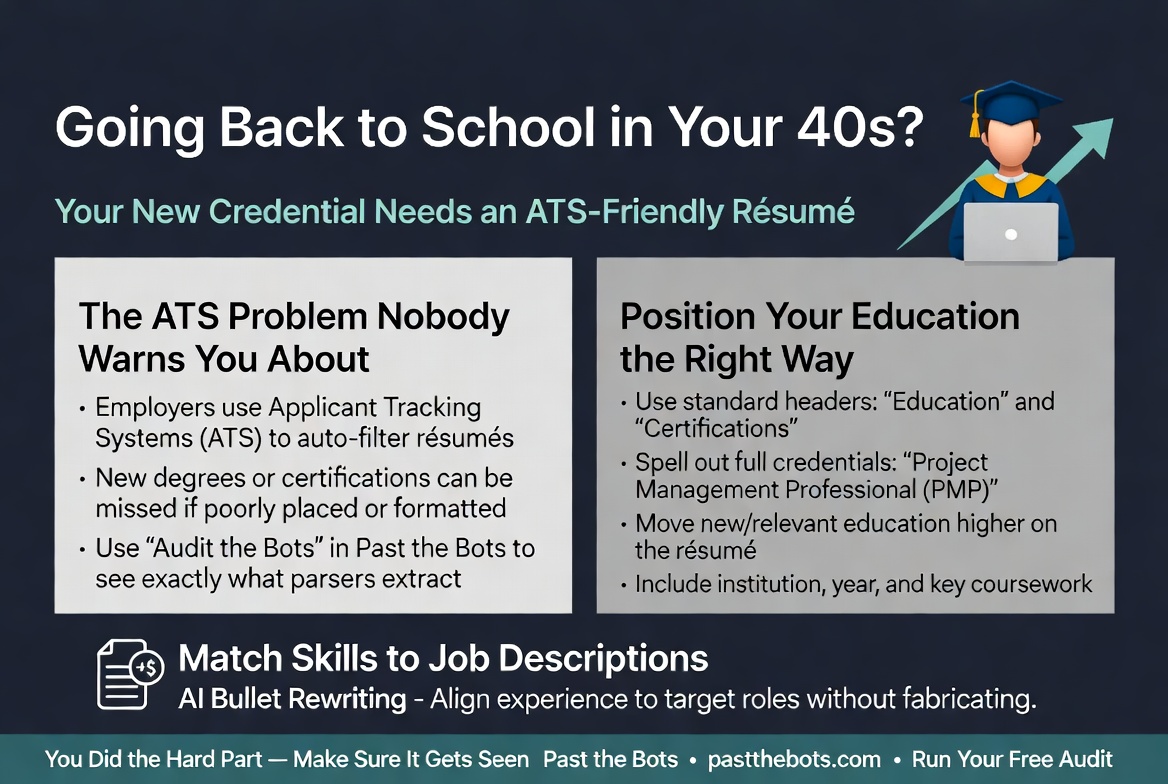 If you've been thinking about going back to school, you're in very good company. A growing wave of workers in their 40s are heading back to earn degrees, certifications, and credentials, often to pivot into a new industry, move up in their current one, or simply stay competitive in a job market that keeps raising the bar on qualifications.
That's genuinely exciting. But here's the part nobody talks about at orientation: a shiny new credential doesn't automatically translate into interview callbacks if your résumé can't survive automated screening.
The ATS Problem Nobody Warns You About
Most mid-size and large employers use an Applicant Tracking System to filter résumés before a human ever sees them. These systems scan for specific keywords, section labels, and formatting patterns. If your résumé is structured in a way the parser doesn't recognize, or if your new credential is buried where the system won't find it, you can be screened out before anyone reads a single bullet point.
For career returners and career changers, this is a real issue. Your résumé probably has a long work history, maybe some gaps, possibly a mix of old job titles and new coursework. That kind of complexity can confuse parsers in ways that hurt your chances.
What an ATS Actually Pulls From Your Résumé
When a hiring system processes your file, it's trying to extract specific things: your name and contact info, your job titles and employers, your dates, your skills, and your education. If any of those land in the wrong place, or if your formatting makes them hard to parse, the system may misread or skip them entirely.
The Audit the Bots feature in Past the Bots shows you exactly what different parsers extract from your résumé. It's often surprising. A credential you're proud of might not be registering at all, or your degree might be showing up without the field of study attached to it.
Running an audit before you apply anywhere is a fast way to catch those silent problems.
Positioning Your New Education the Right Way
Here's a common mistake mid-career job seekers make: they put their new degree or certification at the bottom of their résumé out of habit, because that's where education usually lives. But if you just completed a data analytics bootcamp or finished a nursing degree and that credential is the whole reason you're applying, it should be much closer to the top.
A few things worth knowing:
- Label your sections clearly. Use standard headers like "Education" and "Certifications" rather than creative alternatives. ATS systems are literal.
- Spell out the full credential name and the acronym. Write "Project Management Professional (PMP)" not just "PMP," because different job postings use both.
- Include the institution and the year. Some parsers use that to validate the entry. A credential with no date or no issuing institution can get flagged or skipped.
- Don't bury relevant coursework. If you took classes in Python, financial modeling, or UX research and those skills appear in job postings you're targeting, list them. They are legitimate keywords.
Matching Your New Skills to the Job Description
Here's where a lot of career changers leave points on the table. You've built real skills through school, but you may not be using the same language the employer is using in their job posting.
Past the Bots has a skill-weighted match score that compares your résumé against a pasted job description. It shows you which keywords you've matched, which ones are missing, and whether there are any knockout gaps, things the employer clearly requires that aren't on your résumé at all.
For someone re-entering the market or pivoting industries, this is genuinely useful. You might have the skills but be using different terminology. Closing that language gap can make a measurable difference in your match score.
Rewriting Bullets Without Making Anything Up
One of the harder parts of a career pivot is translating what you actually did into language that resonates with a new industry. Past the Bots includes an AI tailoring tool that rewrites your bullet points to better align with a specific job description, without fabricating experience you don't have.
That distinction matters. You don't want to claim skills you don't have. But you absolutely should present the skills you do have in the clearest, most relevant way possible.
You Did the Hard Part
Going back to school while managing a career, a family, and everything else life throws at you in your 40s is no small thing. Don't let a résumé formatting issue or a keyword gap be what stands between you and the interview. A quick audit and a few targeted fixes can go a long way toward making sure the work you put in actually gets noticed.