Bezos's 'Regret Minimization' Framework Is the Career Advice You Need Right Now
June 10, 2026 · 4 min read · Past the Bots
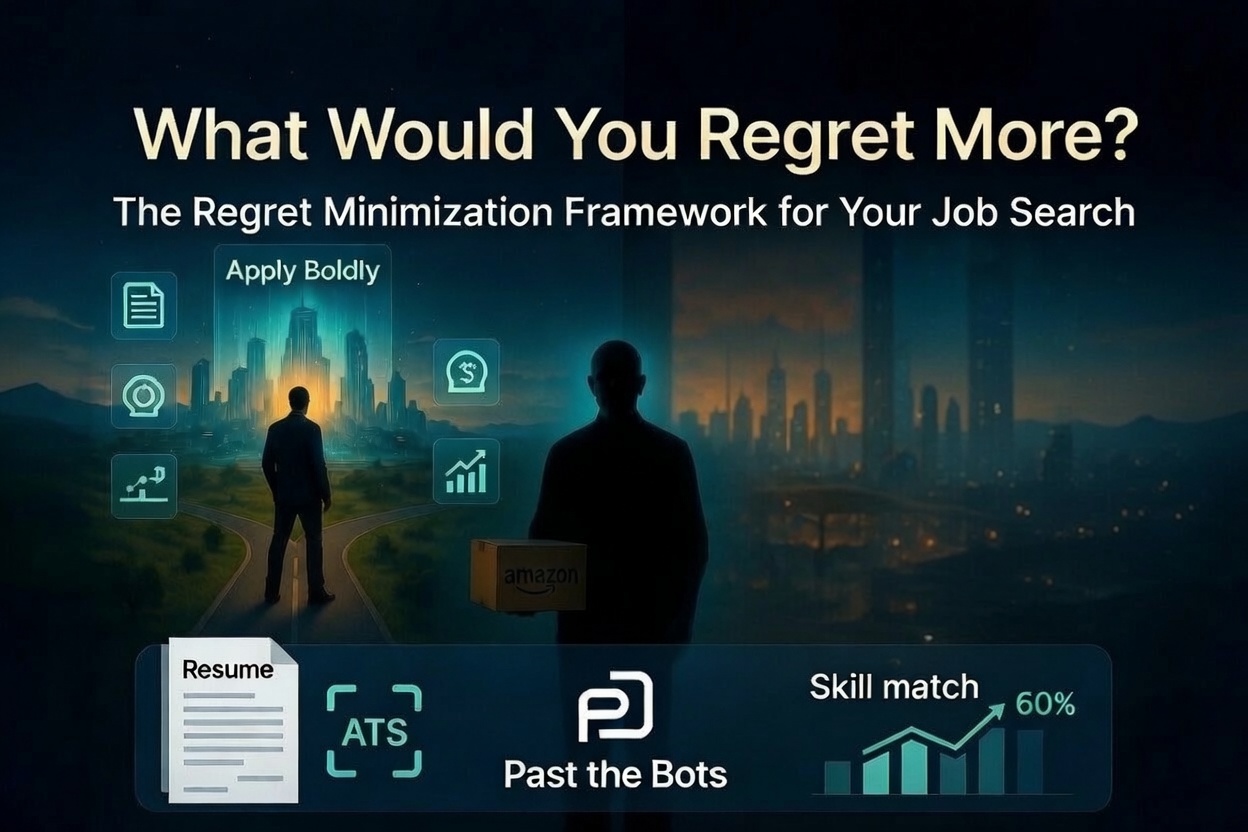
What Would You Regret More?
Back in the 1990s, Jeff Bezos made a decision that changed everything. Before leaving a comfortable Wall Street job to start an internet bookstore, he asked himself a simple question: When I'm 80, which will I regret more -- not trying, or failing?
That mental exercise, which he later called the Regret Minimization Framework, is getting a lot of attention again in 2026. And honestly? It makes sense why. The job market right now is stressful in ways that feel uniquely paralyzing. Layoffs in tech and finance. AI reshaping entire roles. Hiring freezes followed by sudden surges. A lot of job seekers are stuck in a loop of hesitation, applying halfway, tweaking their resume for the hundredth time, and never quite pulling the trigger on the roles they actually want.
So let's borrow Bezos's framework and apply it directly to your job search.
The Regret You're Probably Ignoring
Here's a question worth sitting with: Are you applying to jobs you actually want, or are you playing it safe with roles that feel like a sure thing?
Most people underestimate themselves when they're job searching. They skip postings because they don't meet 100% of the requirements (spoiler: almost nobody does). They send a generic resume because tailoring feels like too much work. They skip the cover letter. They never follow up.
Fast-forward to age 80. Are you going to regret that you applied too boldly? Or that you never really swung?
The answer is pretty obvious. So the real question becomes: what's actually stopping you?
For most people, it's one of two things. Either they don't feel confident their resume will get through, or they don't know how to position themselves for a specific role without feeling like they're stretching the truth.
Both of those are solvable problems.
The ATS Wall Is Real, But It's Not Insurmountable
Applicant Tracking Systems filter out a huge percentage of resumes before a human ever sees them. Estimates vary, but if your resume isn't formatted correctly or doesn't include the right keywords for a specific role, it's likely getting deprioritized automatically.
That's a real barrier. But here's the thing: it's not mysterious or random. ATS systems are looking for specific, predictable things. You can learn exactly what they're looking for.
The Audit the Bots tool on Past the Bots shows you how different parsers actually read your resume -- what they extract, what they miss, and where your formatting is causing problems. If a parser can't find your contact information or is misreading your job titles, that's a fixable problem. You just have to know it exists first.
Stop Guessing, Start Matching
One of the biggest sources of job-search anxiety is not knowing whether you're even in the ballpark for a role. You read a job description, you think your background is relevant, but you're not sure how to make that case clearly.
This is where a skill-weighted match score changes the game. Paste a job description into Past the Bots and you'll see exactly which keywords from that posting appear in your resume, which ones are missing, and whether any of the gaps are the kind that would knock you out of consideration entirely.
Once you can see that clearly, tailoring your resume stops feeling like guesswork. You know what to add, what to emphasize, and what's already working.
Tailoring Without Making Things Up
A lot of job seekers worry that tailoring their resume means fabricating experience. It doesn't have to.
Good tailoring means reframing real experience in language that matches what an employer is actually looking for. If you managed vendor relationships at your last job and the posting asks for "third-party partnership management," those are the same thing. You just need to say it their way.
Past the Bots has an AI tailoring tool that rewrites your bullet points to align with a specific job description -- without inventing anything. It works with what you've actually done and helps you present it in the way that registers with both the ATS and the hiring manager reading it.
The 80-Year-Old Test, Applied
Next time you're hovering over a job posting, unsure whether to apply, try Bezos's exercise. Imagine yourself decades from now, looking back. Will you regret that you applied for a role that was a bit of a stretch? Or will you regret that you never gave yourself the shot?
Usually, the answer points pretty clearly toward apply.
And once you've made that call, your job is to make the application as strong as it can be. Not perfect -- strong. Know how your resume reads to a parser. Know which keywords you're missing. Tailor your bullets to the role. Write a cover letter that sounds like a human wrote it.
You did the hard part by deciding to try. Don't let a formatting issue or a missing keyword be the reason it doesn't get seen.