Career Coaches: Run the Full Toolkit for All Your Clients in One Console
July 17, 2026 · 4 min read · Past the Bots
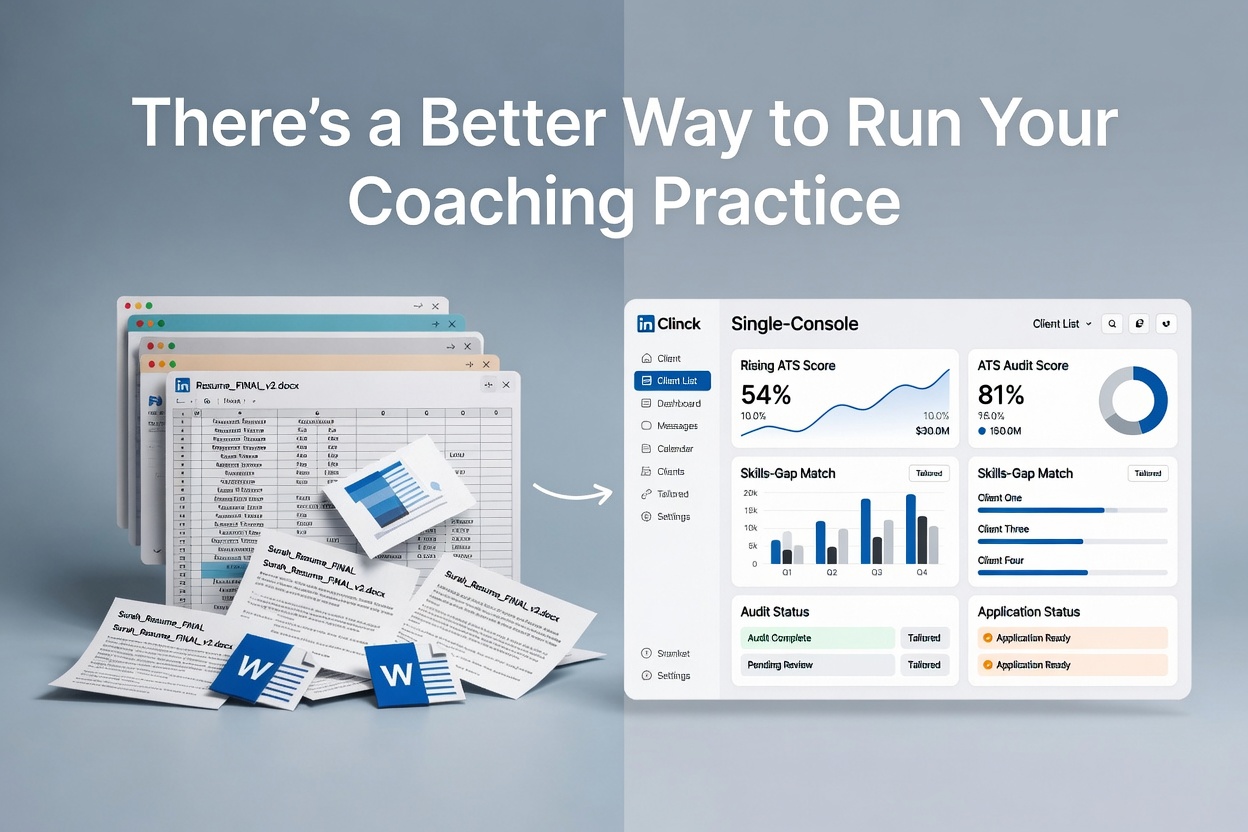 If you're a career coach with a full roster, you already know the drill. One client needs a resume audit before a Monday application deadline. Another is mid-pivot and needs their skills mapped against three different job descriptions. A third just landed an interview and wants a cover letter by tonight. And you're doing all of this across a dozen browser tabs, a spreadsheet you built yourself, and a folder of Word docs with names like "Sarah_Resume_FINAL_v3_revised.docx."
There's a better way to work, and it starts with treating your coaching practice like the operation it actually is.
Why a Single Console Changes Everything
When you're managing multiple clients, context-switching is the enemy of quality. Every time you have to hunt down where a client's resume lives, re-paste a job description, or try to remember what you flagged last session, you're losing time that could go toward actual coaching.
A consolidated dashboard solves this by keeping each client's work in one place: their uploaded resume, the jobs they're targeting, the audit results, and any tailored drafts you've created together. You can pick up exactly where you left off without reconstructing the context from scratch.
For clients, this matters too. They feel the difference between a coach who has to ask "can you resend me your resume?" and one who pulls up their file mid-call and says "okay, so last week we flagged that your skills section wasn't parsing correctly. Let's see what that looks like against this new role."
What to Actually Run for Each Client
Having a consistent intake process for every new client saves time and makes sure nobody slips through with a resume full of fixable problems. Here's a repeatable workflow that covers the bases:
Start with the ATS audit. Before you do anything else, run a full parse check. You want to know what an ATS actually extracts from the resume, including whether the name and contact info are being read correctly, which sections are being recognized, and where the document is throwing up red flags. A lot of clients come in with formatted resumes that look beautiful as PDFs but are nearly unreadable to a parser. Catching this on day one sets the foundation for everything else.
Do a skills gap scan against a real job description. Ask your client to paste in two or three job postings they're actively targeting. Running a keyword match against each one tells you which skills are already present, which are missing entirely, and which gaps might be disqualifying before a human even sees the application. This is a much more honest conversation starter than "your resume looks pretty good to me."
Rewrite for fit, not fabrication. Once you know the gaps, the next step is figuring out what your client actually has that maps to what the employer wants, and making sure the resume says so clearly. AI-assisted bullet rewriting can help here, as long as it's working with real experience rather than inventing it. The goal is to surface relevant accomplishments that were either buried, vague, or written for a different kind of role.
Rebuild if necessary. If the resume structure itself is the problem, a clean single-column rebuild is often the fastest path forward. Two-column layouts, tables, and text boxes are common ATS killers. Starting fresh from an ATS-safe template means everything you've fixed in the audit actually holds.
Tracking Progress Across a Roster
One of the most underused parts of coaching is progress tracking. When you can see at a glance that a client's match score went from 54% to 81% after a round of tailoring, that's a concrete data point you can share with them. It reinforces that the work is paying off, and it helps you identify who still needs the most attention.
A few things worth tracking for each client:
- Baseline ATS score from the initial audit and current score after revisions
- Match percentage against their top target job descriptions
- Which critical issues have been resolved and which are still open
- Deliverables completed: tailored resume versions, cover letters, outreach messages
- Application activity: where they've applied and what response they've gotten
You don't need a complex system for this. Even a simple status column that shows whether a client is at "audit complete," "tailored for target role," or "application ready" helps you triage who needs your attention this week.
The Bigger Picture
The best career coaches aren't just resume editors. They're strategic partners who help clients understand why they're not getting callbacks and what to actually do about it. Having the right tools and a consistent workflow frees you up to spend more time on that higher-level work, and less time rebuilding context from scratch every session.
Your clients hired you because they trust your expertise. A well-organized toolkit just makes sure that expertise comes through clearly every time.