Career Gaps Are More Common Than Ever. Here's How to Get Back in the Game.
July 10, 2026 · 4 min read · Past the Bots
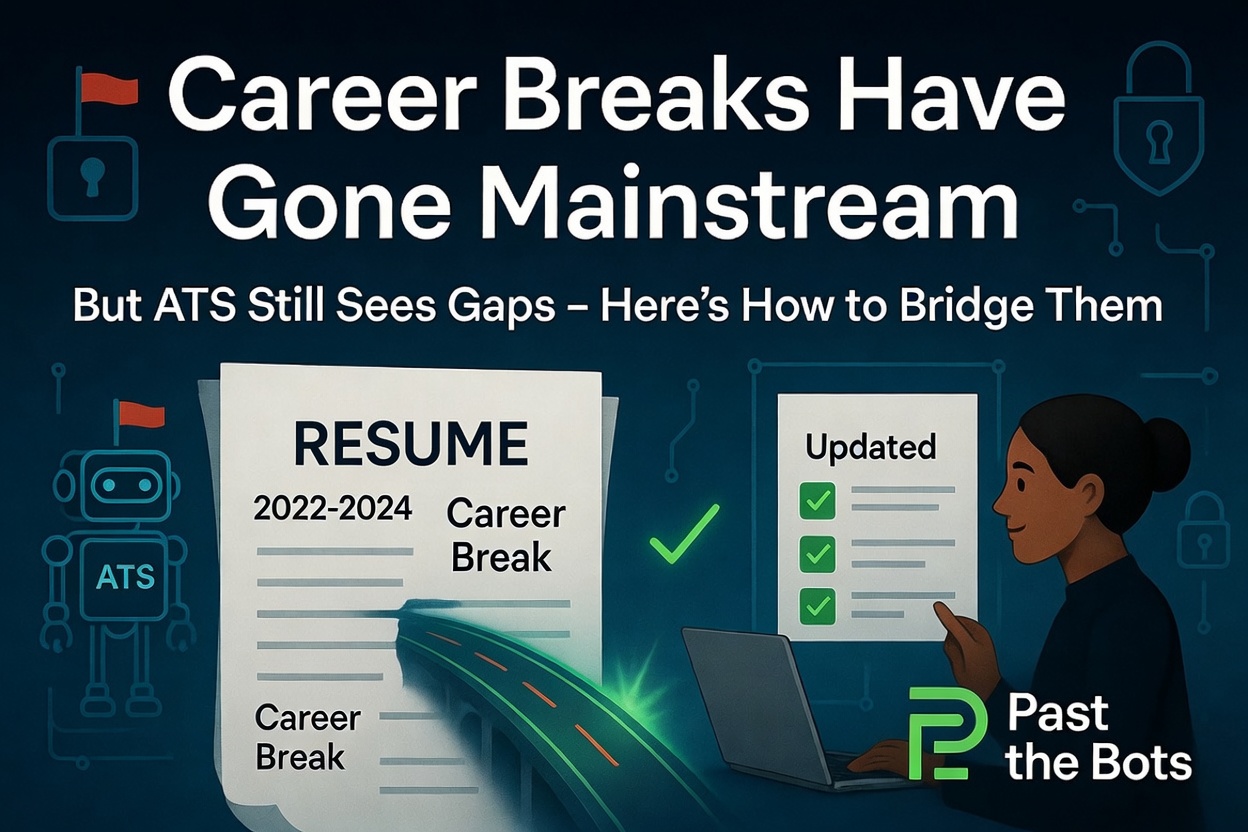 Career breaks have gone mainstream. According to a recent report covered by MSN, more professionals than ever have taken extended time away from work—for caregiving, health, layoffs, burnout, or simply to reset. LinkedIn even added an official "Career Break" entry to profiles. The stigma is fading.
But here's the uncomfortable truth: the humans doing the hiring may be more understanding about gaps than they used to be, but the software screening your résumé isn't. Applicant Tracking Systems don't read context. They parse dates, calculate timelines, and match keywords. A two-year gap doesn't come with an explanation attached.
So how do you actually get back in?
Address the Gap Directly on Your Résumé
The worst thing you can do is try to hide a career break with a vague date range. ATS software will still calculate it, and a recruiter who catches the discrepancy later won't be impressed.
Instead, name the gap explicitly. Career coaches cited in the MSN piece recommend treating the break as its own résumé entry. Something like:
- Career Break | 2022 - 2024
- Provided full-time care for a family member
- Completed [relevant certification or course]
- Freelanced or consulted (list specific projects if applicable)
This approach works for humans and for ATS parsers. When a parser sees a labeled entry with dates, it reads a job. When it sees nothing, it just sees a hole.
Update Your Skills Section Aggressively
A lot changes in two or three years. Tools get updated, industry terminology shifts, new frameworks emerge. If your last role was in 2021, your skills section might be quietly working against you.
Before you apply anywhere, pull the job descriptions for the roles you're targeting and make a list of the skills that keep showing up. Then audit your résumé honestly:
- Which of those skills do you actually have?
- Which did you maintain or develop during your break?
- Which ones are genuinely missing and worth a quick course or certification?
Past the Bots has a skill-weighted match score that does exactly this kind of comparison for you. Paste in a job description, upload your résumé, and it shows you which keywords matched, which are missing, and which gaps might be automatic disqualifiers. That last category, the knockout gaps, is the one worth paying the most attention to before you hit submit.
Tailor Every Application (Yes, Really)
Re-entry applicants often make one generic résumé and blast it out. That approach rarely works for people with recent experience, and it works even less well when you have a gap to overcome. You need your résumé to signal relevance as loudly as possible.
The practical problem is that tailoring takes time. You have to rewrite bullets, adjust your summary, and reorder skills for every application.
This is where AI tailoring tools can actually help. The key is using one that rewrites your bullets to match the job without inventing experience you don't have. That's not just an ethical line, it's a practical one. A fabricated accomplishment will fall apart in an interview.
Past the Bots' AI tailoring feature is built around this constraint. It reshapes how you describe real experience to better match what a specific employer is looking for, nothing more.
Make Sure the ATS Can Actually Read Your Résumé
This one trips up a lot of re-entry job seekers who are working from an old résumé template. Older templates often use tables, text boxes, headers and footers, or graphics that look fine in Word but turn into gibberish when an ATS parser tries to read them.
If your name ends up in the wrong field, or your skills section gets swallowed by a formatting quirk, it doesn't matter how good the content is.
The Audit the Bots tool on Past the Bots shows you exactly what different parsers extract from your résumé: your name, contact info, section headers, and skills. If something is getting lost in translation, you'll see it before a recruiter does. The platform can also rebuild your résumé into a clean, single-column ATS-safe format if you need a fresh start.
Don't Forget the Cover Letter
For re-entry candidates specifically, the cover letter still matters. It's the one place where you can give a brief, confident explanation of your break and quickly pivot to why you're ready and qualified now. Keep it short, forward-looking, and specific to the role.
The bottom line: career gaps are more normalized than ever, but the ATS doesn't know that. Your job is to make sure your résumé is formatted cleanly, keyword-matched to each role, and honest about your timeline. Do that, and you give yourself a real shot at getting a human on the other end to actually read it.