Cut These 3 Overused Résumé Words Before an ATS (or a Recruiter) Rolls Their Eyes
July 15, 2026 · 4 min read · Past the Bots
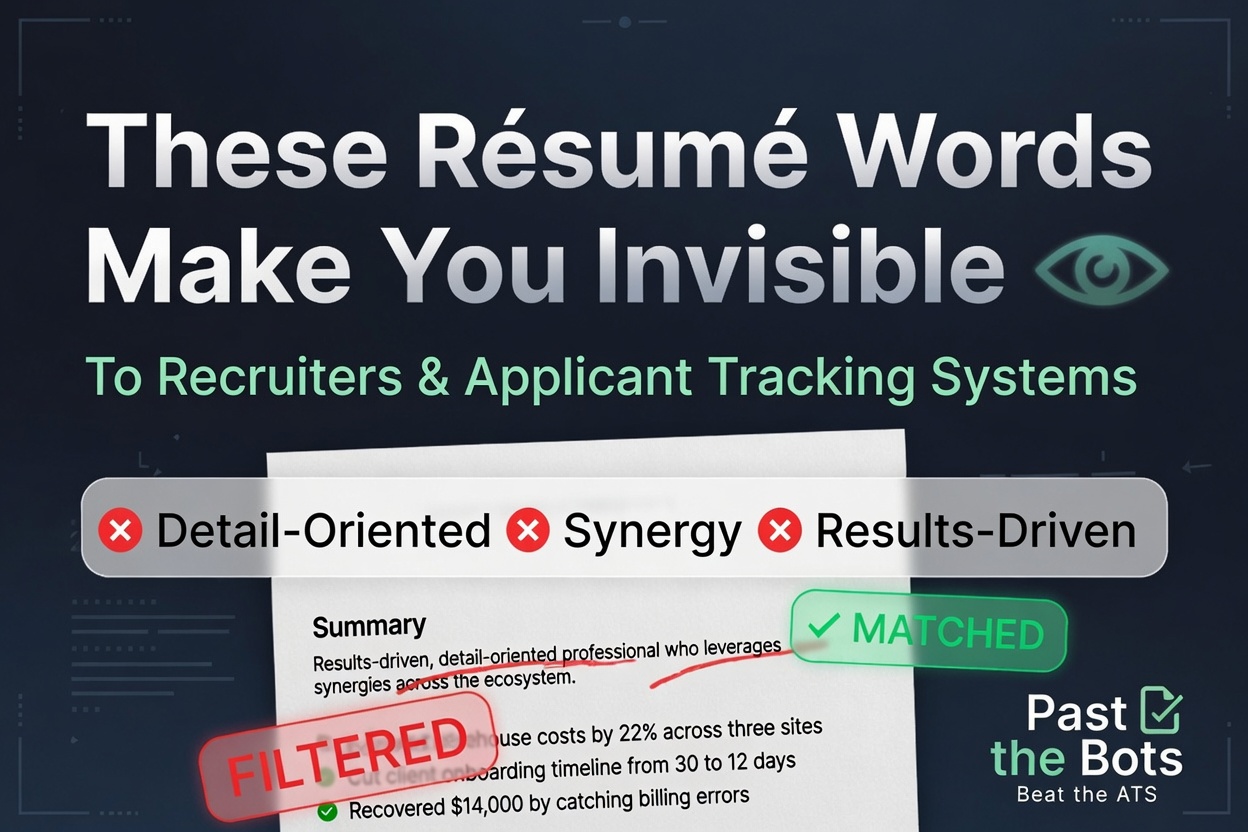 If you've spent any time reading career advice lately, you've probably seen the warning: certain words on your résumé are so overused they've become invisible. A recent piece circulating on MSN backs this up, pointing out that hiring managers and recruiters have grown numb to vague, buzzword-heavy language, and that the words you think make you sound impressive can actually work against you.
But here's the part that often gets left out of that conversation: those same words can also confuse or get ignored by the Applicant Tracking System screening your résumé before a human ever sees it. So you're not just annoying a recruiter. You might be getting filtered out entirely.
Let's look at the three biggest offenders and what you can actually do about them.
1. "Detail-Oriented"
Every résumé says it. No one has ever written "I am sloppy and careless" in their summary. That's exactly why this phrase carries zero weight.
For an ATS, the problem is different. "Detail-oriented" isn't a skill it's looking to match against a job description. It's not a keyword a recruiter typed into a Boolean search. It takes up space in your summary or bullet points without contributing anything a parser can actually use.
What to do instead: Show the detail. "Caught a billing error that recovered $14,000 in revenue" is detail-oriented behavior. That's what belongs in a bullet point. If the job description mentions "quality assurance" or "accuracy" or "compliance," use those specific words in context.
2. "Synergy" (and Its Cousins: "Leverage," "Ecosystem," "Robust")
These words peaked somewhere around 2008 and never really left. They signal corporate-speak more than they communicate anything real. A recruiter reading "leveraged synergies across the ecosystem" has no idea what you actually did.
An ATS is equally lost. These words don't map to job titles, certifications, tools, or skills. They're filler that dilutes the signal in your résumé.
What to do instead: Be literal. "Coordinated between the sales and product teams to cut the client onboarding timeline from 30 days to 12" says the same thing without the jargon. Plain language is almost always stronger.
3. "Results-Driven"
This one shows up in summaries constantly, and it's ironic because résumés that lead with "results-driven" often have the fewest actual results in the bullet points below.
For ATS purposes, "results-driven" is not a searchable term. No recruiter has a saved search for it. No job description lists it as a required qualification. It's occupying prime real estate in your résumé header and doing nothing.
What to do instead: Put a real result right up front. Something like "Operations manager with a track record of reducing warehouse costs by 22% across three sites" tells a story in the same number of words. Now you're demonstrating results instead of claiming them.
Why This Matters More Than Ever Right Now
Most mid-to-large employers are using ATS platforms to screen résumés before a recruiter opens them. Those systems are parsing your document, extracting your skills and experience, and scoring you against the job description. Vague language doesn't score. Specific, relevant keywords do.
This is exactly where a tool like Past the Bots is useful. The ATS scan shows you precisely what a system extracts from your résumé, including your skills section, contact info, and job titles. If your summary is packed with phrases like "results-driven professional" and "leverages synergies," you'll see quickly that nothing meaningful is being pulled from it.
The skill match feature takes it a step further. You paste in a job description and it shows you which keywords you've matched and which ones are missing entirely. That's where you want to focus your rewriting energy, not on making your summary sound impressive, but on closing the gap between what you've done and what the employer is explicitly asking for.
The AI tailoring tool can help you rewrite your bullets to reflect the language of a specific job without making anything up. It works with your actual experience and reshapes how you describe it so it reads as relevant to that posting.
The Bottom Line
Cutting buzzwords isn't just about sounding better to a human reader. It's about making space for language that actually works, both for the automated systems doing the first pass and for the recruiter who opens your résumé after you clear that hurdle.
Audit your summary right now. If it could describe literally anyone in your field, rewrite it. Be specific about what you did, what it impacted, and what tools or skills you used. That specificity is what gets you past the bots and into the interview.