Degrees Are Out, Skills Are In — Here's How to Make Sure Your Résumé Proves It
June 21, 2026 · 4 min read · Past the Bots
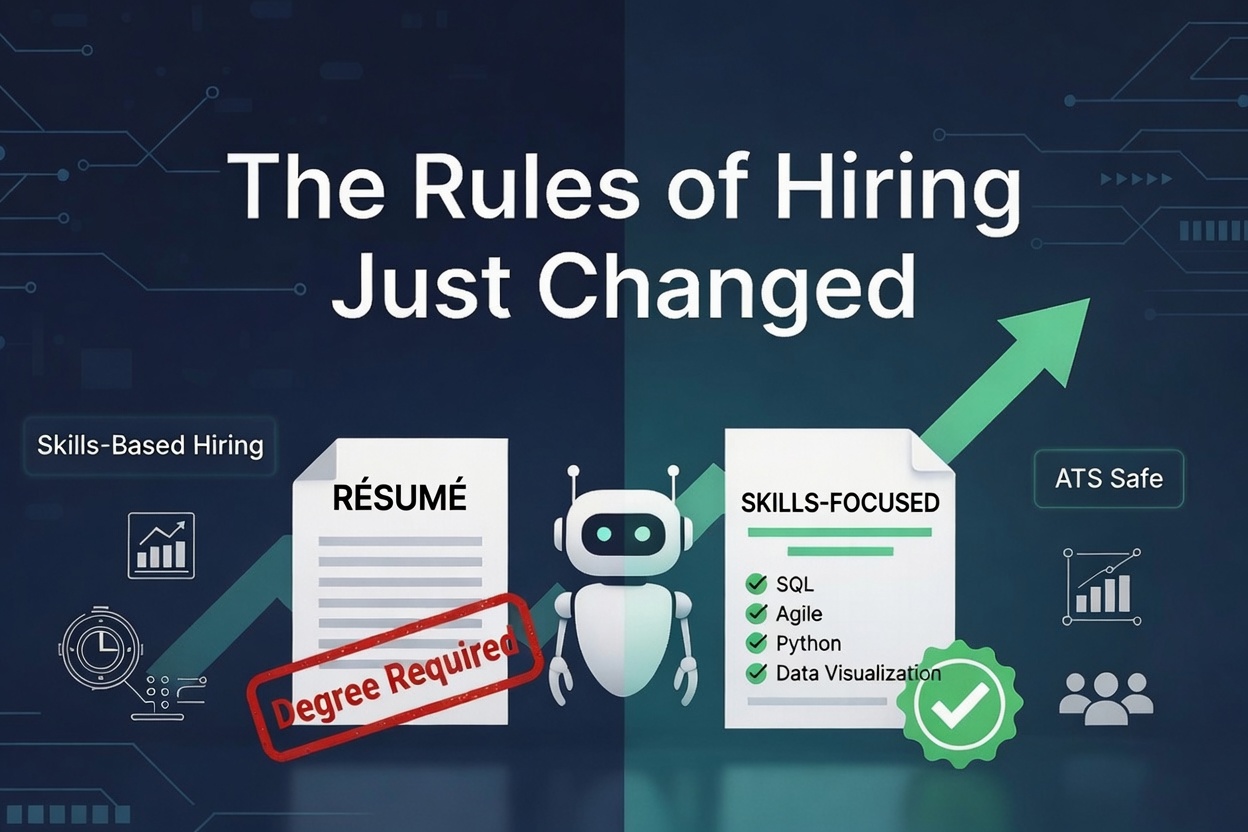
The Rules of Hiring Just Changed
Something big has been quietly happening in the job market. Major employers — including Google, IBM, Accenture, and a growing list of state governments — have been dropping four-year degree requirements from job postings. According to recent reporting, this shift toward skills-based hiring is accelerating fast, and it's reshaping what recruiters and their ATS software are actually screening for.
For job seekers, that sounds like great news. And it can be — but only if your résumé is actually built to show your skills in a way that both humans and automated systems can read clearly.
Here's the catch: a lot of résumés are still structured around credentials and job titles rather than demonstrable skills. If you just swap "B.S. in Marketing" for "I know Google Analytics," that's not enough. The real opportunity is bigger than that.
Why Skills-Based Hiring Still Gets Filtered by Bots
Even when a recruiter genuinely wants to hire on skills, the first gatekeeper is usually an Applicant Tracking System. That system is parsing your résumé before any human sees it, extracting specific keywords, section headers, and skill mentions.
If your skills are buried inside dense paragraphs, listed under vague headings, or formatted in a two-column layout that confuses the parser, the ATS may never surface them correctly. A recruiter searching for "Python" or "project management" might never find your résumé, even if those skills are legitimately there.
This is exactly the kind of problem that's easy to miss because you can't see what the ATS is extracting. You just know you're not getting callbacks.
What Your Résumé Needs Right Now
If you want to take advantage of the skills-first hiring trend, here's what to focus on:
1. Make your skills section scannable and specific. Don't just write "Communication" or "Leadership." Those are so generic they're almost invisible to keyword matching. Instead, use the actual tool, platform, or methodology names: Salesforce, SQL, Agile, HubSpot, financial modeling, OSHA 30, whatever applies to your field.
2. Mirror the language in the job posting. This is where a lot of people leave points on the table. If the job description says "data visualization" and your résumé says "data charting," an ATS keyword match might not connect the two. You have to use the exact phrasing employers are searching for.
3. Back up skills with results in your bullets. A skills section tells the ATS what you can do. Your bullet points tell the recruiter (once they get there) that you actually did it. "Managed social media accounts" is weak. "Grew organic Instagram engagement 40% in six months by shifting to a video-first content strategy" is something a hiring manager remembers.
4. Keep your format ATS-safe. Tables, text boxes, and multi-column layouts break parsers. Headers like "My Professional Journey" confuse the system into missing an entire section. Stick to clean, single-column formatting with standard section names.
How Past the Bots Fits Into This
This is genuinely where a tool like Past the Bots earns its keep.
The ATS scan shows you exactly what a parser extracts from your résumé — your name, contact info, skills, and section content — so you can see if your skills are actually landing or disappearing into a formatting void. It flags critical issues, warnings, and things that are working fine, so you know where to focus.
The skill-weighted match score is especially useful for skills-based roles. You paste in a job description, and it shows you which keywords matched, which are missing, and whether there are any knockout gaps (the must-have requirements you haven't addressed at all). In a skills-first hiring environment, closing those gaps matters more than ever.
If you need to tailor your bullets to highlight specific skills for a specific role, the AI tailoring tool rewrites them to match the job without putting experience on your résumé you don't actually have. That's an important line, and it's one the tool is built to respect.
And if your formatting is working against you, the ATS-safe single-column rebuild gives you a clean foundation that parsers can actually read.
The Bottom Line
Skills-based hiring is a real shift, and it genuinely opens doors for people who've built expertise outside of traditional degree paths. But the opportunity only materializes if your résumé communicates those skills clearly, specifically, and in a format that automated systems can process.
Knowing you have the skills isn't enough. You have to prove it on the page, and you have to prove it in a way the bots can read before the humans ever get there.