Employers Want AI Skills. Here's How to Actually Get (and Show) Them.
June 25, 2026 · 4 min read · Past the Bots
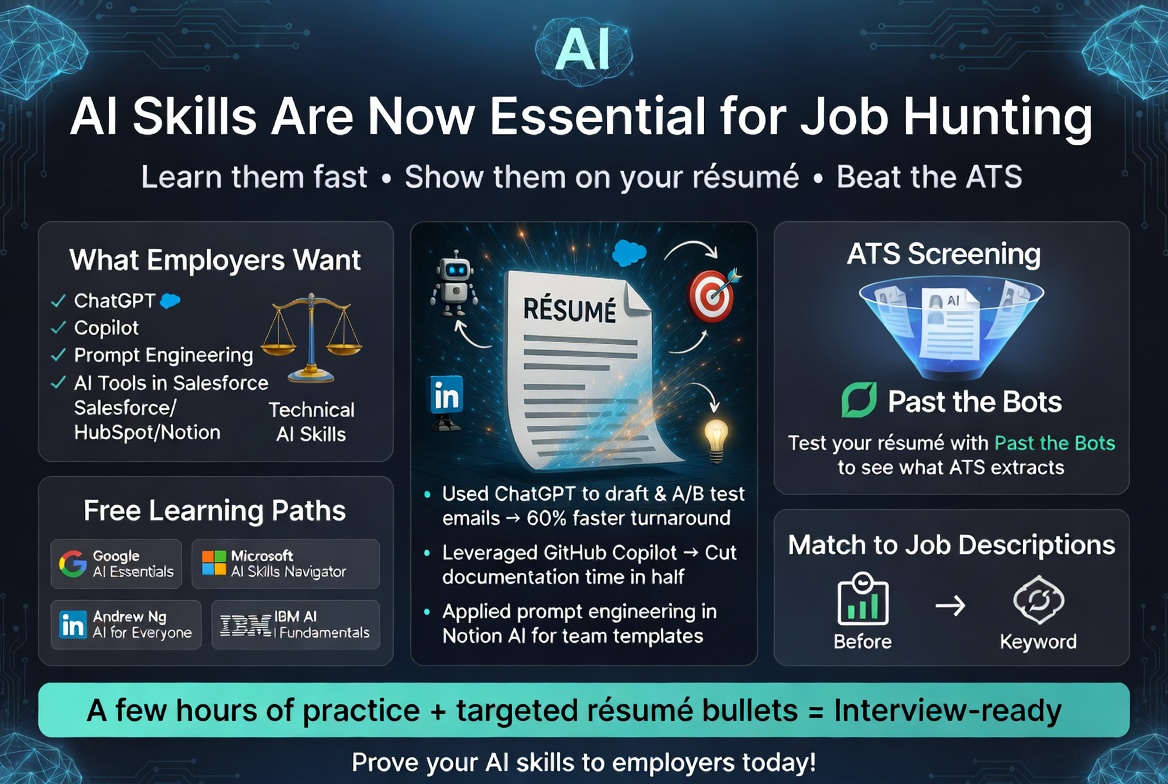 If you've been job hunting lately, you've probably noticed something: even roles that have nothing to do with building AI are starting to list AI skills in the requirements. According to a recent report covered by MSN, employers across industries are demanding proficiency with tools like ChatGPT, Copilot, and various AI-powered platforms, and many candidates are scrambling to catch up.
The good news? These skills are genuinely learnable, often faster than people expect. The trickier part is making sure your résumé actually communicates them in a way that gets past automated screening before a human ever reads it.
Let's talk about both.
What Employers Actually Mean by "AI Skills"
Before you panic-enroll in a machine learning bootcamp, it helps to understand what most non-technical employers are really asking for. The MSN piece points to a divide between foundational AI literacy (understanding what these tools do and how to use them responsibly) and technical AI skills (building models, writing code, fine-tuning systems).
For the vast majority of open roles, employers want the former. They want someone who can:
- Use tools like ChatGPT, Gemini, or Copilot to speed up real work tasks
- Prompt effectively to get useful outputs, not just passable ones
- Understand enough about how AI works to catch errors and hallucinations
- Apply AI tools within specific platforms (think Salesforce Einstein, HubSpot AI, Notion AI, etc.)
If you're already doing any of this, even informally, that counts. The question is whether your résumé says so.
Where to Actually Learn This Stuff
The report highlights a few paths that are worth your time:
Free and low-cost options:
- Google's AI Essentials course on Coursera covers practical literacy without assuming a technical background
- Microsoft's AI Skills Navigator (linked from their Learn platform) helps you find relevant training based on your current role
- LinkedIn Learning has short, role-specific AI courses that come free with many library cards and some job seeker programs
- Prompt engineering guides from Anthropic, OpenAI, and others are publicly available and genuinely useful
If you want something more credentialed:
- IBM's AI Fundamentals badge on Credly is recognized and free
- Coursera's AI for Everyone by Andrew Ng is a classic starting point that holds up
The key insight from the reporting: learning by doing matters more than certificates alone. Employers want to see that you've applied these tools, not just that you watched videos about them.
Turning What You've Learned Into Résumé Content
This is where most job seekers drop the ball. They add "ChatGPT" to a skills section and move on. That's not enough.
ATS systems are scanning for skills in context. They want to see keywords, yes, but they're increasingly rewarding specificity. A bullet that says "Used AI tools" gets ignored. A bullet that says "Used ChatGPT to draft and A/B test email sequences, reducing copy turnaround time by 60%" gets noticed.
Here's a simple framework for writing AI skill bullets:
- Tool name + specific task + measurable outcome or context
- Example: "Leveraged GitHub Copilot to accelerate internal documentation, cutting first-draft time in half"
- Example: "Applied prompt engineering techniques in Notion AI to standardize weekly reporting templates across a 12-person team"
Once you've written those bullets, it's worth checking that the ATS can actually read and parse them. Formatting issues, unusual section headers, and certain file types can cause even strong content to disappear in the screening process. Running your résumé through a tool like Past the Bots lets you see exactly what an ATS extracts from your file, which skills it picks up, and which it misses, before you submit anywhere.
Match Your AI Skills to Each Job Description
Not every employer uses the same language. One company says "generative AI," another says "LLM tools," another lists specific platforms like "Midjourney" or "HubSpot AI." If your résumé uses different terminology than the job posting, the ATS may not make the connection.
When you're applying to roles that mention AI skills, paste the job description into a match tool and see which of your keywords land and which fall short. That gap list is your editing checklist. You're not fabricating anything, you're making sure the experience you already have is described in the language the system is scanning for.
The Bottom Line
AI skill requirements aren't going away, and for most roles, the bar to clear is lower than it sounds. A few hours of structured learning, some deliberate practice, and a résumé that actually surfaces those skills in the right language can move you from overlooked to interview-ready faster than you'd think.
The employers are ready to hire people with these skills. Make sure your résumé is ready to prove you have them.