Gen X Got Blindsided. Here's How to Take Care of Your Career Before It Happens to You.
June 13, 2026 · 4 min read · Past the Bots
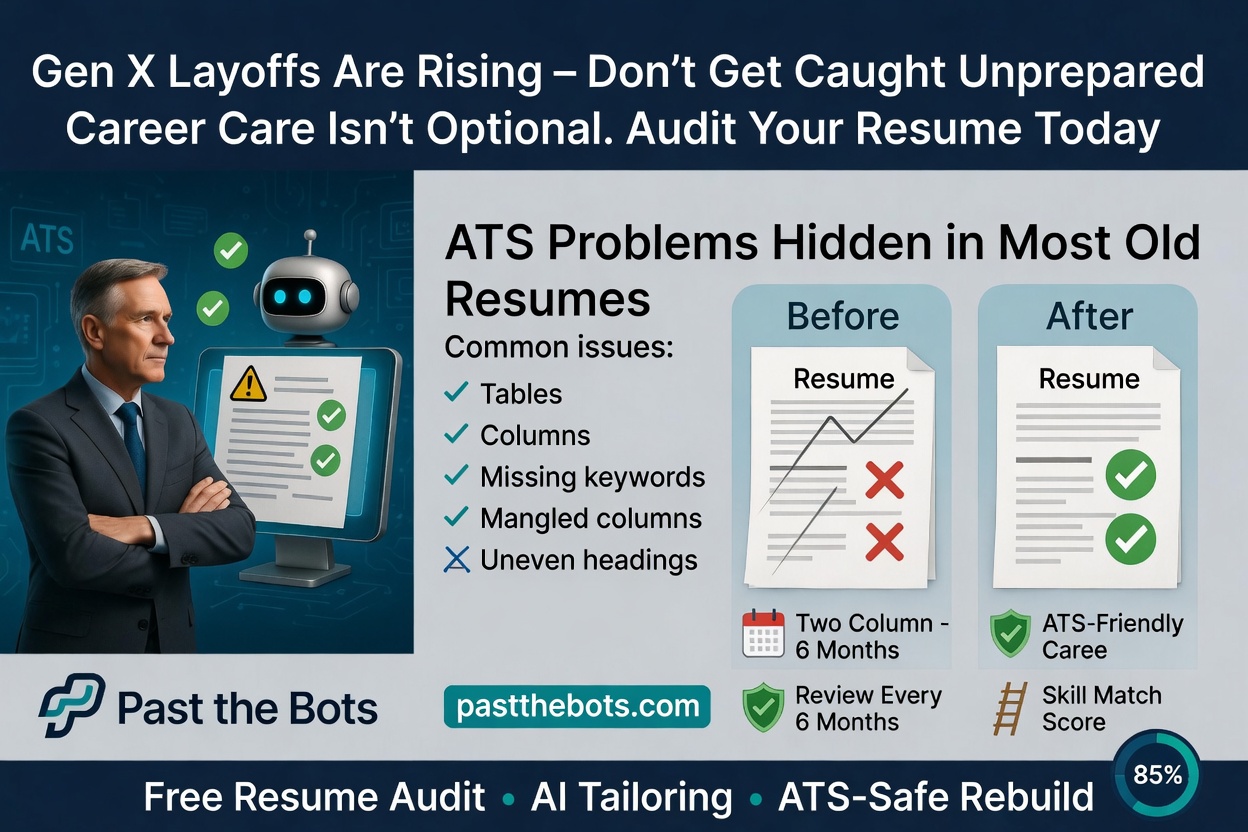 A recent article making the rounds pointed out something uncomfortable: Gen X workers are getting laid off at a striking rate, and a lot of them weren't prepared for it. After decades of loyalty, strong performance reviews, and climbing the ladder the "right" way, they're suddenly back in a job market that looks almost nothing like the one they entered.
And here's the hard truth: the job market has changed faster than most career advice has.
If you're in your 40s or 50s (or really, any age), this is your reminder that career care isn't something you do after you lose a job. It's something you do while you still have one.
What "Career Care" Actually Means
Think of it like going to the dentist. You don't wait until your tooth is cracking to make an appointment. You go for checkups, catch small problems early, and keep things in good shape so a minor issue doesn't become a crisis.
Career care works the same way. It means:
- Keeping your resume updated and modern, not just dusting it off in a panic
- Knowing how your resume actually performs in today's hiring systems
- Understanding whether your skills still read as relevant to the market
- Having a way to get back out there quickly if something changes
The workers who struggle most after a layoff are often the ones who haven't touched their resume in five or ten years. The ones who land on their feet fastest? They were already paying attention.
The ATS Problem Nobody Told Gen X About
Here's something that genuinely catches a lot of experienced professionals off guard: most companies now use Applicant Tracking Systems (ATS) to screen resumes before a human ever sees them.
If your resume isn't formatted in a way these systems can read, or if it's missing the right keywords for a role, it can get filtered out automatically. You could be the most qualified person who applied and still never hear back.
This isn't about gaming the system. It's about making sure the system can actually read what you've built over a career.
The Audit the Bots tool on Past the Bots shows you exactly how different parsers read your resume. Things like whether your contact info is being picked up correctly, whether your job titles are parsing cleanly, whether your sections are being recognized at all. These are small formatting issues that can have a big impact.
A Resume Checkup Looks Like This
When you run your resume through Past the Bots, you get a scan that flags issues as critical, warning, or ok. Critical issues are things that could cause a system to miss your name or contact information entirely. Warnings are things that might hurt your score or readability. OK items are things you're doing right.
From there, you can paste in a specific job description and get a skill-weighted match score that shows which keywords you're hitting and which ones are missing. If a role requires five years of project management experience and that phrase doesn't appear clearly in your resume, you'll see it flagged.
The goal isn't to stuff your resume with keywords. It's to make sure the experience you actually have is visible.
Updating Without Starting From Scratch
One of the most exhausting parts of updating an old resume is figuring out how to reframe 15 or 20 years of experience for a modern job market. Past the Bots has an AI tailoring feature that rewrites your bullet points to match a specific job description, without fabricating anything. It works with what's already there and helps you say it in a way that lands.
There's also an ATS-safe single-column rebuild if your current resume uses a design that looks great to humans but confuses parsers (two-column layouts, tables, text boxes, and graphics are common culprits).
Don't Wait for the Call
Nobody expects to be the one who gets laid off. That's kind of the whole problem. The Gen X workers in that article didn't see it coming either.
You don't have to live in fear of it. But you do have to stay ready.
Set a reminder to review your resume every six months. Run it through an ATS checker. Look at job postings in your field and compare the language you're using to the language they're using. Keep a running list of your recent wins so you're not scrambling to remember them later.
Career care isn't dramatic. It's just consistent. And the people who do it are almost always better positioned when something unexpected happens.
Your experience is real. Make sure the systems standing between you and your next opportunity can actually see it.