Half of AI Job Cuts Could Be Reversed by 2027. Here's How to Be Ready When They Are.
June 17, 2026 · 4 min read · Past the Bots
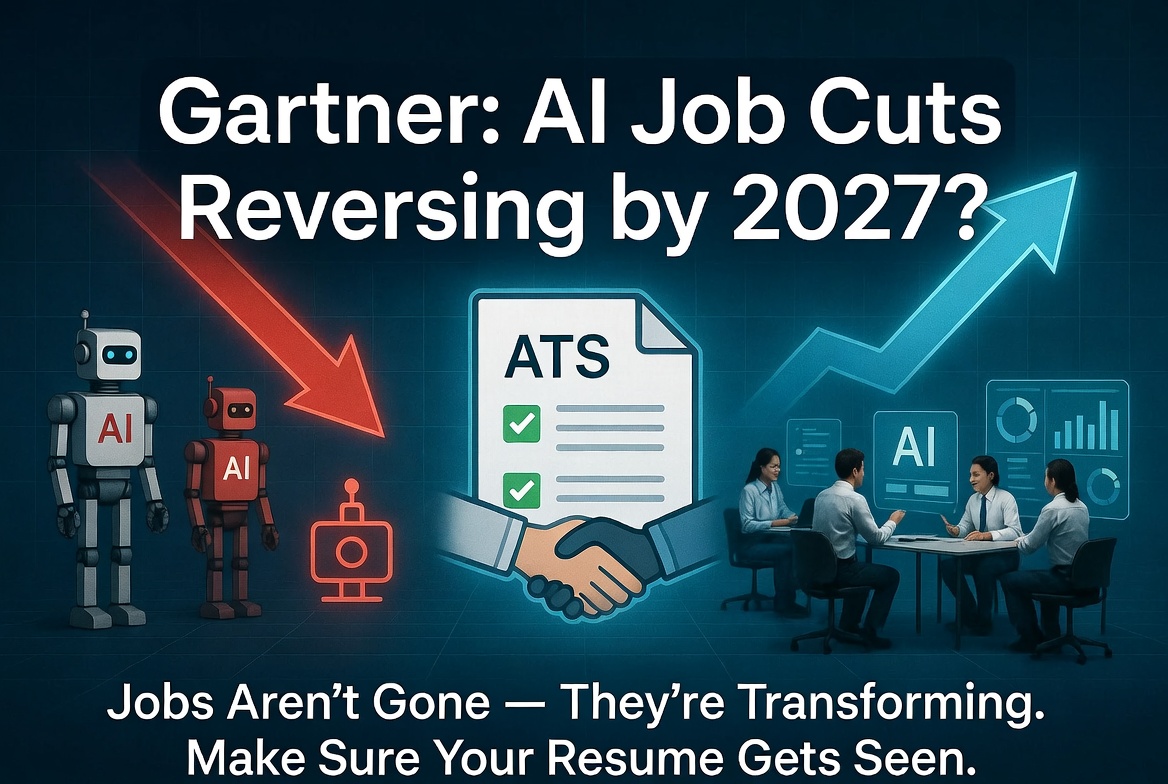 A recent Gartner report made some waves with a surprising prediction: roughly half of the job cuts attributed to AI could be reversed by 2027. The reason? Companies are discovering that fully automating complex work is harder than expected, and they need humans back in the loop, just in different, often more specialized, roles.
If you were laid off recently, or if you're watching your industry shift under your feet, that's actually hopeful news. But here's the catch: the jobs coming back won't look exactly like the ones that disappeared. They'll demand sharper skills, tighter alignment with how AI tools work, and frankly, a resume that can survive automated screening before it ever reaches a human.
Let's talk about what that means practically.
The Jobs Aren't Gone, They're Transforming
Gartner's analysts point out that AI is better at handling discrete, repetitive tasks than at managing nuanced judgment calls, stakeholder relationships, or creative problem-solving. That means roles are splitting: some tasks get automated, while the human parts of those jobs get consolidated into newer, higher-value positions.
What this looks like on the ground:
- A data entry role disappears, but a data quality analyst role opens up to supervise what the automation produces
- Junior copywriting positions shrink, but AI content strategists who can prompt, edit, and govern AI output are in demand
- Customer service headcount drops, but escalation specialists and CX ops roles grow
The pattern is consistent: AI handles volume, humans handle complexity and oversight.
The Hiring Process Is Still Automated, Even If the Role Isn't
Here's where job seekers get tripped up. You might be perfectly qualified for one of these emerging hybrid roles, but if your resume isn't readable by an Applicant Tracking System, you'll never get the chance to prove it.
ATS software parses your resume before any recruiter sees it. It's looking for specific things: correctly labeled sections, extractable contact information, skills that match the job description's language. If your formatting is off, or if you're using the wrong terminology, you get filtered out automatically.
This is true even at companies hiring urgently to backfill positions. Speed doesn't make them skip the ATS. It just means the software does the first cut faster.
What You Should Actually Do Right Now
1. Audit how your resume reads to a parser.
Before you apply anywhere, find out what an ATS actually sees when it processes your resume. The Past the Bots Audit the Bots tool shows you exactly how different parsers extract your name, contact details, work history, and skills sections. You'd be surprised how often a creative resume format scrambles all of that.
2. Match your language to the job description.
If a job posting says "AI oversight" and your resume says "automation management," those might mean the same thing to you but not to the ATS. The skill-weighted match score in Past the Bots compares your resume against a specific job description and flags matched keywords, missing terms, and knockout gaps so you can fix them before applying.
3. Update your skills section for 2025 realities.
If you've been using AI tools in your work, even informally, list them. Prompt engineering, working with ChatGPT or Copilot, reviewing AI-generated outputs, validating automated processes: these are real, relevant skills. A lot of job seekers undersell this because it feels informal. It isn't.
4. Rewrite your bullets to show impact, not just tasks.
Roles that survive or come back after automation pressure are going to be the ones that demonstrably moved the needle. "Managed reports" won't cut it. "Reduced monthly reporting time by 40% by introducing automated validation checks" will. If you need help reshaping bullets to reflect real impact without overstating what you did, the AI tailoring feature in Past the Bots rewrites your content to match a job description without fabricating experience.
5. Get your resume into an ATS-safe format.
Two-column layouts, text boxes, headers and footers, graphics: all of these can break parsing. If you're not sure whether your current resume is safe, a single-column rebuild removes the guesswork.
The Window Is Real, But Short
Gartner's 2027 timeline sounds like you have time, but hiring for these rebounding roles will start well before then. Companies that over-cut are already feeling the gaps. The candidates who get those calls will be the ones whose resumes are clean, keyword-aligned, and ready to go through screening without getting filtered out.
Getting your resume ATS-ready isn't about gaming the system. It's about making sure the work you've already done actually gets seen.