How to Answer 'What's Your Greatest Weakness?' Without Getting Rejected
June 9, 2026 · 4 min read · Past the Bots
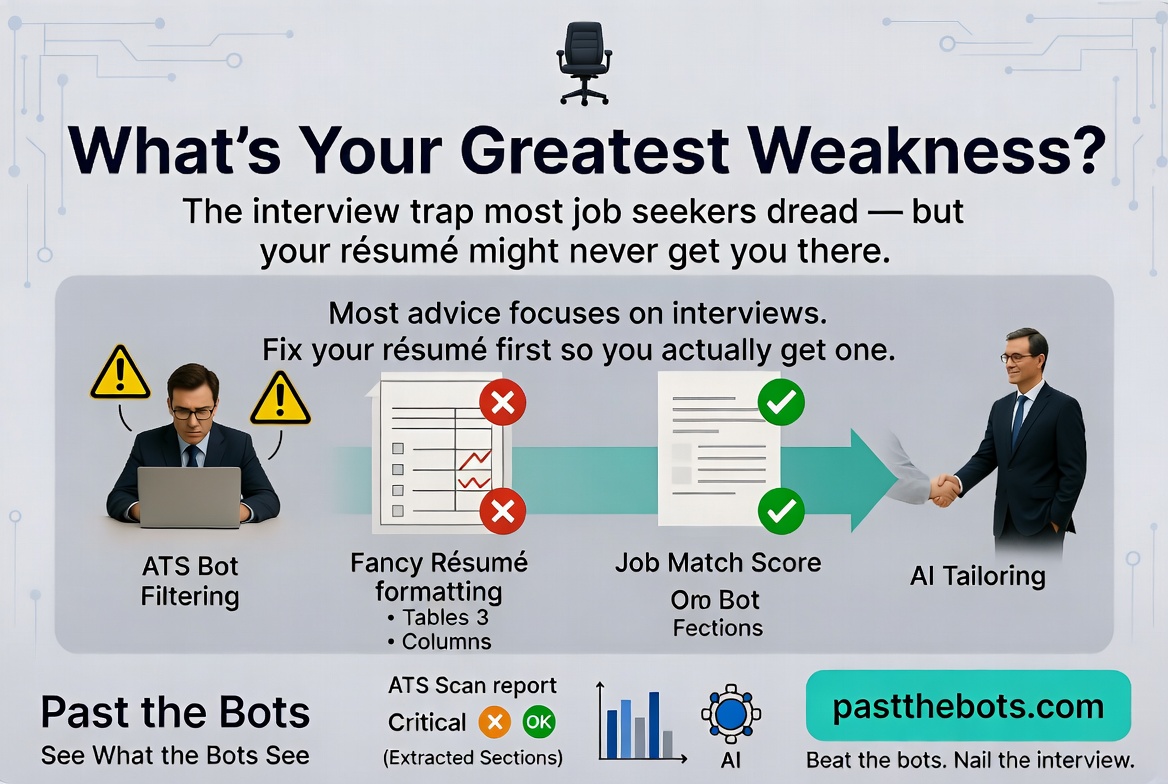 You've probably dreaded it since the first time you heard it in a job search article: "What's your greatest weakness?"
Career experts consistently flag this as one of the most mishandled interview questions out there. And it makes sense why. It feels like a trap. Answer too honestly and you look unqualified. Answer too cleverly and you sound like you're dodging the question. Get it wrong either way and you might not get a callback.
But here's the thing: this question almost never shows up in a first-round phone screen or automated screening. Before you ever get to the point where an interviewer can ask you anything, your résumé has to survive the bots.
Why the Weakness Question Matters Less Than You Think (Right Now)
Most job seekers spend time preparing for interview questions when they haven't solved the earlier problem: their résumé isn't making it through Applicant Tracking Systems in the first place.
ATS software scans, parses, and scores your résumé before a human ever reads it. If your formatting is off, your keywords don't match, or your sections aren't labeled correctly, you're getting filtered out before anyone has the chance to ask you a single question.
So yes, absolutely prepare for "what's your greatest weakness." But make sure you're actually getting to the interview first.
When You Do Get to the Interview: How to Answer It Well
The advice career experts give on this question consistently comes down to a few key principles:
- Pick something real, not a fake strength in disguise. "I work too hard" is not a weakness. Interviewers see through it immediately and it wastes the question.
- Choose something you've actively worked on. The best answers show self-awareness plus growth. Think: "I used to struggle with delegating, so I started [specific habit], and it's made me a better team lead."
- Keep it relevant but not disqualifying. Don't name a weakness that's a core requirement of the job you're applying for.
- Be brief and forward-looking. Two to three sentences. Acknowledge it, explain what you've done about it, move on.
The goal isn't to convince the interviewer you have no flaws. It's to show you're self-aware and coachable. Those are qualities hiring managers actually want.
The Part Nobody Talks About: Getting to the Interview
Here's where a lot of job seekers get stuck in a frustrating loop. They apply to dozens of roles, hear nothing back, and assume it's an interview skills problem. But if your résumé is being misread or filtered out by ATS software, the interview never happens.
A few things that cause résumés to fail ATS screening:
- Unusual formatting like tables, columns, text boxes, or headers and footers (parsers often skip or scramble these)
- Missing keywords that match the job description
- Mislabeled sections that the system doesn't recognize
- Skills buried in context rather than called out clearly
This is exactly what Past the Bots is built to catch. The ATS scan shows you what the system actually extracts from your résumé: your name, contact info, skills, and each section, flagged as critical, warning, or OK. You see what the bot sees, not what you think you submitted.
The job match tool lets you paste in a job description and get a skill-weighted score showing which keywords you hit, which you're missing, and whether there are any knockout gaps that could automatically filter you out.
If your résumé needs work, the AI tailoring feature rewrites your bullets to better reflect the language in the job posting without inventing experience you don't have. The rewrite is grounded in what's already on your résumé. No fabrication, no fluff.
And if your formatting is the problem, the ATS-safe single-column rebuild strips out the elements that confuse parsers and gives you a clean, machine-readable version that's still easy for humans to read.
The Full Picture
Landing a job takes two distinct skill sets: getting past the automated screening, and then performing well in interviews. Most job search advice focuses on one or the other.
Preparing a great answer to "what's your greatest weakness" is worth doing. It signals maturity and self-awareness, and it's a question you'll face in almost every process.
But pair that prep with a résumé that actually makes it through. Check how an ATS reads yours. Fix the gaps. Use language that matches the roles you're targeting.
You can't show off your interview skills if the bots never let you in the door.