How to Find Legitimate Remote Jobs That Pay Well (And Actually Get Past the Screening)
July 9, 2026 · 4 min read · Past the Bots
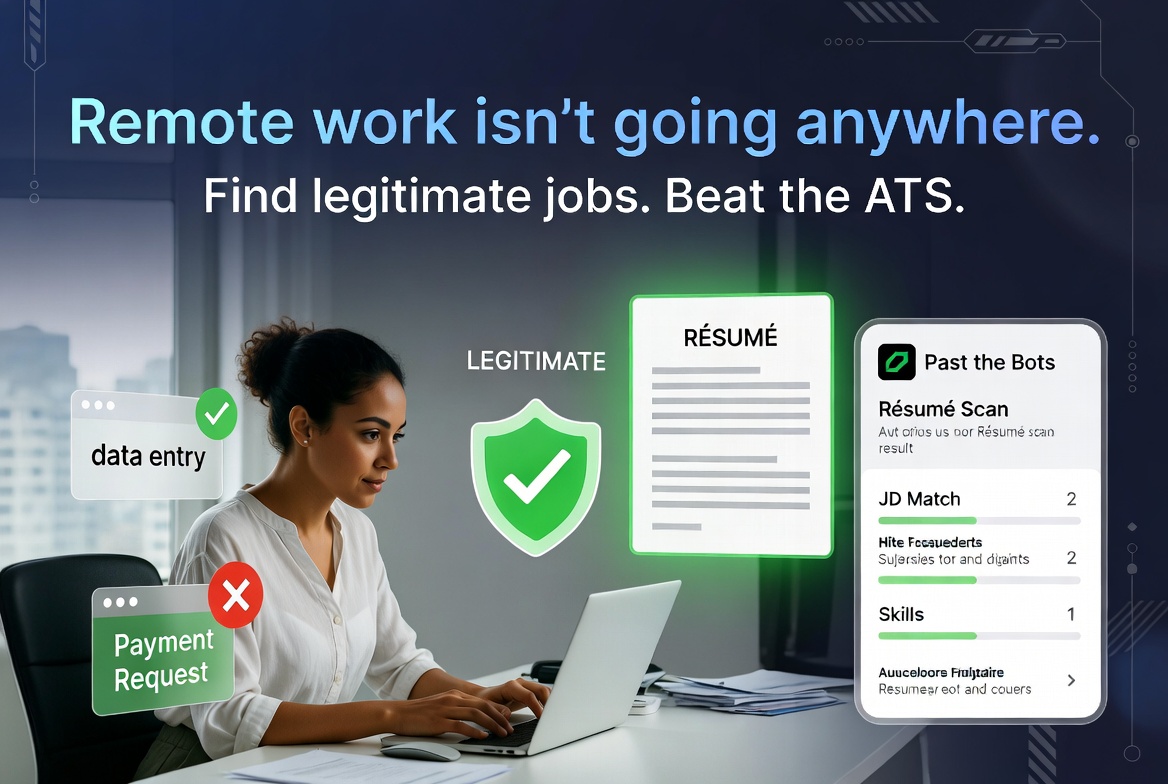 Remote work isn't going anywhere. Millions of legitimate, well-paying work-from-home jobs are posted every week across dozens of industries. The challenge isn't whether those jobs exist—it's finding the real ones, then making sure your application actually gets seen.
Let's tackle both problems.
Where to Find Legitimate Remote Jobs (Without Getting Scammed)
The remote job market has a noise problem. For every real posting, there are sketchy "opportunities" that want you to pay for training, ship packages, or work for pennies per task. Here's how to filter them out fast.
Stick to trusted platforms and company career pages.
- LinkedIn Jobs with the "Remote" filter applied is still one of the most reliable sources for professional roles.
- We Work Remotely, Remote OK, and FlexJobs (paid, but heavily vetted) specialize in remote listings and have strong spam filters.
- Company career pages directly are underrated. If you know you want to work for a specific employer, go straight to their site. Real remote jobs are listed there without the middleman noise.
- USAJobs.gov for federal remote roles, which tend to be stable and well-compensated.
Red flags to skip immediately:
- Any job that asks you to pay upfront for equipment, certification, or access
- Vague job titles like "Data Entry Specialist" with no company name attached
- Salaries that seem wildly high for minimal qualifications
- Contact via personal Gmail or WhatsApp rather than a company domain
A good rule of thumb: if you can't find the company on LinkedIn with real employees, keep moving.
The Remote Job Market Is Competitive—Your Résumé Has to Work Harder
Here's the part most job seekers don't think about until they're frustrated: remote jobs often attract two to three times more applicants than on-site roles. More applicants means more reliance on Applicant Tracking Systems (ATS) to do the initial sorting.
That means your résumé isn't just competing with other humans—it's competing with an algorithm first.
ATS software parses your résumé and pulls out key information: your name, contact details, job titles, dates, and skills. Then it scores your résumé against the job description. If your formatting confuses the parser, or if you're missing the right keywords, you can be screened out before a recruiter ever sees your name.
For remote roles specifically, a few things tend to hurt candidates:
- Complex résumé templates with columns, text boxes, or graphics that parsers can't read correctly
- Missing remote-work keywords that signal you can actually function independently (think: "remote collaboration," "async communication," "distributed team")
- Skills buried in paragraphs rather than called out clearly where ATS tools look for them
How to Actually Fix This
Before you submit your next remote application, run your résumé through an ATS check. This tells you exactly what a parser sees—and what it misses.
The Past the Bots résumé scan shows you what an ATS extracts from your file: your contact info, your skills, your section headers, and your work history. It flags critical issues (like a phone number that didn't parse), warnings (like a skills section that's hard to read), and things that are fine as-is. It's the difference between guessing and knowing.
From there, the skill-match tool lets you paste in a job description and see exactly which keywords from that posting appear in your résumé and which are missing. For remote roles, you might find that you're doing all the right things—managing projects asynchronously, collaborating across time zones—but you've never written those skills down in a way the ATS recognizes.
If your résumé needs a structural overhaul, the ATS-safe single-column rebuild strips out the formatting that trips up parsers and gives you a clean, readable file that both software and humans can work with.
And if you want to tailor your résumé to a specific remote role without overstating your experience, the AI tailoring feature rewrites your existing bullets to better match the job description. It doesn't invent experience you don't have—it just makes sure what you do have is framed in a way that resonates.
The Bottom Line
Finding a great remote job is a two-step problem. Step one is sourcing real opportunities from trustworthy places—job boards that vet their listings, company career pages, and professional networks. Step two is making sure your application can actually get through the automated screening that stands between you and a recruiter's inbox.
Most job seekers focus only on step one and wonder why they're not hearing back. Fix both, and your odds improve dramatically.
Start by knowing what an ATS actually sees when it reads your résumé. Everything else gets easier from there.