How to Get Your Résumé to the Top of AI's Pile
July 2, 2026 · 4 min read · Past the Bots
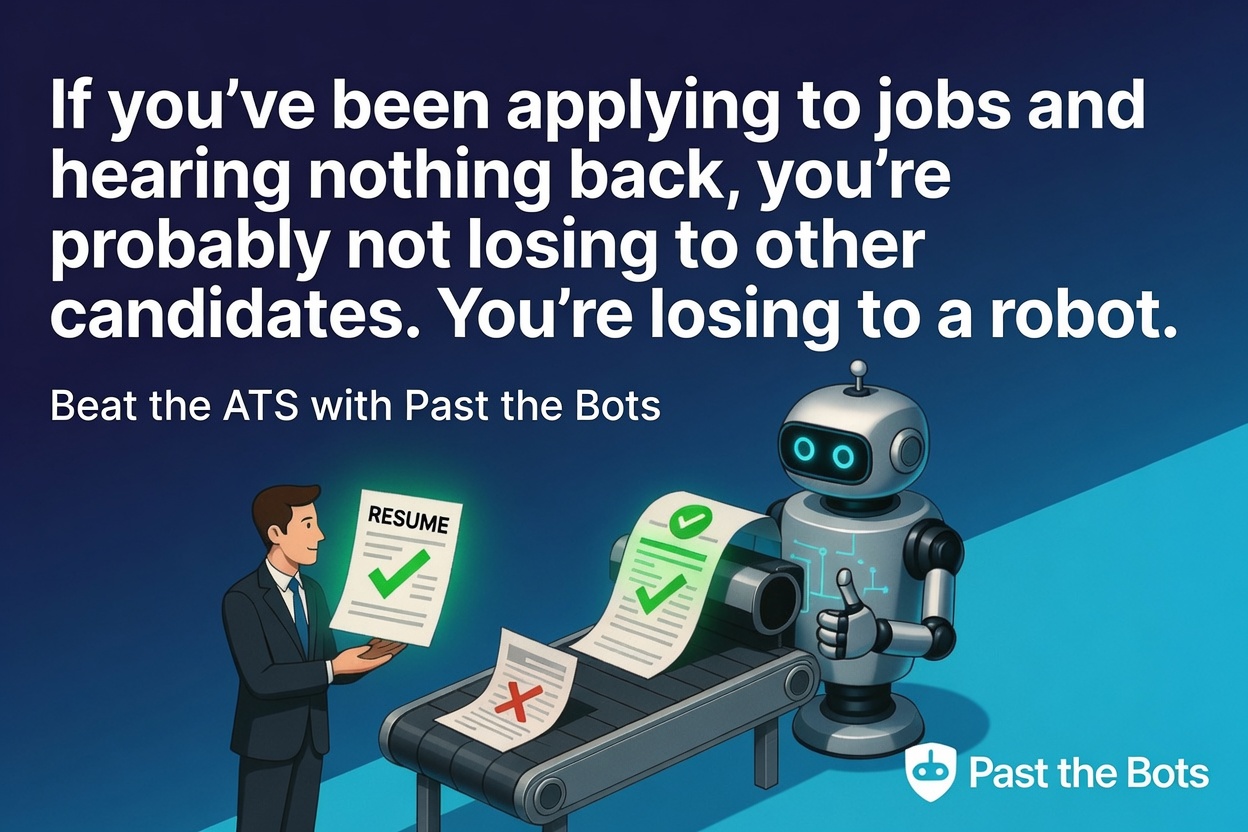 If you've been applying to jobs and hearing nothing back, you're probably not losing to other candidates. You're losing to a robot.
Most mid-size and large employers use Applicant Tracking Systems (ATS) to filter résumés before a recruiter ever opens them. These systems parse your document, extract information, score it against the job description, and rank you against every other applicant. If your résumé isn't formatted and written in a way the parser understands, you slide down the pile or disappear from it entirely.
The good news: this is a solvable problem. Here's what actually works.
The Parser Problem Nobody Talks About
Most people assume an ATS reads a résumé the way a human does. It doesn't. It's looking for specific data fields: your name, contact info, job titles, dates, skills, education. If your formatting buries that information inside a table, a text box, a header, or a two-column layout, the parser may skip it entirely.
This is why a beautiful, design-heavy résumé can actually hurt you. What looks polished to your eye can look like a blank page to a bot.
Common formatting mistakes that trip up parsers:
- Two-column layouts (skills in a left sidebar often get ignored)
- Text inside graphics or images
- Headers and footers for contact info
- Non-standard section labels like "Where I've Been" instead of "Work Experience"
- Fancy fonts and special characters
The Past the Bots Audit tool actually shows you how different parsers read your résumé, so you can see exactly what a machine extracts versus what you intended to say. It's a quick gut-check that reveals problems you'd never spot by just reading your own document.
Keywords Are Not Optional
ATS software scores your résumé partly by how well it matches the job description. That means if the job posting says "project management" and your résumé only says "led cross-functional initiatives," the system may not connect those two things.
You don't need to stuff your résumé with every buzzword in the posting. But you do need to mirror the language the employer actually used, especially for skills, tools, and job titles.
How to approach keyword matching:
- Copy the full job description into a document
- Highlight every skill, tool, certification, and requirement
- Compare that list against your résumé word by word
- Add missing terms naturally, only if you genuinely have that experience
Past the Bots does this comparison automatically. You paste the job description, and it shows you a skill-weighted match score with exactly which keywords matched, which are missing, and which gaps might be knockout criteria for that role. That last part matters a lot. Not all missing keywords are equal. Some are preferences. Others will get you filtered out automatically.
Tailoring Without Fabricating
Here's where a lot of job seekers get stuck. They know they need to tailor their résumé for every application, but rewriting bullets from scratch for each job posting is exhausting, and it's easy to accidentally oversell.
The right approach is to reframe real experience using the employer's language, not invent experience you don't have. If you managed a $200K budget and the job description emphasizes financial oversight, that bullet should say "managed a $200K departmental budget" rather than something vague like "handled money stuff."
The AI tailoring feature in Past the Bots does exactly this: it rewrites your bullets to match a specific job description without adding anything that wasn't already there. It's more like a translator than a fabricator. Same experience, clearer signal to the ATS and the recruiter reading behind it.
The Format That Actually Works
If you're not sure whether your current résumé is ATS-friendly, the safest bet is a clean single-column format with:
- Standard section headings (Summary, Work Experience, Education, Skills)
- Your contact info in the body of the document, not a header
- A simple, readable font at 10 to 12 points
- Saved as a .docx file unless the application specifically requests PDF
Past the Bots can rebuild your résumé into an ATS-safe single-column format if your current one has structural issues, and you can export a clean .docx ready to submit.
One Last Thing
None of this is about gaming the system. ATS software exists because recruiters are overwhelmed with volume. Making your résumé readable to both a machine and a human is just good communication. You're making it easier for the right people to find you.
Start with an honest audit of what the bots actually see when they read your résumé. You might be surprised how much signal is getting lost before anyone human lays eyes on it.