How to Pivot Your Career Without Losing Momentum (or Getting Filtered Out by ATS)
July 10, 2026 · 4 min read · Past the Bots
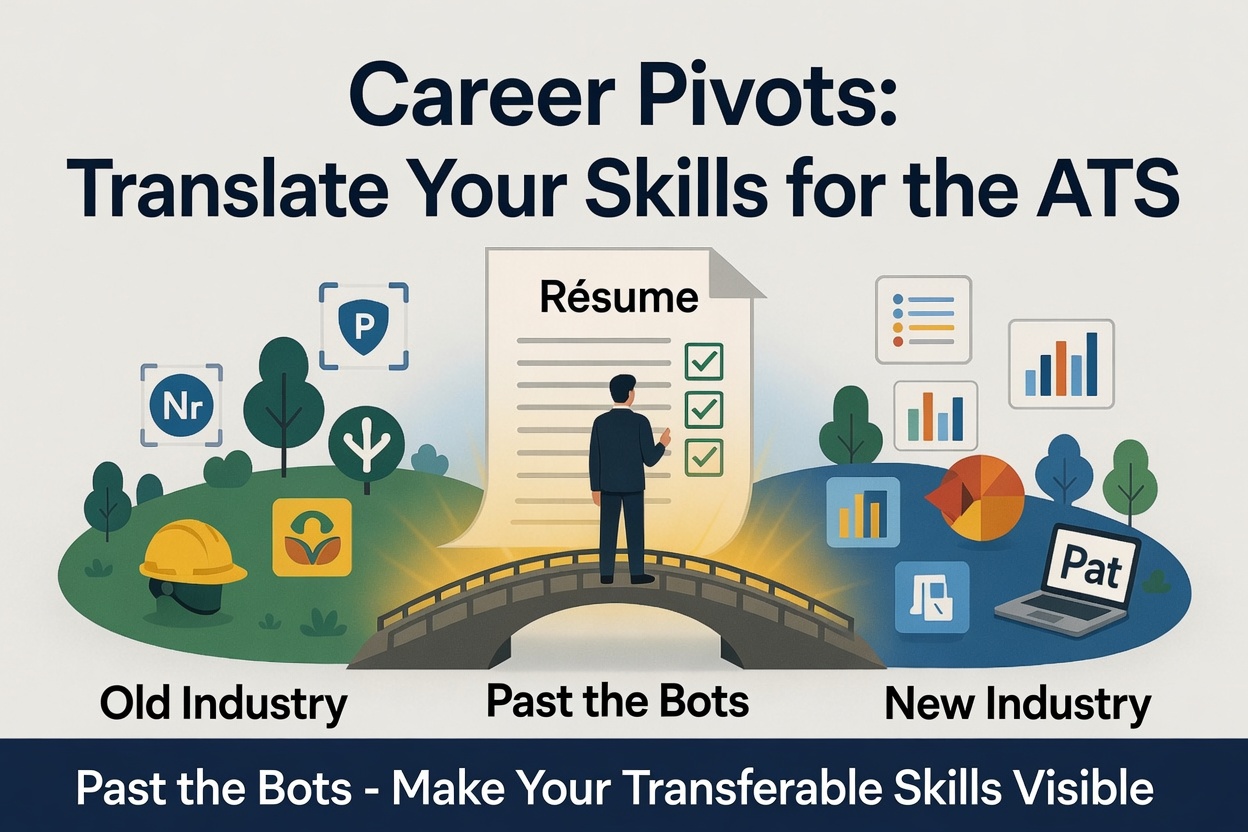 Thinking about switching industries or stepping into a new role that looks nothing like your current title? You're not alone. Career pivots have become one of the most common job search scenarios, and the good news is that transferable skills are very real. The tricky part is getting an Applicant Tracking System to recognize them before a recruiter ever lays eyes on your résumé.
That's where most pivoters quietly lose momentum without realizing it.
The Pivot Problem Nobody Talks About
When you change direction, your résumé usually has one big problem: it's written in the language of your old career. Every industry has its own vocabulary. A project manager in construction and a project manager in software might do genuinely similar work, but their résumés read completely differently. ATS platforms are trained to pull specific keywords, and if yours are coming from the wrong dictionary, you'll get filtered out before any human considers whether you'd actually be great at the job.
This isn't about being underqualified. It's about translation.
Start by Understanding What the ATS Actually Sees
Before you rewrite a single bullet, it helps to know what's already working and what isn't. A lot of pivoters spend hours editing their résumé in the dark, guessing at what to change.
Instead, run your current résumé through an ATS scanner first. Past the Bots will show you exactly what the parser extracts: your name and contact info, which skills it picks up, how it reads your section headers, and where it gets confused. You might discover that your résumé has a skills section the ATS can't parse, or that a job title from your old industry is getting flagged as irrelevant.
Knowing the starting point makes everything that comes next much more intentional.
Match Your Language to the New Role
Here's a practical step that makes a huge difference: paste a job description from your target role into a skill-matching tool and see where your résumé actually lines up.
With Past the Bots, you get a weighted match score that shows you:
- Which keywords from the job description appear in your résumé (matched)
- Which important ones are missing (gaps you can fill if you genuinely have that experience)
- Any knockout terms that might disqualify you automatically if they're absent
For a pivoter, this is gold. Let's say you're moving from nonprofit program management into corporate operations. The job description might use words like "cross-functional coordination," "KPI tracking," or "process optimization." You've done all of those things. You just called them something else. Now you know exactly what to update.
Rewrite Bullets Around Transferable Skills (Without Faking Anything)
This is the part that makes people nervous. "If I change my wording, am I being dishonest?"
No. Accurately describing your real experience in language that matches a new field is just good communication. The key word is accurately.
Past the Bots has an AI tailoring feature that rewrites your bullet points to align with a specific job description. It uses what's already on your résumé and adjusts the framing and vocabulary. It won't invent responsibilities you didn't have. Think of it as a translator, not a fabricator.
For example, "Coordinated volunteer schedules and tracked program outcomes for 12 community initiatives" might become "Managed cross-functional scheduling and KPI reporting across 12 simultaneous programs." Same job. Much better translation.
Don't Let Formatting Undo Your Work
One more thing pivoters often overlook: a résumé that looks great in Word can fall apart inside an ATS. Tables, columns, text boxes, headers with logos. These all cause parsing errors that make even a perfectly keyworded résumé invisible.
If you're pivoting, you're already asking the ATS to give you the benefit of the doubt. Don't also make it fight through a complicated layout. A clean, single-column format is the safest bet, and Past the Bots can rebuild your résumé into an ATS-safe structure if your current one has formatting issues.
The Momentum Part
The reason career pivots stall isn't usually a lack of transferable skills. It's a gap between how you've described your experience and what the systems (and hiring managers) on the other side are looking for.
Closing that gap is mostly a language and visibility problem. Get clear on what keywords the new field uses, make sure your résumé speaks that language, and confirm the ATS can actually read what you've written.
Do those three things and you stop losing momentum to filters you didn't know were there. Your experience gets a real shot at being seen, and that's where a successful pivot actually begins.