How to Put Your Side Hustle on Your Résumé (Without Confusing an ATS)
June 27, 2026 · 4 min read · Past the Bots
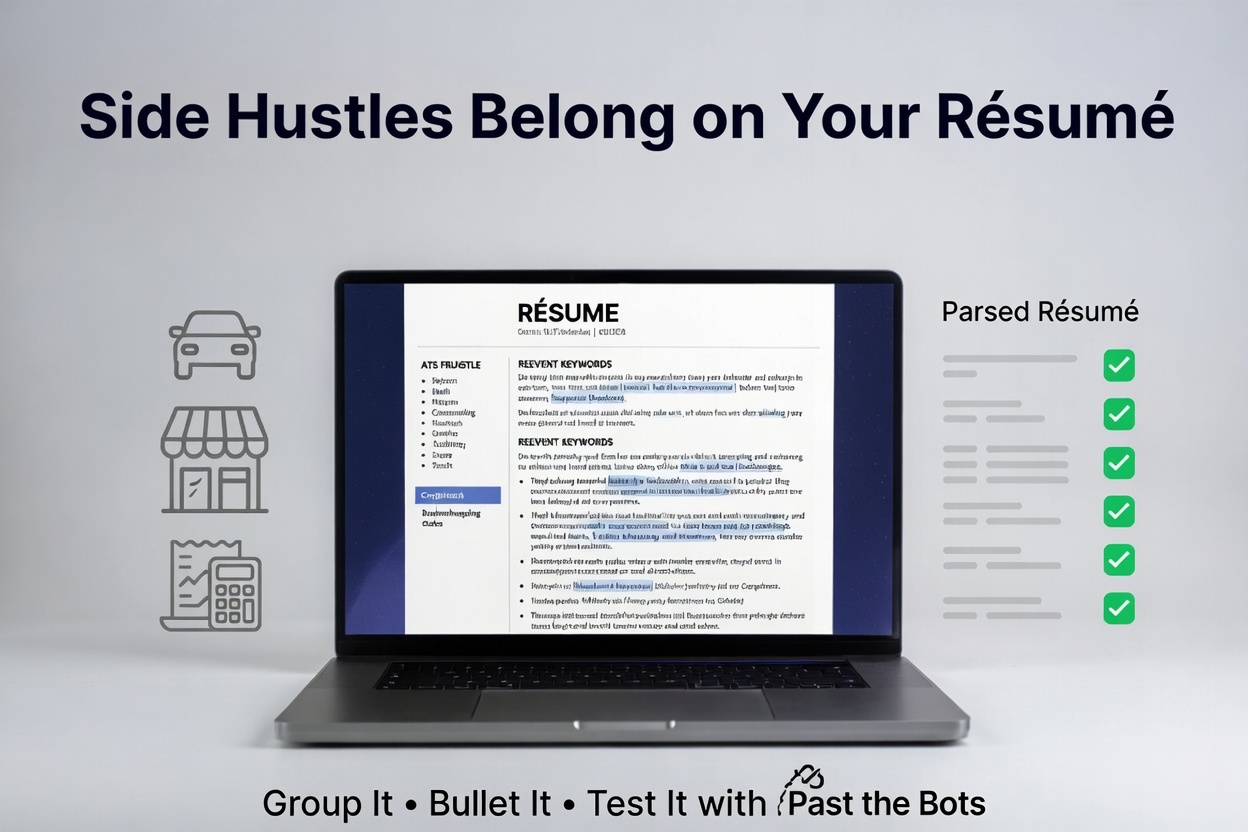 You drove for Uber on weekends, built Shopify stores for local businesses, or did bookkeeping for three small clients while working your day job. That's real experience. Real skills. Real results.
But when you try to put it on your résumé, something weird happens. It either looks cluttered, reads like a hobby, or disappears entirely when an applicant tracking system tries to parse it. You know the work counts. Getting the software to agree is a different story.
Here's how to approach it.
Why ATS Systems Struggle With Side-Hustle Experience
Applicant tracking systems are built to find patterns: employer name, job title, dates, bullet points. They expect a clean narrative. Freelance and gig work tends to break that pattern in a few ways:
- Multiple short-term clients can look like job-hopping
- Self-employed entries sometimes get skipped if the employer field is blank or oddly formatted
- Inconsistent titles like "Freelancer" or "Independent Contractor" don't always map to the skills the system is scanning for
- Skills buried in prose instead of bullets get missed entirely
None of this means your side hustle shouldn't be on your résumé. It means you need to format it so the parser can actually read it.
Pick a Format That Parsers Can Follow
The most ATS-friendly way to list freelance work is to treat yourself like a business. Create a single block entry rather than listing every individual client:
Freelance Web Developer | Self-Employed | Jan 2022 - Present
Then use bullets to describe what you actually did. Keep client names out of the job title field (you can mention a notable one in a bullet if it adds credibility).
This gives the parser a clean employer field, a recognizable title, and a date range it can work with. No confusion, no gaps.
If your side hustle has a real business name, use it. "Bright Copy Co." reads more credibly than "Various Clients" and still passes through parsers cleanly.
Write Bullets That Match the Job You Want
This is where most people leave points on the table. They describe what they did in their side hustle without connecting it to the role they're applying for.
Say you did social media management for local restaurants while working a full-time sales job. If you're now applying for a marketing coordinator role, your bullets should reflect that lens:
- Managed Instagram and Facebook for four restaurant clients, growing average engagement by 34% over six months
- Created monthly content calendars and scheduled 20+ posts per week using Buffer and Later
- Reported on performance metrics and adjusted strategy based on reach and click-through data
Those bullets speak directly to what a marketing coordinator hiring manager (and their ATS) is looking for. "Helped restaurants with social media" does not.
The Past the Bots skill match tool is genuinely useful here. Paste the job description you're targeting, and it shows you exactly which keywords are present in your résumé and which are missing. If your side hustle covers some of those gaps, that's the signal to rewrite those bullets with the right language.
Don't Let It Cannibalize Your Main Experience
If your side hustle is directly relevant to the job, give it a real section near the top. If it's supplementary, it can sit at the bottom of your experience section or in an "Additional Experience" block.
What you don't want is a résumé where five freelance clients each get their own entry and your strongest full-time role gets buried. The visual weight should match the relevance.
Run It Through a Parser Before You Send It
Even well-formatted side-hustle entries can trip up certain parsers. Some systems misread self-employment dates. Others skip sections that fall outside a two-column layout.
The Audit the Bots feature in Past the Bots lets you see exactly how different parsers extract your résumé data: your name, contact info, job titles, skills, and sections. If your freelance role is getting dropped or mislabeled, you'll see it before the recruiter's ATS does.
It's a quick way to catch problems that aren't visible just by reading your résumé on screen.
The Short Version
Side hustles belong on your résumé if the skills are relevant. The key moves are:
- Group your freelance work under one employer-style entry
- Write bullets that match the job description you're applying to
- Use specific tools, metrics, and outcomes instead of vague descriptions
- Test how parsers read it before you submit anywhere
You did the work. Make sure the software knows it.