Interview Prep That Actually Comes From Your Experience
July 16, 2026 · 4 min read · Past the Bots
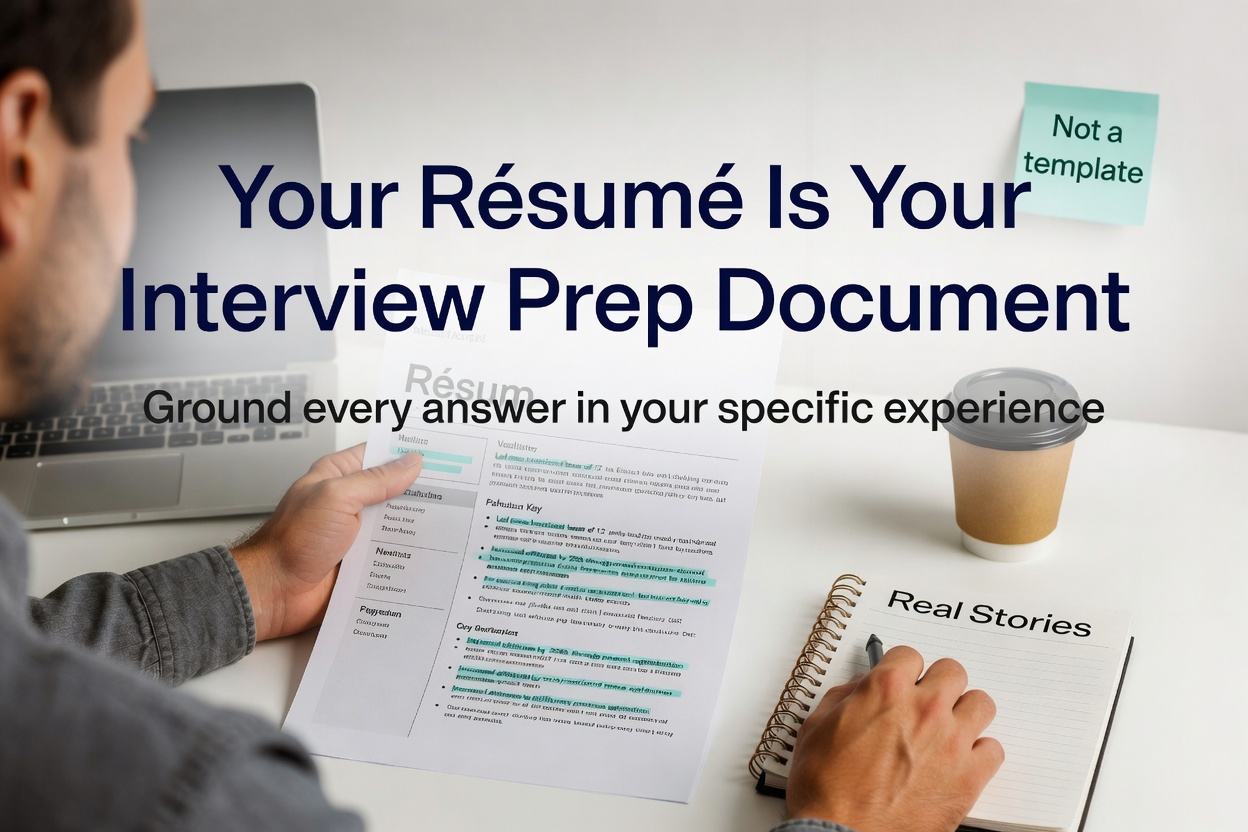 Most interview prep advice tells you to rehearse answers to a list of common questions. That's fine, but it skips the most important step: grounding every answer in your specific experience, not a generic template.
Here's a better approach. Use your résumé as your prep document, not just your application document.
Start by Reading Your Résumé Like an Interviewer Would
Before you walk into any interview, print your résumé (or open it on screen) and read it the way a skeptical hiring manager would. For every bullet, ask yourself:
- What does this actually mean? "Improved team efficiency" means nothing without a story behind it.
- What would someone want to know more about? Anything vague, impressive, or unusual is a likely question.
- Can I talk about this for two minutes without notes? If not, it needs more prep.
Every bullet you wrote is an implicit promise that you can talk about that topic in depth. If you can't, you'll get caught flat-footed on something that's literally on your own résumé.
Predict Your Likely Questions
Once you've read your résumé like an outsider, you can predict a big chunk of what you'll be asked. Here's how different types of experience tend to translate into interview questions:
Leadership or management roles Expect: "Tell me about a time you had to manage a difficult team member" or "How do you prioritize when everything feels urgent?"
Career changes or gaps Expect: "I see you moved from X to Y, can you walk me through that?" or "What were you doing during this period?"
Specific projects or results Expect: "Tell me more about how you achieved that" or "What would you do differently now?"
Technical skills listed Expect: "How have you used [skill] in a real project?" or "What's the most complex problem you've solved with [tool]?"
Short tenures or multiple job changes Expect: "Why did you leave after only a year?" for each one.
Make a list of the five or six spots on your résumé most likely to draw a question. Those are your prep priorities.
Build Answers From Real Stories, Not Formulas
You've probably heard of the STAR method (Situation, Task, Action, Result). It works, but people often apply it backward, starting with the formula instead of starting with the memory.
Try this instead:
- Recall the actual event first. Think about a real project, conflict, win, or failure that relates to that bullet.
- Write it out in plain language, like you're texting a friend about what happened at work.
- Then structure it into a 90-second version you could say out loud.
The goal is to have three to five solid stories that you can adapt to different questions. A good story about leading a product launch can answer questions about leadership, cross-functional collaboration, handling pressure, and dealing with setbacks. One story, many uses.
Match Your Stories to the Job Description
This is where preparation gets sharper. Pull up the job description and look for the specific skills, verbs, and priorities the employer keeps repeating. Words like "cross-functional," "data-driven," or "customer-facing" are signals about what they care about.
Now match those priorities to your stories. If the role emphasizes data analysis and you have a bullet about building a reporting dashboard, that's your anchor story for that interview. If you ran a Past the Bots match scan on your résumé against the job description, you already have a list of the keywords that scored well and any gaps, which tells you exactly which experience to lead with and what you may need to address head-on.
Prepare Smart Questions to Ask Them
The "do you have any questions for us?" moment is not a formality. It's another signal of how prepared and thoughtful you are. Skip the generic ones ("What does a typical day look like?") and ask things that show you've done real thinking:
- "I noticed the job description emphasizes [specific thing]. What does success look like in that area in the first six months?"
- "What's the biggest challenge the team is currently working through?"
- "How does this role interact with [another team or function mentioned in the JD]?"
- "What have you seen top performers in this role do differently than others?"
These questions come from the job description and your own curiosity, not a list you memorized.
The Night Before
Don't cram. Instead, do a quick 20-minute review:
- Reread your résumé and the job description side by side
- Say your top three stories out loud, not just in your head
- Write down your two or three questions to ask
That's it. The real prep happened earlier. Now you just need to show up and have a conversation backed by actual experience, which is exactly what you have.