It's Not AI Stealing Entry-Level Jobs — It's a Hiring Slowdown. Here's How to Stand Out Anyway.
July 1, 2026 · 4 min read · Past the Bots
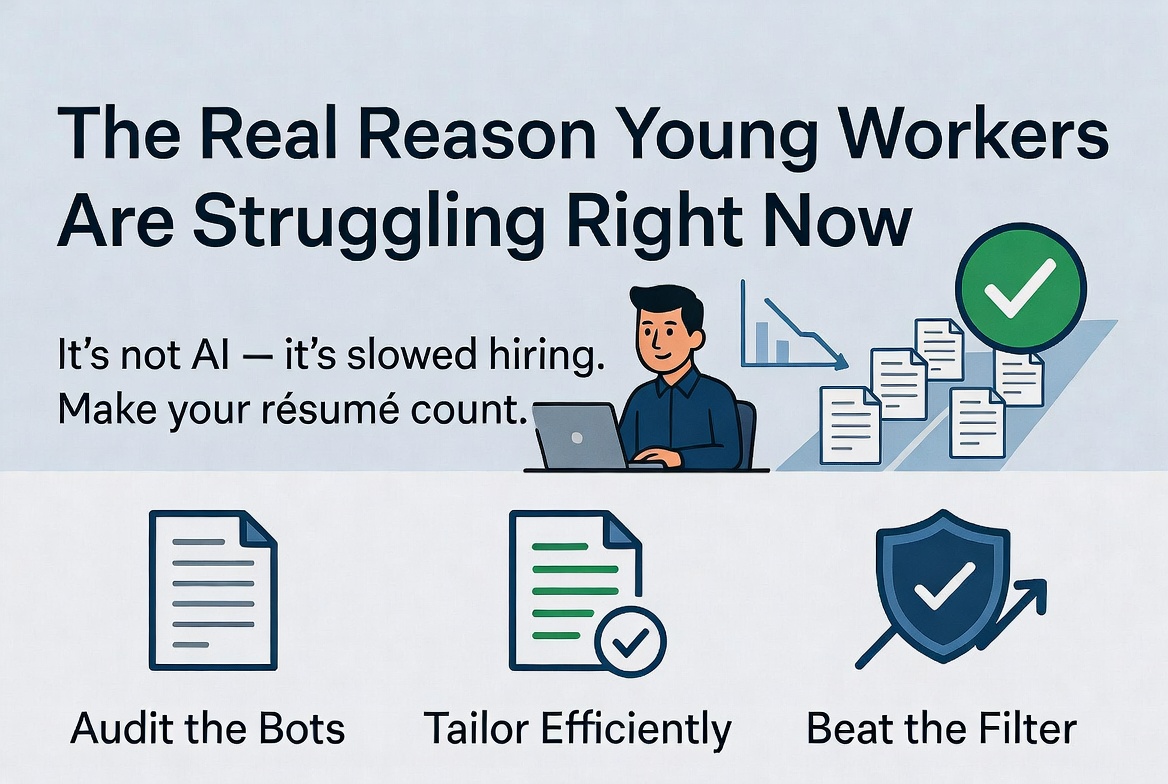
The Real Reason Young Workers Are Struggling Right Now
If you've been applying for months without much luck, you've probably wondered whether robots are just rejecting you before a human ever looks. Turns out, that's only part of the story.
A recent study from the Federal Reserve found that the biggest driver of job market struggles for young and entry-level workers isn't artificial intelligence replacing them — it's simply that hiring has slowed down dramatically. Employers are holding onto the workers they have and posting fewer new openings. When fewer doors open, competition for every single one gets brutal.
That's actually important context, because it changes how you should think about your job search.
Fewer Jobs Means Every Application Has to Work Harder
When hiring is slow, the math is simple: more candidates are chasing fewer roles. Recruiters and hiring managers get flooded. And yes, that's exactly when ATS (Applicant Tracking System) screening becomes a bigger filter — not because companies are automating you out of a job, but because they need some way to manage hundreds of applications for a single opening.
This is where a lot of otherwise-qualified candidates get quietly eliminated. Your résumé never lands in front of a human because the system couldn't parse it correctly, didn't find the right keywords, or flagged your formatting as unreadable.
So while the job market headwind is real and frustrating, there's a piece of this you can control: making sure your résumé actually survives the screening process.
What ATS Systems Are Actually Looking For
Here's a quick reality check on how these systems work:
- Parsing first. The ATS tries to extract your name, contact info, work history, and skills. If your formatting is complex — tables, columns, headers in text boxes — it often garbles or drops information entirely.
- Keyword matching second. The system compares what it extracted against the job description. Missing keywords, even if you have the experience, can sink your score.
- Human eyes last. Only résumés that clear the automated filter typically get reviewed by a recruiter.
In a competitive market, there's no margin for a résumé that loses points on the technical stuff.
How to Actually Compete Right Now
Here's what makes a difference when you're up against a crowded applicant pool:
1. Know how your résumé is being read. Before you apply anywhere, find out what an ATS actually extracts from your file. Tools like the Audit the Bots feature on Past the Bots show you exactly how different parsers interpret your résumé — what they pull correctly, what they miss, and what gets scrambled. It's eye-opening, especially if you've been using a creative template.
2. Tailor every application, but do it efficiently. Generic résumés perform poorly in slow markets. You need your résumé to reflect the specific language of each job posting. That doesn't mean rewriting from scratch every time — it means strategically swapping in the right keywords and adjusting your bullets to match what the employer actually asked for. A skill-weighted match score against the job description tells you exactly what's missing before you hit submit.
3. Fix the structural problems once. If your résumé has formatting that confuses parsers, fix it now and be done with it. A clean, single-column layout reads correctly across virtually every ATS. This isn't about making your résumé look boring — it's about making sure your actual experience gets seen.
4. Let your bullets do more work. Entry-level candidates especially tend to undersell what they've done. Internships, class projects, part-time jobs, volunteer work — these all count, but they need to be framed in terms of impact and relevance, not just duties. AI tailoring can help rewrite weak bullets to better align with a target role without inventing experience you don't have.
5. Get found between applications. When active job postings are scarce, it pays to be discoverable. Building a talent profile that surfaces your skills to recruiters searching for candidates is a low-effort way to generate inbound interest while you're actively applying outbound.
The Bigger Picture
A slow hiring market is genuinely tough, and it's okay to acknowledge that. But it also means the candidates who do the unglamorous work — cleaning up their résumé, tailoring their applications, understanding how the screening process works — have a real advantage over people who are just blasting out the same document everywhere.
You can't control how many jobs get posted this quarter. You can control whether your résumé makes it past the first filter.
Start there.