Laid Off in Your 50s? Here's How to Stop Getting Filtered Out Before Anyone Sees Your Resume
June 12, 2026 · 4 min read · Past the Bots
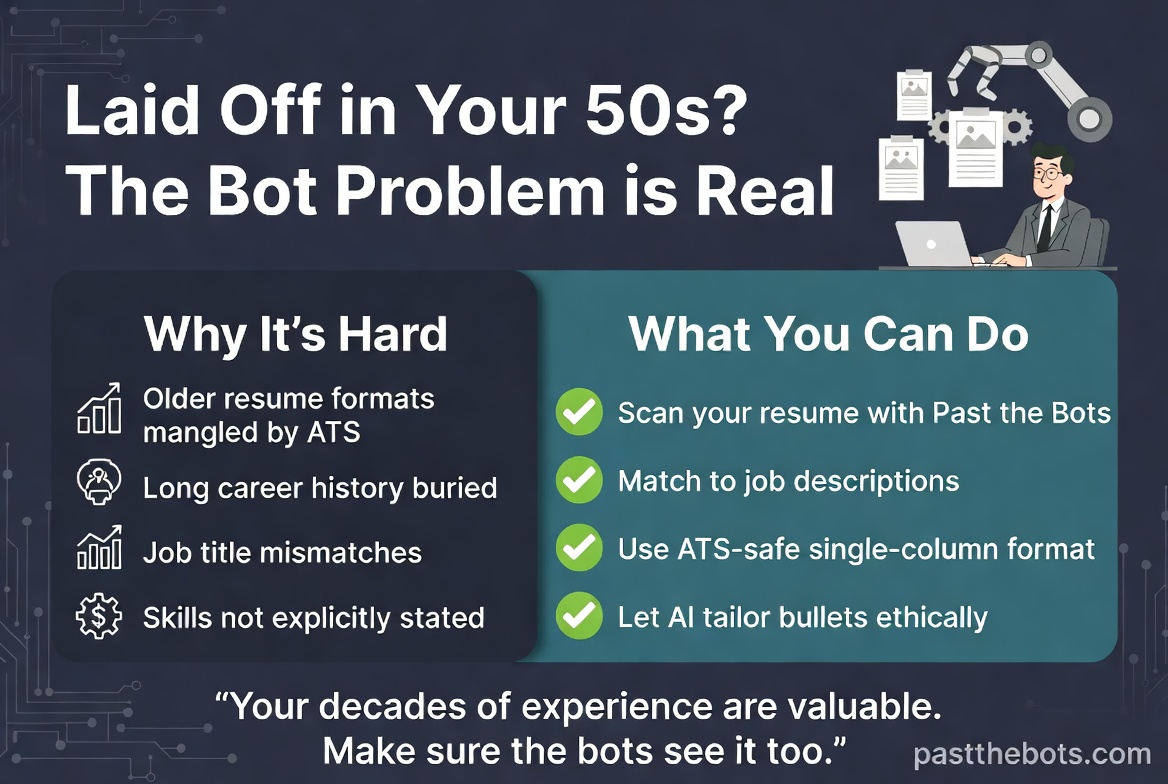 If you've recently been laid off and you're in your 50s, you're dealing with something genuinely hard. Not "hard" in a vague motivational-poster way, but specifically, practically hard. You have decades of real experience, strong references, and a track record that should speak for itself. But the callbacks aren't coming.
A recent article from a job seeker in exactly this situation put it plainly: the market feels confusing and discouraging, and it's hard to know where you even fit anymore.
Here's one thing worth knowing: a big chunk of the silence you're hearing isn't a human decision. It's automated.
The Bot Problem Is Real, and It's Not About Age
Most mid-to-large employers run resumes through an Applicant Tracking System (ATS) before a recruiter ever sees them. These systems parse your resume, extract keywords, and rank you against the job description. If your resume doesn't format or phrase things the way the system expects, you can score low even when you're genuinely qualified.
This hits experienced professionals especially hard for a few reasons:
- Older resume formats often use tables, columns, headers in text boxes, or creative layouts that ATS parsers simply mangle or skip entirely.
- Long career histories can bury your most relevant experience. If your most impressive, relevant role was 12 years ago, the system may weight it less than a recent role that doesn't match the job at all.
- Job title mismatches are common. You might have been a "Director of Client Solutions" when the posting is looking for an "Account Director." Same job, different words, and the bot doesn't give you credit for the match.
- Skills assumed but not stated. If you've been doing something for 25 years, you might not think to write it down. The ATS doesn't know what you know unless it's on the page.
What You Can Actually Do About It
The good news is that once you understand the problem, most of it is fixable.
Start with a resume scan. Before you send another application, find out what an ATS actually sees when it reads your resume. Past the Bots has a tool that shows you exactly what gets extracted: your name and contact info, your skills, your section headers, your work history. You'll often find things missing or misread that you had no idea were a problem.
Match your resume to each job description. This sounds tedious, but it doesn't have to mean rewriting from scratch every time. The skill-match tool on Past the Bots lets you paste in a job description and see a weighted score showing which keywords you're hitting, which ones are missing, and whether there are any "knockout" gaps that would automatically disqualify you. That last part matters a lot. Some ATS systems are set to filter out anyone who doesn't include a specific required term.
Rebuild in an ATS-safe format. If your resume has columns, graphics, or a creative layout, it may be getting scrambled before anyone reads it. A clean, single-column format isn't boring, it's strategic. It's the format that actually survives the parser intact.
Let AI rewrite your bullets, carefully. One of the trickiest parts of tailoring a resume is rephrasing your experience to match a job description without sounding like you're lying or over-inflating what you did. A good AI tailoring tool rewrites your existing bullets to better reflect the language of the role, without adding experience you don't have. That distinction matters both ethically and practically.
On the "Where Do I Fit" Question
The article that inspired this post touches on something that goes beyond resume mechanics: the feeling of not knowing where you belong in a market that feels designed for someone younger.
That's a real feeling, and it's worth sitting with it separately from the tactical stuff. But it's also worth separating the emotional experience from the practical one. Sometimes "I'm not getting responses" is age discrimination. And sometimes it's a formatting issue that's been quietly killing your applications for months.
Figuring out which one you're dealing with requires actually knowing what the bots are doing with your resume. Once you rule out the technical problems, you have much clearer information about what you're actually up against.
Decades of experience are genuinely valuable. The goal right now is making sure that value is visible to the systems that are doing the first round of filtering, so that the humans who do the hiring actually get a chance to see what you bring.
That's a solvable problem. Start there.