Locked Out at 50+: How Older Job Seekers Can Stop the ATS From Ending Their Search Before It Starts
June 30, 2026 · 4 min read · Past the Bots
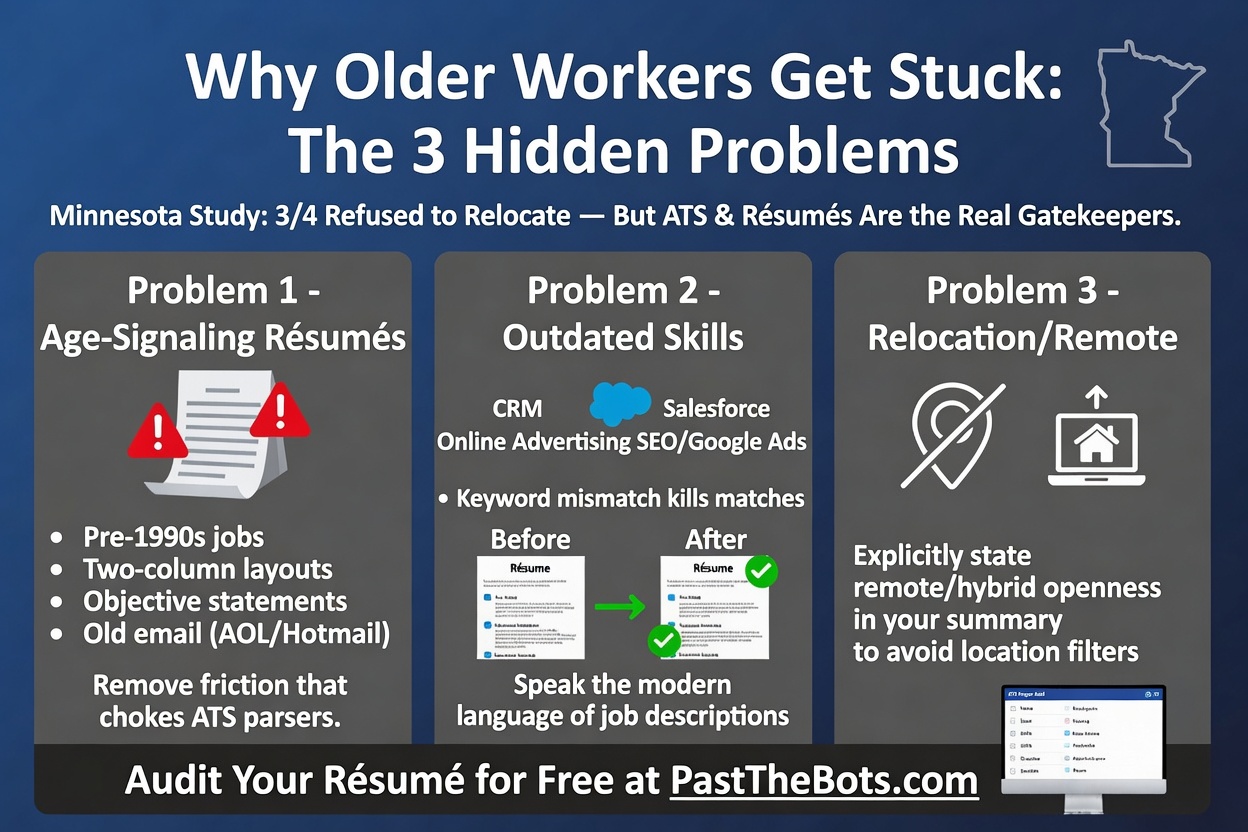 A revealing study of 62 older Minnesotans who lost white-collar jobs later in life found that nearly three-quarters refused to relocate, and three stubborn problems kept most of them stuck. The research pointed to geographic limitations, outdated skills perception, and age-signaling résumés as the core culprits.
Two of those three are things you can actually fix right now, before you send another application.
Let's dig in.
Why the ATS Is an Especially Cruel Gatekeeper for Experienced Candidates
Applicant Tracking Systems were not designed with 25-year careers in mind. They scan for keywords, parse section headers, and rank candidates based on matches to a job description. When your résumé spans two decades, lists software that has been rebranded three times, and uses formatting that made sense in 2008, the parser often chokes.
The result: a human recruiter never sees your application. Not because you're underqualified, but because the bot couldn't read your file correctly.
This is the hidden problem underneath the relocation and skills-gap issues the Minnesota study identified. Even candidates who were willing to adapt and had genuinely relevant skills were getting filtered out before anyone could evaluate them.
Problem 1: Your Résumé Is Silently Signaling Your Age
This isn't about hiding your experience. It's about removing friction.
Common age signals that also hurt ATS parsing:
- Listing jobs from the early 1990s or before. Most guidance says to keep it to 10-15 years. Anything older clutters your résumé and can push important skills below the fold that parsers prioritize.
- Using a two-column layout. These look polished in Word but many ATS platforms read columns left-to-right across the page, scrambling your contact info, job titles, and dates into gibberish.
- Objective statements instead of a summary. An objective statement reads as dated. A tight, keyword-rich summary tells both the bot and the human what you bring immediately.
- Listing an AOL or Hotmail email address. Small thing, big signal. Switch to Gmail.
If you want to see exactly how a parser is actually reading your file right now, the Audit the Bots tool on Past the Bots will show you what different ATS systems extract from your résumé, including your name, contact details, skills, and section labels. It's a fast way to catch invisible formatting problems you'd never spot by just rereading the document yourself.
Problem 2: Outdated Skills Perception Is a Keyword Problem
The study found that employers frequently assumed older candidates lacked current technical skills, even when that wasn't true. Part of that is bias. But part of it is a résumé language problem.
If you managed a team that used Salesforce but your résumé says "CRM systems," the ATS won't match Salesforce. If you ran digital marketing campaigns but your résumé describes it as "online advertising," you'll miss keyword hits for SEO, Google Ads, Meta Ads, or whatever the job description actually specifies.
Modern job descriptions use current terminology. Your résumé has to match.
A practical fix: paste the job description into a skill-matching tool and see exactly which keywords you're missing and which ones you've already covered. Past the Bots does this with a weighted match score so you can see not just gaps, but which missing keywords are likely to be knockout criteria for that specific role.
Then update your language to reflect how the industry talks about your skills today, without inventing experience you don't have. That distinction matters. Rewriting "led cross-functional initiatives" to "managed Agile sprint planning across engineering and marketing teams" is accurate and specific. Making up a PMP certification is not.
Problem 3: The Relocation Issue (And What You Can Control Around It)
The majority of the older job seekers in the study were unwilling to relocate, often for completely legitimate reasons: family, mortgages, community ties. That's a real constraint.
What you can control is making sure remote and hybrid opportunities aren't slipping past your résumé. If you're open to remote work, say so explicitly in your summary section. Some ATS filters screen for location keywords, and if your résumé only lists your city, you may be getting filtered out of remote-eligible roles you'd actually want.
A Practical Starting Point
If you haven't looked at your résumé through an ATS lens, start there before anything else. Run it through a parser check, look at how your sections are being read, and compare your language to two or three job descriptions you're targeting. You may find that the biggest obstacle isn't your experience at all. It's how that experience is being communicated to a system that can't read between the lines.
The bot doesn't know what you've built. Your job is to make sure it can at least read your name correctly before a human gets the chance to.