Remote Work Really Does Make People Happier — So Why Is Your Résumé Sabotaging Your Remote Job Search?
June 22, 2026 · 4 min read · Past the Bots
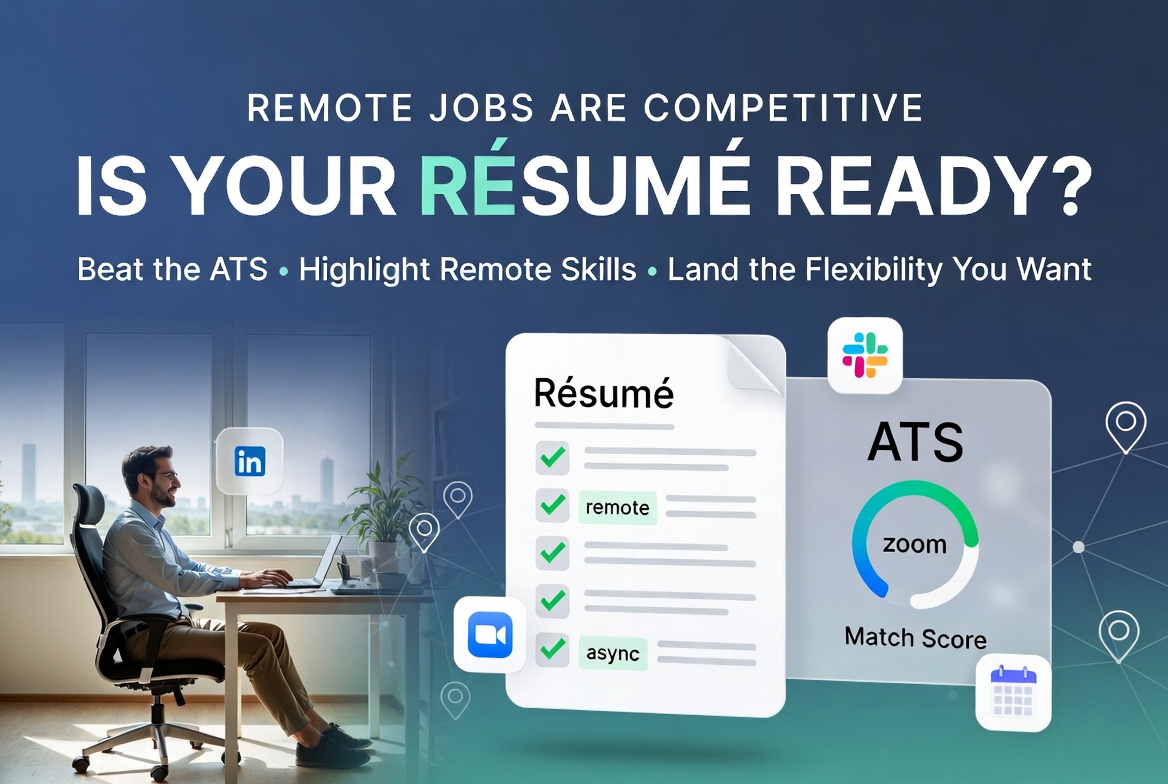 The debate over remote work keeps grinding on, but the evidence is starting to settle. A growing body of research confirms that remote and hybrid workers report higher job satisfaction, better work-life balance, and lower stress than their fully in-office counterparts. One recent analysis found that the flexibility to work from home is one of the strongest predictors of employee happiness — ranking above salary bumps for many workers.
If you're job hunting specifically for remote roles, that data probably doesn't surprise you. You already know what you want. The harder question is: is your résumé actually helping you get it?
Because here's the thing — remote positions are some of the most competitive listings on any job board. A role that's open to candidates nationwide (or worldwide) can pull in hundreds of applications within 48 hours. That means the ATS filter is working overtime before a human ever sees your name.
Remote Jobs Have a Specific Screening Problem
Most job seekers assume that ATS systems are just looking for keywords. And yes, keywords matter. But for remote roles specifically, there are a few extra layers that trip people up.
First, the location parsing issue. Many applicant tracking systems try to match candidates to a geographic area. If your résumé lists a city that doesn't match the job's region, some systems flag it or deprioritize it automatically — even for a fully remote role. It sounds absurd, but it happens constantly.
Second, remote-specific skills are often missing. Employers listing remote positions want to see signals that you can actually thrive without an office. Things like async communication, self-management, comfort with tools like Slack, Notion, Zoom, or Loom, and any mention of distributed teams or cross-timezone collaboration. If none of that language shows up in your résumé, you may be losing match score points to candidates who remembered to include it.
Third, the keyword match against remote job descriptions is different. Remote JDs often include phrases like "independently motivated," "results-oriented," "comfortable with ambiguity," or specific collaboration tools. Your résumé needs to reflect the language of those postings, not generic office-world phrasing.
What You Can Actually Do About It
Here's where to start:
Run your résumé against the specific job description. Not a generic remote job — the actual posting you're applying to. A skill-weighted match score will show you exactly which keywords you're missing and which ones are knockout gaps (the must-haves the employer flagged as required).
Add remote-work context to your bullets. Instead of "collaborated with the marketing team on quarterly campaigns," try "collaborated async with a distributed marketing team across three time zones on quarterly campaigns." Same job, more relevant signal.
Check what the ATS actually extracts from your résumé. If you're using a creative template with columns, text boxes, or icons, there's a real chance the parser is mangling your contact info or skipping whole sections. A clean, single-column format eliminates that risk entirely.
Be explicit about remote experience. If you've worked remotely before, say so directly. "Fully remote role" or "remote-first team" in your job description line tells the system and the recruiter that this isn't your first rodeo.
Tailor without fabricating. AI tailoring tools can help you rewrite bullets to match a specific job's language and priorities without inventing experience you don't have. That's the line worth holding: reflect your real work more accurately, don't invent new work.
The Happiness Data Has a Career Takeaway
Here's the broader point worth sitting with. If research consistently shows that remote work improves wellbeing, then landing a remote role isn't just a career move — it's a quality-of-life move. That makes it worth the extra effort to get your application right.
A lot of job seekers treat their résumé as a static document they update once a year. But remote roles reward the people who treat each application as its own project: pull the JD, check the keyword match, tighten the bullets, confirm the ATS can read the file, and send something that was actually built for that specific role.
That's not more work for its own sake. It's the practical difference between getting filtered out in 10 seconds and getting to the phone screen.
The robots are reading your résumé before any human does. Make sure they're reading the right version.