The $100K Low-Stress Job Is Real — Here's How to Actually Land One
June 4, 2026 · 4 min read · Past the Bots
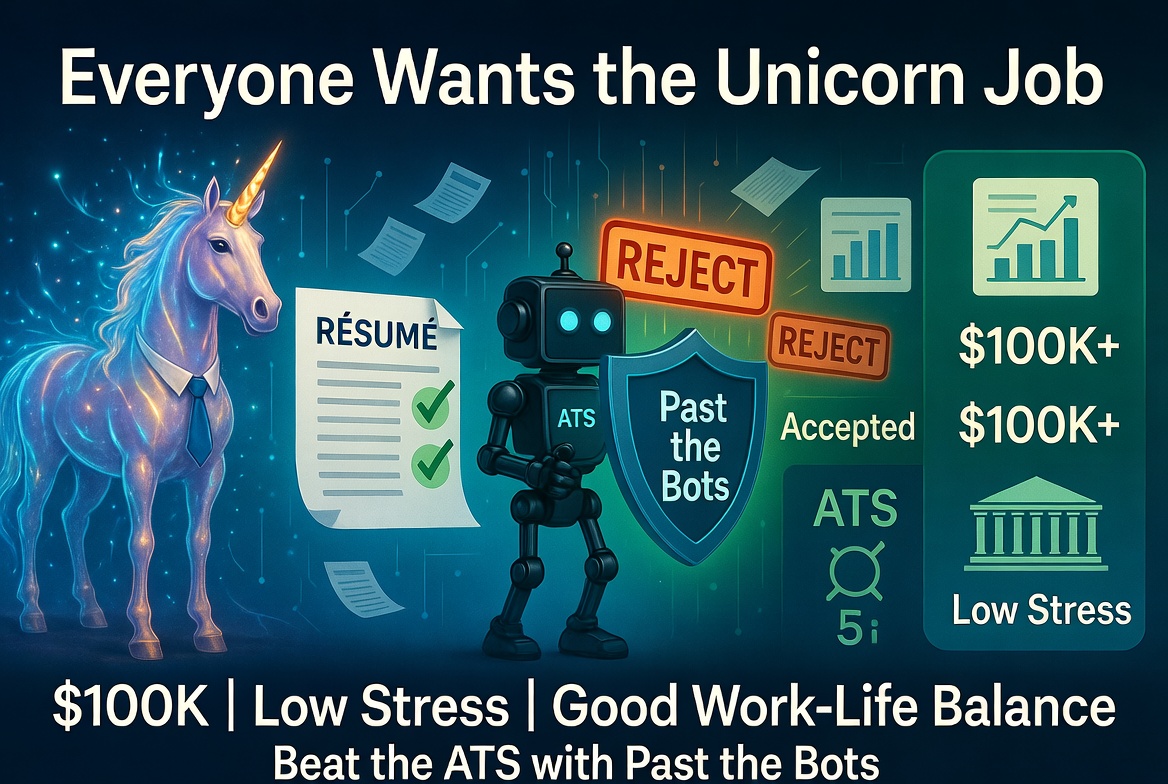
Everyone wants the unicorn job: six figures, reasonable hours, and a manager who doesn't text you at 11pm. According to a recent MSN/MarketWatch piece, those jobs genuinely exist — roles in data management, technical writing, compliance, and certain government or research positions regularly clear $100K without the brutal hours that come with, say, investment banking or surgical residency.
The problem isn't finding those job postings. It's getting your résumé seen by an actual human once you apply.
Why Your Résumé Gets Rejected Before Anyone Reads It
Most mid-to-large employers run applications through an Applicant Tracking System (ATS) before a recruiter ever lays eyes on them. The system parses your résumé, extracts your skills and experience, and ranks you against the job description. If your formatting is off, or you used the wrong keyword, or your skills section doesn't align with what the job posting asked for, you're filtered out automatically.
This is especially frustrating for the kinds of roles that top the "low-stress, high-pay" lists:
- Data analyst or data manager roles often require specific tool names (SQL, Tableau, Power BI) to even register in the ATS
- Technical writer positions look for terms like "documentation," "DITA," "API documentation," or "style guide" depending on the company
- Compliance officer roles might screen for specific certifications (CRCM, CCEP) or regulatory frameworks (SOX, HIPAA, GDPR)
- Statistician or research analyst postings may require "SAS," "R," or "SPSS" to be spelled out explicitly
If your résumé says "worked with data visualization tools" instead of naming Tableau or Power BI, the ATS may score you near zero for that requirement — even if you're genuinely qualified.
Step One: Find Out How the Bots Actually Read Your Résumé
Before you apply to anything, it's worth knowing what an ATS actually pulls from your current résumé. Past the Bots has an "Audit the Bots" tool that runs your résumé through multiple parsers and shows you exactly what gets extracted: your name, contact info, job titles, dates, skills, and section headers.
You might be surprised. A résumé with a creative two-column layout might have half its content completely missed. A header with your email embedded in a text box might not be read at all. The audit makes the invisible visible.
From there, the ATS scan flags issues as critical, warning, or OK — so you know what to fix first and what's fine to leave alone.
Step Two: Match Your Résumé to the Specific Job
Here's where a lot of job seekers lose ground. They find a great posting for a low-stress $110K compliance analyst role and send the same résumé they've been using for months. The ATS compares that résumé to the job description and might score it a 40% match when a little targeted editing could push it to 80%.
Past the Bots has a skill-weighted match score that compares your résumé against a pasted job description. It shows you:
- Which keywords from the job description you already have
- Which ones are missing
- Whether any are knockout gaps (requirements so central to the role that missing them likely disqualifies you outright)
For those high-value, lower-competition roles mentioned in the MSN article, the keyword list is often pretty specific and consistent. Nail it once and you can use the same targeted approach across similar postings.
Step Three: Rewrite Bullets Without Making Things Up
Once you know what's missing, the next step is working those terms into your résumé naturally. This doesn't mean stuffing keywords into random places. It means accurately describing what you've done using the same language the employer uses.
The AI tailoring feature in Past the Bots rewrites your bullets to align with a target job description — but it works only with what you've actually done. It won't fabricate credentials or invent experience. It just helps you say what's true in a way that registers with both the ATS and the human reader who comes after it.
Step Four: Make Sure the Format Doesn't Sink You
Fancy résumé templates are a real liability. If you're applying to any employer using an ATS (which is most of them), a clean single-column format is almost always safer. Past the Bots can rebuild your résumé in an ATS-safe layout and export it as a .docx you can submit anywhere.
The Bottom Line
The $100K, good-work-life-balance job isn't a myth. But the path to it runs through the same automated screening as every other role. Getting your résumé actually read is the first job. Once you clear that bar, your real qualifications can do the rest.