The Degrees Employers Are Hiring For Right Now (And How to Make Sure Your Résumé Actually Gets Seen)
June 14, 2026 · 4 min read · Past the Bots
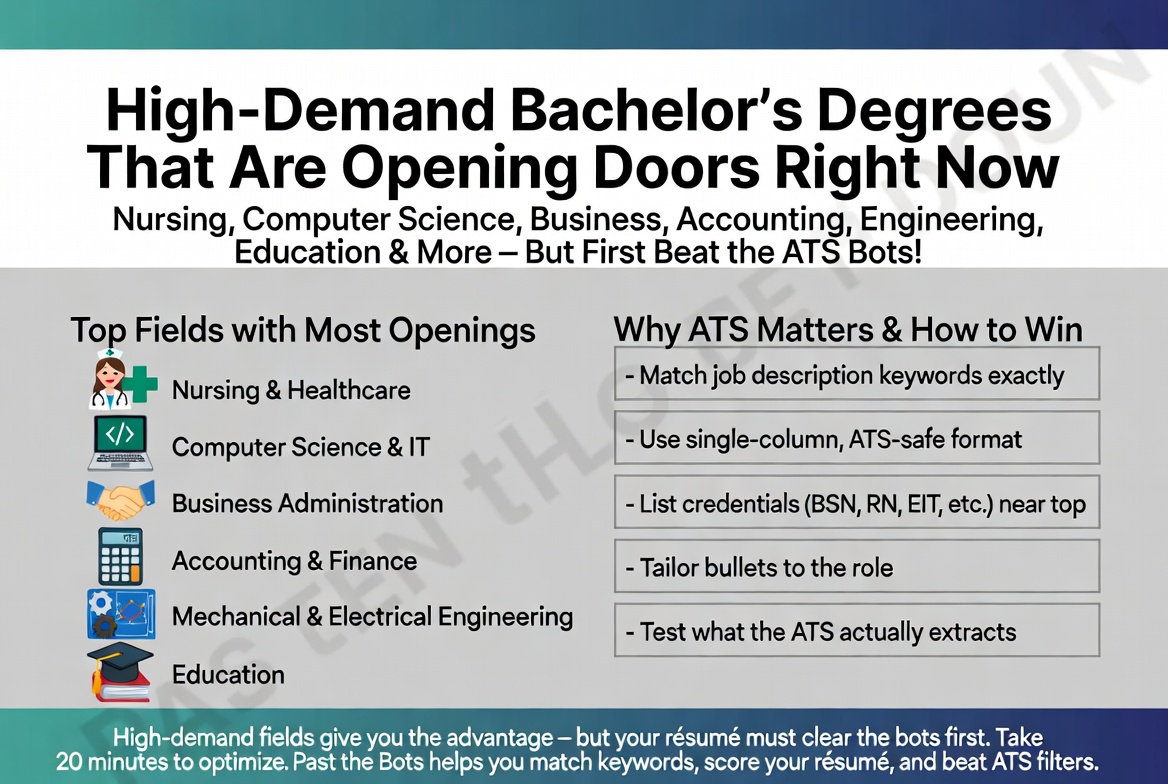 If you recently graduated or are thinking about your next move, there's good news: certain bachelor's degrees are opening doors to a lot of jobs right now. According to recent data, the highest-demand fields include nursing, computer science, business administration, accounting, mechanical engineering, and education, among others. These aren't just popular majors. They're fields where employers are actively posting openings and struggling to fill roles.
But here's the catch most job seekers don't talk about: having the right degree doesn't guarantee your résumé gets seen. Before a recruiter ever reads your name, an Applicant Tracking System (ATS) has already scanned, parsed, and ranked your application. If your résumé isn't formatted and worded in a way the ATS can read, it doesn't matter how qualified you are.
Let's break down what's in demand and what you can do to make sure your résumé actually clears the bots.
The Degrees With the Most Job Openings
Based on current hiring data, these fields are seeing the highest volume of open positions for bachelor's degree holders:
- Nursing and healthcare (registered nurses, healthcare administrators)
- Computer science and IT (software developers, cybersecurity analysts, data analysts)
- Business administration (operations managers, project managers, business analysts)
- Accounting and finance (accountants, financial analysts, auditors)
- Mechanical and electrical engineering (product designers, systems engineers)
- Education (teachers, instructional coordinators)
- Marketing and communications (digital marketers, content strategists)
If your degree falls into one of these categories, you're in a strong position. There are real jobs out there. The challenge is making sure you show up in the right searches and score well when an ATS evaluates your résumé against a job description.
Why ATS Scanning Is Especially Important in High-Volume Fields
The more job openings there are in a field, the more applications employers receive. Nursing, tech, and business roles at well-known companies can attract hundreds of applicants for a single position. That's exactly why ATS filtering is so aggressive in these industries.
ATS software doesn't just look for your degree. It scans for specific keywords, section headers, job titles, certifications, and skills that match what the employer is looking for. If your résumé uses different language than the job posting, even slightly, you can score lower than a less-qualified candidate who happened to mirror the right terms.
For example, a computer science graduate applying to a data analyst role might list "Python scripting" on their résumé when the job posting says "Python programming." A human would see those as identical. Many ATS systems won't.
How to Make Your Résumé Work in High-Demand Fields
Match the language in the job description exactly. Pull the job posting and compare it word for word with your résumé. If they say "cross-functional collaboration" and you say "worked with different teams," consider updating your language. Tools like the job match feature in Past the Bots show you exactly which keywords are present, which are missing, and which gaps could knock you out of consideration entirely.
List your credentials clearly and early. If you're a nurse with a BSN or RN license, or an engineer with an EIT certification, those need to be visible near the top of your résumé. ATS systems are specifically hunting for credentials in healthcare and engineering roles.
Use a clean, single-column format. Tables, text boxes, headers in the page margin, and two-column layouts often confuse ATS parsers. What looks polished in Word can become a jumbled mess when an ATS tries to read it. An ATS-safe format puts everything in a simple, linear flow the parser can actually follow.
Check what the ATS actually extracts from your résumé. This is something most job seekers never do. You can upload your résumé and see exactly what information an ATS pulls out: your name, contact details, job titles, skills, and education. If something important isn't being extracted correctly, you'll want to know before you've already applied to 30 jobs.
Tailor your bullets to each role without making things up. This is where a lot of people get stuck. Tailoring feels time-consuming and uncomfortable. But there's a real difference between fabricating experience and reframing what you actually did using language that fits the role. If you managed a team budget as part of a student project, that's relevant experience for a business analyst role. It just needs to be framed correctly.
The Bottom Line
Being in a high-demand field is a genuine advantage. Employers need people with your background. But the path from application to interview still runs through the ATS, and a lot of strong candidates get filtered out before anyone reads a single word they wrote.
Take an extra 20 minutes before you hit submit. Check your keywords, verify your formatting, and make sure the ATS can actually read what you've written. That's often the difference between a callback and silence.