The Executive Assistant Role Is Evolving Fast — Here's How to Make Sure Your Résumé Keeps Up
June 28, 2026 · 4 min read · Past the Bots
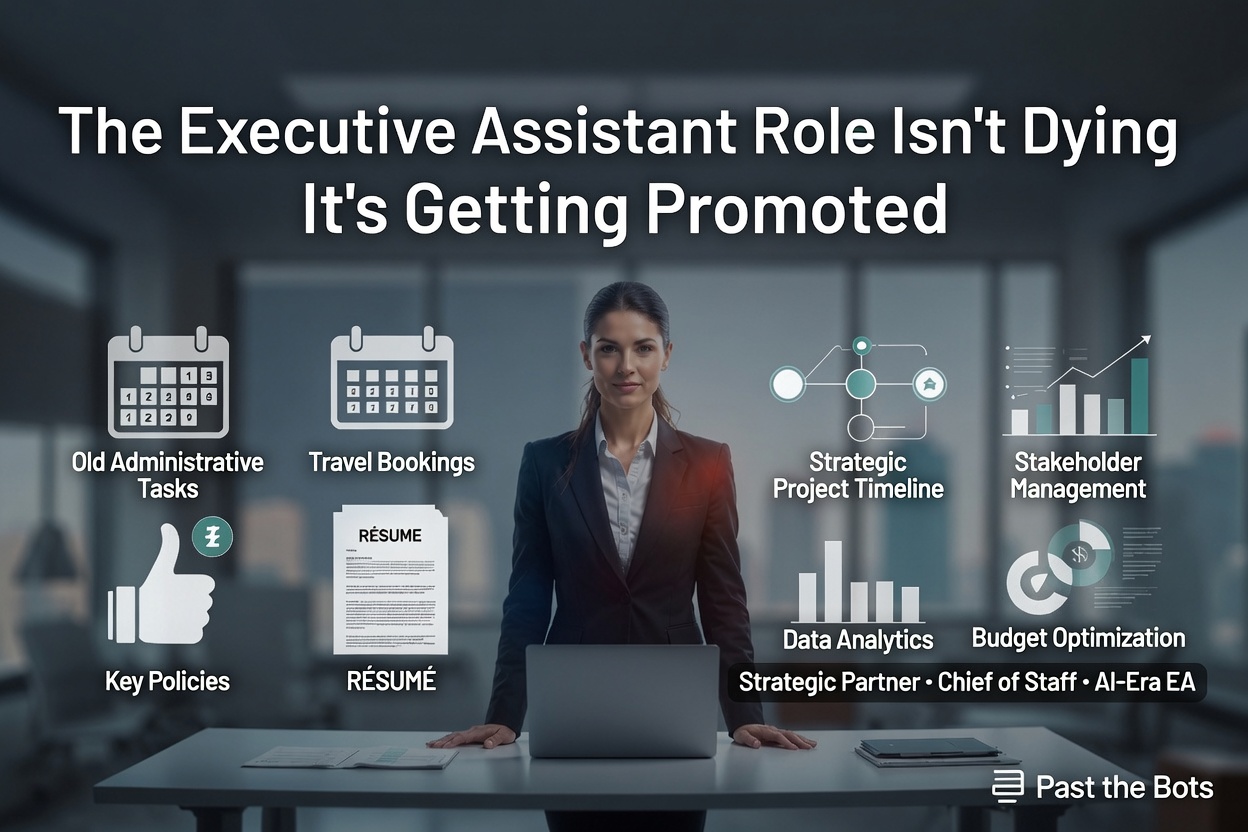 If you've been following the conversation around AI and administrative roles, you've probably seen some version of the headline: Is the executive assistant job disappearing? The short answer, according to a recent piece from MSN, is no. The longer answer is more interesting: the EA role isn't dying, it's being promoted.
What's happening is a real shift. As AI tools absorb the purely transactional parts of the job (calendar scheduling, travel booking, inbox triage), the executives who still want dedicated support are looking for something different. They want strategic partners. Chiefs of Staff. Operations leads who also happen to know how the boss thinks.
That's genuinely good news if you're an experienced EA. But it creates a specific résumé problem you need to solve before you apply anywhere.
The Skills Are There. The Résumé Might Not Show It.
Here's what we see constantly with EA résumés: the person has done real, high-level work, but their bullets read like a job description from 2012.
- "Managed calendars for C-suite executives"
- "Coordinated travel arrangements"
- "Prepared meeting agendas and took minutes"
None of that is wrong. But none of it signals strategic partner to a hiring manager or, more importantly, to the ATS that screens résumés before a human ever sees them.
The elevated EA roles being posted right now use different language. They're asking for things like stakeholder management, cross-functional project coordination, budget oversight, executive communications, and operational efficiency. If those exact phrases aren't on your résumé, you may be getting filtered out before anyone reads a single bullet.
What ATS Systems Are Actually Looking For
Applicant tracking systems don't read your résumé the way a person does. They extract keywords and compare them against what the job description prioritized. A 15-year EA with incredible experience can score lower than a less-qualified candidate whose résumé just happens to mirror the job posting's language more closely.
This is where running your résumé through an ATS scan becomes genuinely useful, not just a feel-good exercise. When you paste in a job description for a Senior Executive Assistant, Chief of Staff, or Executive Operations Manager role, a good scan will show you exactly which skills are showing up as matched versus missing. It'll flag whether your contact info is being parsed correctly, whether your section headers are readable, and whether the keywords that matter to that specific role are present in your document.
With Past the Bots, you get a skill-weighted match score that shows matched keywords, missing keywords, and any knockout gaps, the must-have qualifications where your résumé goes silent. For EA roles right now, those knockout gaps are often things like project management, budget management, or specific tools like Asana, Notion, or Salesforce that you may actually use but haven't thought to mention.
Rewriting Bullets Without Fabricating Anything
The goal isn't to pretend you've done things you haven't. It's to describe what you have done in language that reflects its actual scope.
"Managed calendars for three C-suite executives" might more accurately be written as "Optimized scheduling and time allocation for three C-suite executives across 200+ stakeholders, reducing scheduling conflicts by 30%." If that's true, say it that way.
This is exactly what AI tailoring is designed to help with. You paste in your existing résumé and the job description, and the tool rewrites your bullets to match the role's language and emphasis, without inventing experience. It surfaces the parts of your background that are most relevant and helps you say them more precisely.
For EAs specifically, this often means surfacing things like:
- Budget or vendor management you handled but buried in a vague bullet
- Process improvements you drove that you described as routine admin
- Cross-departmental projects you coordinated that you undersold as "supporting" someone else
The Title Problem Is Real Too
One more thing worth knowing: ATS systems use your job title as a signal. If you're applying for a Chief of Staff role but your title has always been "Executive Assistant," some systems will down-rank you before your bullets are even parsed.
You can't change your official title, but you can add a professional headline at the top of your résumé that bridges the gap. Something like "Executive Assistant | Strategic Operations & Chief of Staff Functions" tells both the parser and the human reader that you're positioning for the next level.
The Opportunity Is Real If Your Résumé Reflects It
The EA role isn't going away. It's getting more interesting, better compensated, and more strategically visible. But the hiring process for these elevated roles is competitive, and many of the best candidates are losing out at the screening stage simply because their résumé language hasn't caught up with their actual experience.
That's a fixable problem. Start by auditing how your current résumé reads against the specific roles you want, and then close the gaps.