The Hourglass Job Market Is Back: What It Means for Entry-Level and Senior Job Seekers Right Now
June 16, 2026 · 4 min read · Past the Bots
Hiring Is Growing, But Not Evenly
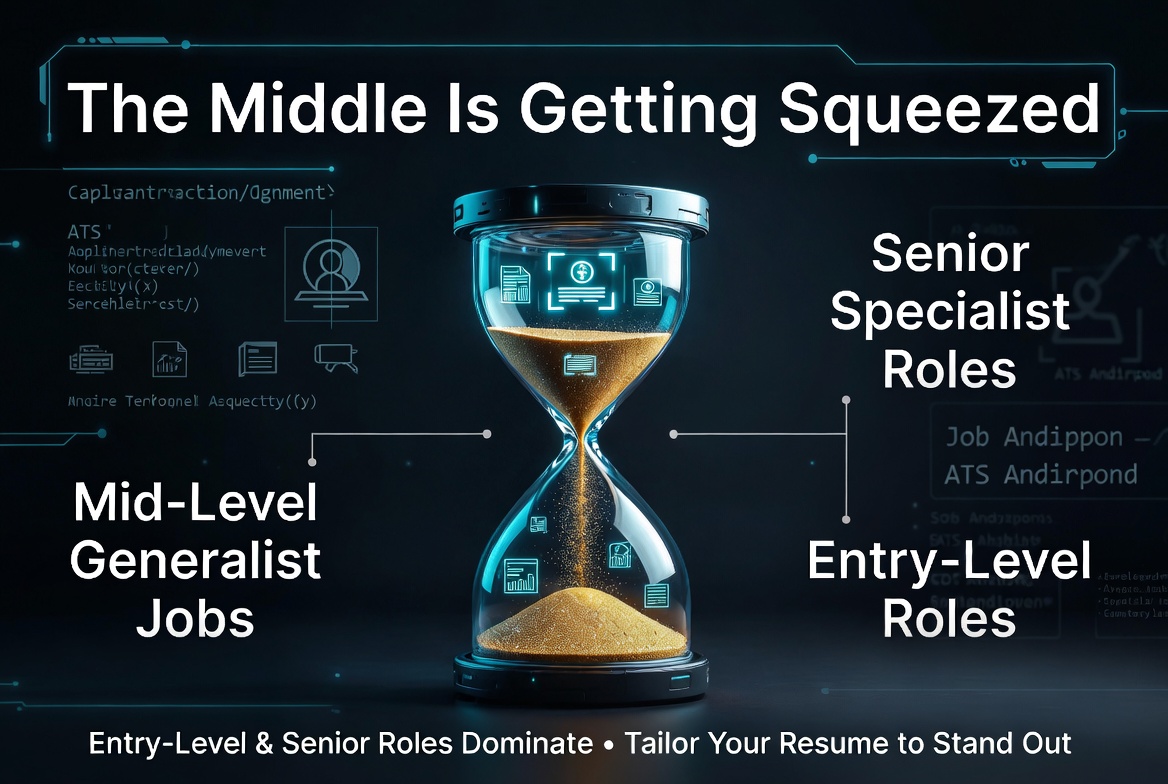
If your job search has felt frustrating lately, there's actually some good news worth paying attention to. According to recent reporting, employers are ramping up hiring at two distinct levels: entry-level and senior roles. The middle is still sluggish, but the ends of the experience spectrum are seeing real momentum.
This kind of "hourglass" hiring pattern happens when companies need to build foundational capacity while also bringing in seasoned leadership to guide strategy. For job seekers, that means opportunity, but only if your résumé speaks directly to the level you're targeting.
And that's where a lot of people get tripped up, especially with automated screening systems standing between your application and an actual human being.
Why This Market Shape Matters for Your Résumé
When companies are hiring at the extremes of the experience ladder, they tend to be very specific about what they want. Entry-level roles often have rigid keyword requirements tied to coursework, certifications, or tools. Senior roles lean heavily on demonstrated outcomes, leadership scope, and industry-specific language.
Applicant Tracking Systems (ATS) are configured to filter for exactly those signals. If your résumé doesn't reflect the right language for your target level, it can get screened out before anyone reads it, no matter how qualified you actually are.
Here's what that looks like in practice:
- Entry-level candidates sometimes write résumés that are too vague ("helped with projects") or that bury relevant skills like programming languages, tools, or coursework under generic descriptions.
- Senior professionals sometimes write résumés that read like a job history rather than a record of impact, missing the specific keywords a system is scanning for at that level.
Both groups lose to the bots for different reasons.
What Entry-Level Candidates Should Do Right Now
If you're early in your career, the competition for those open entry-level spots is real. You need your résumé to surface every relevant skill, even if it came from a class, a side project, or an internship.
Be explicit about tools and technologies. Don't assume an ATS will infer that you know Excel because you listed a finance course. Name the tools. Name the platforms. Name the certifications.
Running your résumé through a tool like the ATS scan in Past the Bots will show you exactly what a system is actually extracting from your document. Sometimes it's less than you think. You might have listed Python three times, but if your formatting is off, the parser might only catch it once, or miss it entirely.
The skill-match feature is especially useful here. Paste in a job description and see which keywords you're hitting and which ones you're missing. That gap list is your to-do list for tailoring.
What Senior Candidates Should Do Right Now
For experienced professionals, the challenge is often the opposite: your résumé is dense with history but light on the signals a modern ATS is tuned to find.
A few things worth checking:
- Are your section headers ATS-standard? Unusual headers like "Where I've Been" instead of "Work Experience" can cause parsers to misread or ignore entire sections.
- Are you using the exact language from job postings? Senior roles often have specific terminology around scope, like "P&L ownership," "cross-functional leadership," or "enterprise accounts." If the posting uses those phrases and your résumé doesn't, you may not score well on a keyword match even if you've done all of that work.
- Are your bullets outcome-focused? Quantified results matter at the senior level. "Managed a team" is a lot weaker than "Led a 12-person team that reduced time-to-hire by 30%."
The AI tailoring feature in Past the Bots can help you rewrite bullets to match the language of a specific job description without inventing experience you don't have. It's a good way to close keyword gaps quickly and honestly.
The Bigger Picture
A recovering job market is genuinely good news, but it also means more applicants competing for the same openings. ATS screening doesn't go away when hiring picks up. If anything, higher application volume makes automated filtering more aggressive.
The job seekers who move fastest through the process are the ones whose résumés are optimized for the systems they're going through, not just readable to a human. Knowing exactly what an ATS sees, where the gaps are, and how to close them is a real advantage right now.
Whether you're just starting out or you're a senior professional ready for your next leadership role, this market has room for you. The question is whether your résumé makes it obvious.