The Most Common Job in Your State Might Be Harder to Land Than You Think
June 9, 2026 · 4 min read · Past the Bots
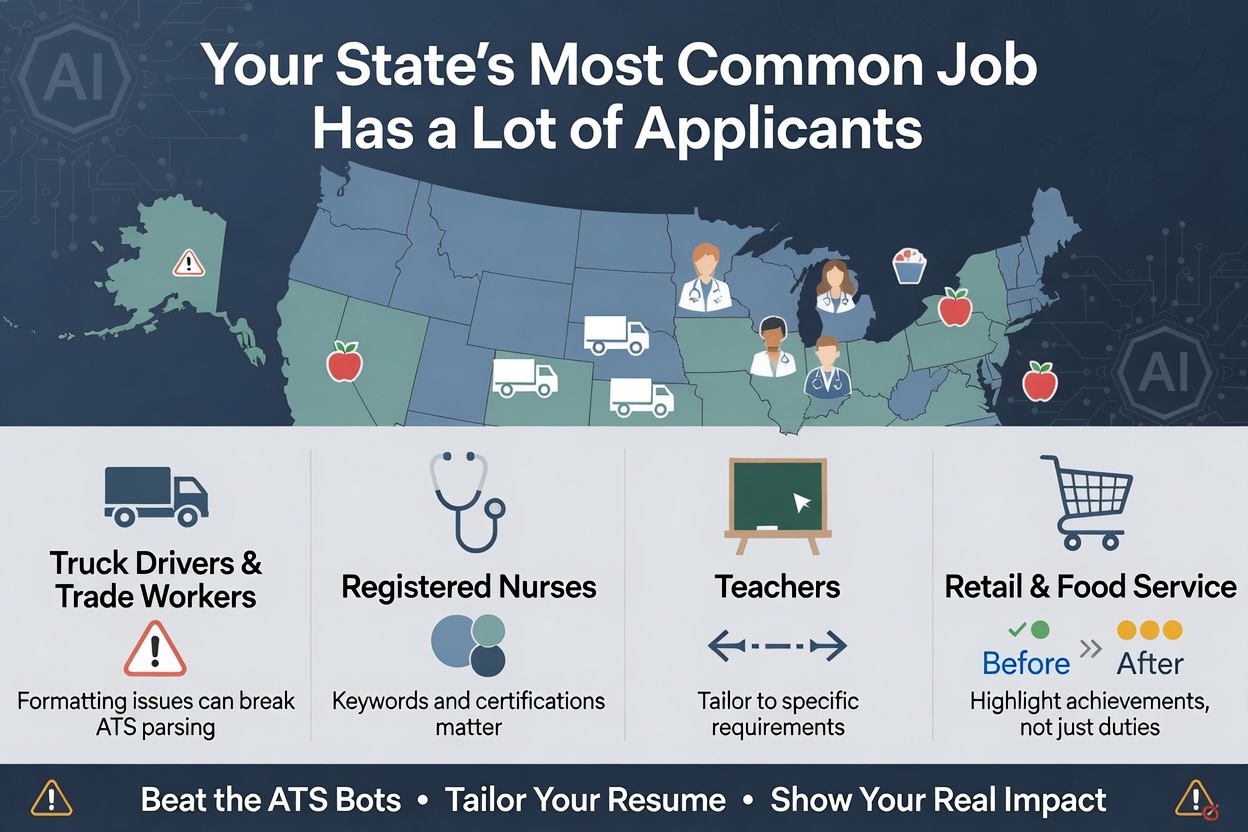
Your State's Most Common Job Has a Lot of Applicants
A recent map making the rounds shows the most common job in every U.S. state. Truck drivers dominate across a huge swath of the middle of the country. Registered nurses are the top job in several states. Fast food workers, retail workers, and teachers round out a lot of the rest.
At first glance, that might feel reassuring if you're in one of those fields. There are tons of these jobs, so I should be fine, right?
Not quite. The most common jobs are also the most applied-for jobs. And when hundreds of people are submitting resumes for the same role, employers lean hard on Applicant Tracking Systems (ATS) to filter the pile before a human ever looks. That means your resume has to get past the bots before it gets in front of a person.
Here's what that actually looks like in practice for a few of the most common job categories, and what you can do about it.
Truck Drivers and Trade Workers: Don't Let Formatting Kill You
CDL drivers, warehouse workers, and skilled tradespeople often build resumes that look great printed out but fall apart when an ATS tries to read them. Tables, columns, logos, and headers placed in text boxes are all common culprits.
When a parser can't read your resume correctly, your name might end up in the skills field, or your endorsements might disappear entirely. You could be fully qualified and completely invisible.
What to do: Run your resume through an ATS scan that shows you exactly what gets extracted, including your name, contact info, skills, and section headers. If the parser is mangling your information, a clean single-column rebuild can fix that without stripping out any of your actual experience.
Registered Nurses and Healthcare Workers: Keywords Are Everything
Healthcare job postings are dense with specific terminology. EMR systems, certifications, specialties, unit types. An ATS is often looking for exact or near-exact matches to those terms before a recruiter ever reads a word.
If your resume says "electronic health records" and the job posting says "Epic," that might not match. If you have ACLS certification but never wrote it out, you might score lower than a less experienced candidate who happened to use the right abbreviations.
What to do: Paste the job description into a skill-matching tool that shows you specifically which keywords are present in your resume, which ones are missing, and which missing ones are likely knockout factors. Then add the missing terms where they honestly reflect your experience. Don't invent skills, but do make sure the skills you actually have are named the way the employer named them.
Teachers and Education Workers: Tailor Every Application
Teaching resumes are tricky because the job title sounds generic but the requirements are highly specific. A district hiring a 4th grade math teacher and a district hiring a high school AP Chemistry teacher both posted a "Teacher" role, but the ATS filters are completely different.
A resume that works for one posting may score poorly on another, even if you're genuinely qualified for both.
What to do: AI tailoring tools can rewrite your bullet points to better reflect the language of a specific job description without fabricating experience. The goal is to surface what you actually did in terms that align with what this particular employer is looking for. It's not spin, it's translation.
Retail and Food Service Workers: You Have More Skills Than You Think
This is one of the most underserved groups when it comes to resume help. Retail and food service resumes often undersell transferable skills because people write what they did rather than the impact of what they did.
"Operated cash register" is not the same as "Processed 100+ transactions per shift with zero cash handling errors." Both are true. Only one gets attention.
What to do: Look at your bullets critically and ask whether they show what you accomplished, not just what your job duties were. Strong action verbs and measurable details make a difference even in entry-level applications.
The Common Thread
Whether you're a CDL driver in Texas, an RN in California, a teacher in New York, or a retail associate anywhere in between, the hiring process starts the same way: a bot reads your resume before a person does.
Understanding what those bots actually extract from your resume, how well your skills match the specific job you're applying for, and whether your formatting is working for you or against you, is the difference between getting filtered out and getting the interview.
The most common job in your state is worth applying for. Just make sure your resume is ready for the competition.