The One-Page Résumé Rule Is Dead. Here's What Actually Gets You Hired.
July 4, 2026 · 4 min read · Past the Bots
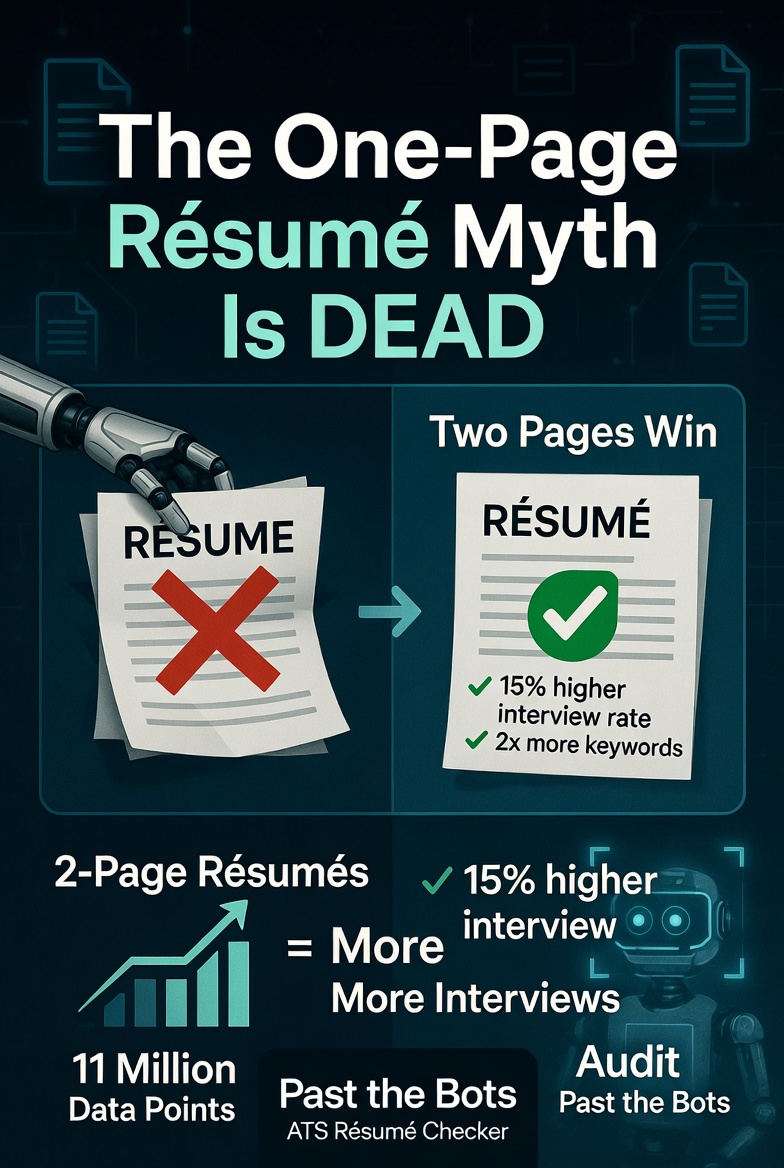 You've heard it a thousand times: keep your résumé to one page. Hiring managers are busy, attention spans are short, blah blah blah. It's practically career-advice gospel.
Except it's wrong. And now there's hard data to prove it.
What the Research Actually Found
A large-scale study analyzing more than 11 million data points looked at résumé length and callback rates across industries and experience levels. The takeaway? Two-page résumés consistently outperformed one-pagers, even for early-career candidates. Candidates who used two pages got more interviews, full stop.
Why? Because more relevant content gives both the ATS and the human reviewer more signal to work with. A one-page résumé that's artificially compressed often strips out exactly the keywords, accomplishments, and context that get you noticed in the first place.
This matters a lot more than most people realize, because the first reader of your résumé usually isn't a human at all.
The ATS Problem Nobody Talks About
Before a recruiter ever sees your résumé, an Applicant Tracking System parses it. That system is looking for specific things: your contact information, your job titles, your dates, your skills, and keywords that match the open role. If your résumé is too sparse, there simply isn't enough for the system to grab onto.
Here's where the one-page myth does real damage. When candidates cram everything onto a single page, they typically:
- Cut skills sections to save space, removing the exact keywords the ATS is scanning for
- Trim bullet points down to vague one-liners that don't include measurable results or relevant context
- Drop older but relevant experience that might contain important industry terms
- Use tiny fonts and narrow margins that some parsers struggle to read correctly
None of that helps you. It just makes you invisible.
More Space Doesn't Mean More Words. It Means More Signal.
The research isn't saying you should pad your résumé with filler. The candidates who benefited from two pages weren't writing longer for the sake of it. They had room to be specific.
Specificity is what wins in both ATS screening and human review. Compare these two bullets:
- Weak: Managed social media accounts and grew following.
- Strong: Grew LinkedIn following from 4,200 to 31,000 in 14 months by launching a weekly video series tied to product launches.
The second version is longer. It's also dramatically better. It has metrics, it has context, and it contains terms a recruiter or ATS would actually search for.
If your résumé is artificially short, you're probably full of bullets like the first one.
How to Know If Your Résumé Is Missing the Mark
The honest answer is: you probably can't tell just by looking at it. You're too close to it. And more importantly, you can't see how an ATS is parsing it.
This is exactly what the Audit the Bots tool on Past the Bots is built to show you. You upload your résumé and it shows you what different parsers actually extract: your name, contact info, job titles, skills, and section headers. If a parser is misreading your dates, scrambling your job titles, or completely missing your skills section, you'll see it right there.
From there, the ATS scan flags critical issues, warnings, and things that are fine, so you know what to fix first. Then the skill-weighted match score compares your résumé against a specific job description and shows you which keywords you're hitting, which ones you're missing, and whether you have any knockout gaps that would filter you out automatically.
That last part is crucial. A two-page résumé filled with the wrong keywords still won't get you through. You need the right content and enough of it.
The Practical Takeaway
If you've been agonizing over cutting your résumé to one page, stop. Here's what to focus on instead:
- Use two pages if you need them. The data supports it. Don't compress good content just to hit an arbitrary length.
- Every bullet should earn its spot. More space isn't a license to be vague. Get specific with numbers, tools, and outcomes.
- Tailor to the job description. Length means nothing if you're not matching the keywords the ATS is screening for.
- Check how it parses. You can write a great résumé that an ATS completely scrambles because of formatting issues. Verify it.
The one-page rule was never based on evidence. Now we have 11 million data points saying so. Give yourself room to tell your actual story, make sure the robots can read it, and then make sure it's saying the right things for the job you want.