The Real Reason Your Resume Isn't Getting Callbacks (And It's Not What You Think)
June 23, 2026 · 4 min read · Past the Bots
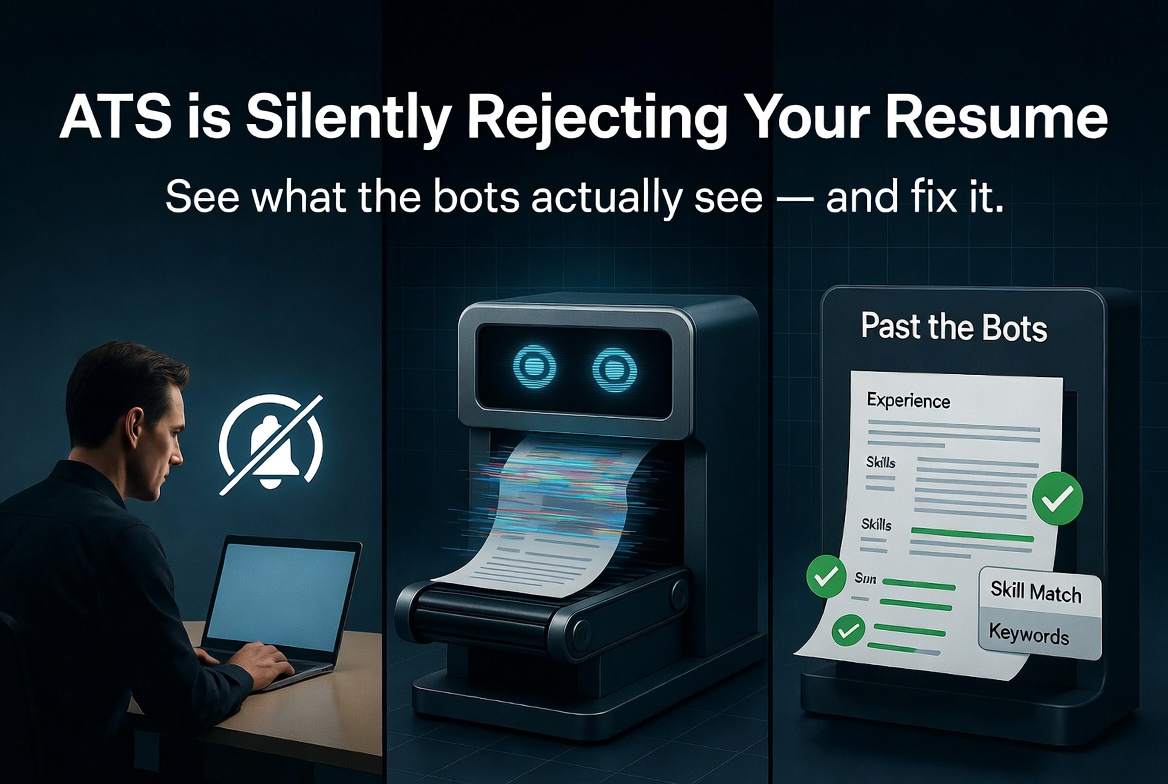 You've applied to dozens of jobs. You're qualified. Your resume looks clean and professional. And yet -- silence.
Before you start second-guessing your experience or rewriting your entire career story from scratch, consider this: the problem might not be your qualifications at all. It might be that the Applicant Tracking System (ATS) scanning your resume is quietly mangling it before any human gets a look.
How Applicant Tracking Systems Actually Work
Most mid-size and large employers use ATS software to manage the flood of applications they receive. These systems don't read your resume the way a recruiter does. They parse it -- pulling out your name, contact info, job titles, dates, skills, and section headers -- and then rank or filter candidates based on what they extract.
The catch? Different ATS platforms parse differently. A two-column layout that looks sharp in Word might spit out garbled text in one system. A skills section buried in a sidebar might get skipped entirely in another. Headers like "Core Competencies" or "What I Bring" might confuse a parser that's looking for something it recognizes as a skills section.
When the system can't read your resume cleanly, you get filtered out -- not because you're underqualified, but because the software couldn't figure out that you were qualified.
The Formatting Traps That Catch People Off Guard
A few of the most common formatting mistakes that hurt ATS readability:
- Tables and text boxes. They look organized but most parsers either skip the content inside or scramble it completely.
- Headers and footers. Contact information tucked into a Word header is often invisible to ATS software.
- Graphics, logos, and icons. These add zero value to a parser and can interrupt how the rest of your document is read.
- Unusual section titles. "My Journey" doesn't register the same way "Work Experience" does.
- Multi-column layouts. Many parsers read left to right, top to bottom -- so a two-column format often gets read in the wrong order.
The frustrating part is that none of these mistakes feel like mistakes when you're looking at your resume on screen. They look good. That's exactly why so many qualified candidates keep getting filtered out without knowing why.
Keywords Matter -- But Context Matters More
Beyond formatting, ATS systems also scan for keywords that match the job description. If a job posting asks for "project management" and your resume says "led cross-functional initiatives," some systems won't make that connection.
This doesn't mean you should stuff your resume with every keyword from the job description. That approach tends to backfire -- either the system flags it as keyword padding, or a recruiter notices immediately that the language doesn't feel authentic.
The smarter move is to mirror the specific language from the job posting where your experience genuinely matches, and make sure those terms appear in the right context (inside a job bullet, not just in a standalone skills list at the bottom).
How to Actually Know If Your Resume Has a Problem
Guessing is frustrating. The better approach is to see exactly what an ATS extracts from your resume before you apply.
That's the core idea behind Past the Bots. You upload your resume and get a concrete look at what different parsers actually pull out -- your name, contact details, job titles, skills, dates, and section structure. Instead of wondering whether your formatting is hurting you, you can see it directly.
The scan flags issues as critical, warning, or OK, so you know what to fix first. From there, you can paste in a job description and get a skill-weighted match score showing which keywords you're hitting, which you're missing, and whether there are any knockout gaps -- requirements the employer likely treats as non-negotiable.
If your resume needs a rebuild, there's an ATS-safe single-column format that strips out the formatting risks without making your resume look generic. And if your bullets need to be rewritten to better reflect a specific role, the AI tailoring tool rewrites them to match the job -- without inventing experience you don't have.
The Bottom Line
Applying to jobs is already hard. Don't let a fixable formatting issue or a missing keyword be the reason you don't get the callback.
Before you hit submit on your next application, take ten minutes to actually check what the ATS sees. You might be surprised how much of your resume isn't coming through the way you think it is -- and how straightforward the fixes are once you know what you're dealing with.