The Skills Gap Is Real — Here's How Recruiters Can Actually Close It
July 6, 2026 · 4 min read · Past the Bots
Why Recruiters Keep Missing Qualified Candidates
There's a frustrating paradox happening in hiring right now. Recruiters say they can't find candidates with the right skills. Job seekers say they can't get past the first screening. Both sides are telling the truth.
A recent look at the small business hiring landscape highlights something that bigger companies deal with just as much: the skills gap isn't always about a shortage of talent. A lot of the time, it's about a matching problem. Qualified candidates exist, but the process of identifying them is broken.
Here's what's going wrong, and what you can actually do about it.
The ATS Isn't Finding the Right People -- It's Just Finding the Right Words
Applicant Tracking Systems were built to help recruiters manage volume. And they do that. But they're surprisingly bad at understanding what a candidate actually knows how to do.
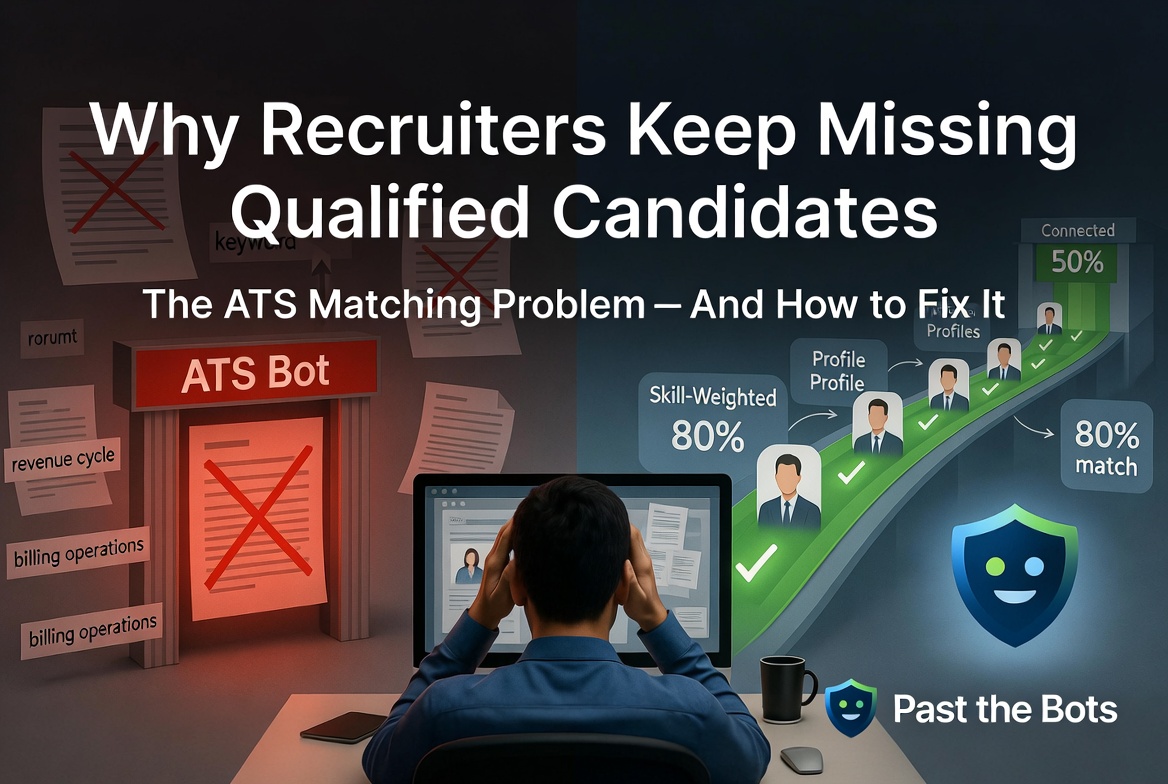
ATS parsers look for keywords. If a candidate calls something "revenue cycle management" and your job description says "billing operations," the system may not connect those dots. The candidate gets filtered out before a human ever sees them.
This is the core of the matching problem. It's not that skilled people aren't applying. It's that the language on their résumé doesn't perfectly mirror the language in your job posting, and the bot penalizes them for it.
The fix isn't to make candidates jump through more hoops. The fix is to get smarter about what your ATS is actually reading.
What Recruiters Can Do Differently
If you're responsible for filling roles, here are some concrete things worth doing:
Audit your own job descriptions. Overly long lists of "required" skills drive away good candidates who assume they won't qualify. Research consistently shows that women in particular tend to apply only when they meet nearly all listed requirements. Trim the must-haves down to the actual must-haves.
Think about synonyms and alternate terms. If your ATS is scanning for "project management," candidates who write "program coordination" or "initiative leadership" may get missed. Build flexibility into your screening criteria wherever possible.
Stop relying entirely on keyword matching for early screening. A skills-weighted match score is more useful than a raw keyword count. If a candidate matches 80% of your core skills but is missing two nice-to-haves, that's a very different situation than a candidate who matches 40% of everything.
Look at what the ATS is actually extracting. Most recruiters never see what the system pulls from a résumé. Contact info that doesn't parse correctly, skills that get dropped, section headers the bot can't read -- these are quiet errors that filter out real candidates for no good reason.
How Past the Bots Fits Into the Recruiter's Workflow
Past the Bots was built with job seekers in mind, but the same tools that help candidates understand how they're being read can help recruiters understand what they're actually screening.
The Audit the Bots feature shows exactly how different parsers read a résumé -- what gets extracted, what gets dropped, and where the gaps are. If you're reviewing a candidate and something feels off, this can tell you whether their résumé just wasn't structured in a way your ATS could handle -- not that they lack the skills.
The skill-weighted match score compares a résumé against a job description and surfaces matched keywords, missing keywords, and knockout gaps. For recruiters, this means you can see at a glance whether a candidate is genuinely misaligned or just using slightly different terminology.
And the talent profile feature gives candidates a structured, searchable presence that makes it easier for recruiters using the platform to find people whose skills actually match what they're hiring for -- not just people who happened to use the exact right words.
The Bigger Picture
The skills gap conversation tends to focus on education and training pipelines. Those are real issues. But a significant chunk of the problem is operational. Companies are using blunt tools to make fine-grained decisions, and qualified candidates are falling through the cracks as a result.
The good news is that this part of the problem is solvable. Better tooling, more thoughtful job descriptions, and a clearer understanding of what your ATS is actually doing can meaningfully improve the quality of your candidate pool without requiring a massive overhaul of your entire hiring process.
Start by understanding what the bots are doing. Then you can decide whether to trust them.