What Happens After a Job Gets Posted Online (And How to Make Sure Your Résumé Survives It)
July 13, 2026 · 4 min read · Past the Bots
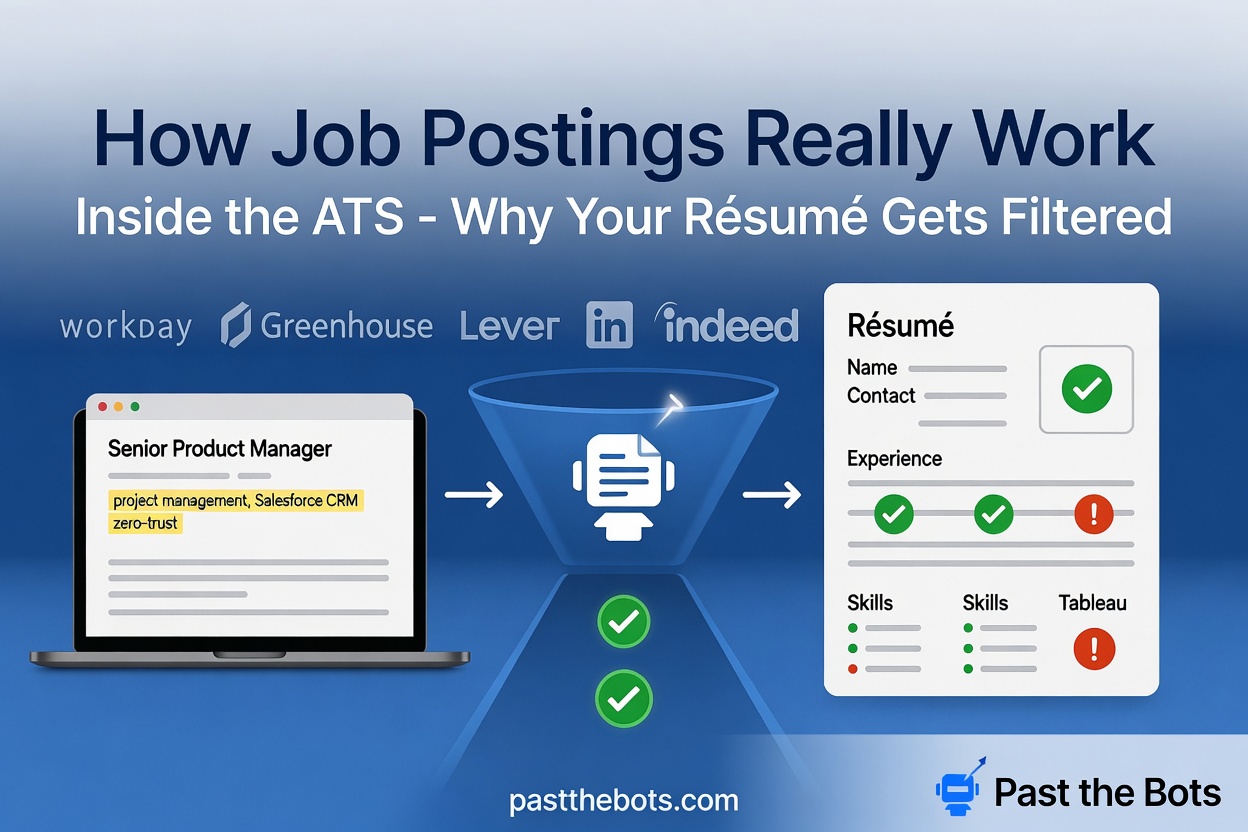 When a company decides to hire someone, they post the job online. Simple enough, right? But what happens on the backend of that posting is exactly why so many qualified candidates never hear back.
Understanding how job postings work from the employer's side gives you a real edge. Let's walk through it.
How Job Postings Actually Work
When a recruiter or hiring manager posts a job, they're usually working inside an Applicant Tracking System (ATS) like Greenhouse, Workday, Lever, or iCIMS. The job description gets published to the company's careers page and often syndicates out to job boards like Indeed, LinkedIn, and ZipRecruiter automatically.
Those job descriptions aren't just written for humans. They're structured around specific skills, titles, and requirements that the ATS is going to scan for when applications start rolling in. The recruiter often sets up filters and knockout questions at the same time they write the posting.
So before a single résumé lands in a human inbox, the ATS has already:
- Parsed every résumé into fields (name, contact info, work history, skills, education)
- Scored or ranked candidates based on keyword matches to the job description
- Filtered out applications that didn't meet minimum requirements
By the time a recruiter actually opens résumés, they're looking at a shortlist the software already curated.
Why Your Résumé Format Matters More Than You Think
Parsing is the step that trips people up most. The ATS doesn't read your résumé the way a person does. It's extracting structured data, and if your formatting confuses it, that data gets scrambled.
Common formatting problems that break parsing:
- Tables and text boxes — content inside them often gets skipped entirely
- Headers and footers — contact info placed there may never get extracted
- Fancy two-column layouts — columns get read left-to-right as one garbled line
- Graphics, icons, and logos — invisible to the parser
- Non-standard section headings — "Where I've Been" instead of "Work Experience" can confuse the system
This is why a clean, single-column résumé in a standard format consistently outperforms a visually elaborate one in ATS environments.
The Keyword Gap Problem
Here's something most job seekers don't realize: recruiters often write job descriptions using very specific language, and the ATS scores your résumé against that exact language.
If the job posting says "project management" and your résumé says "managed projects," those might not match. If they list "Salesforce CRM" and you wrote "CRM tools," you could score lower than a less experienced candidate who happened to use the exact term.
This isn't about gaming the system. It's about speaking the same language the job description uses, especially for skills you genuinely have.
A good approach:
- Read the job description carefully and highlight the skills and tools they mention
- Compare those against what's actually on your résumé
- Where there's a real match, update your language to reflect theirs
- Note any genuine gaps and decide whether they're dealbreakers or skills you can address in a cover letter
Past the Bots does this comparison automatically. Paste a job description and your résumé, and you get a skill-weighted match score showing exactly which keywords matched, which are missing, and which gaps might be disqualifying. It takes the guesswork out of the comparison.
What Recruiters See When They Open Your Application
Once you make it past the initial filter, a recruiter is typically looking at a parsed summary in the ATS, not your actual résumé file. They see what the system extracted: your name, contact info, a timeline of your experience, and a skills list.
If the parser misread your résumé, that summary looks incomplete or confusing, even if your actual file looks great.
Running your résumé through an ATS audit before you apply shows you exactly what gets extracted and what gets missed. The Audit the Bots tool on Past the Bots shows how different parsers read your résumé, flagging critical issues (like missing contact info), warnings (like unusual formatting), and things that are fine. It's the closest thing to seeing your résumé the way the ATS does.
The Practical Takeaway
Job postings are built inside systems designed to filter at scale. That's not cynical, it's just the reality of high-volume hiring. The good news is that once you understand how those systems work, you can format and tailor your résumé in ways that actually get you through.
Clean formatting, matched keywords, and a résumé that parses correctly aren't tricks. They're just table stakes for modern job applications.
Get those basics right and you're already ahead of a large chunk of your competition.