Why a 'Backwards' Career Move Might Be Your Smartest Next Step (And How to Make Your Résumé Agree)
July 8, 2026 · 4 min read · Past the Bots
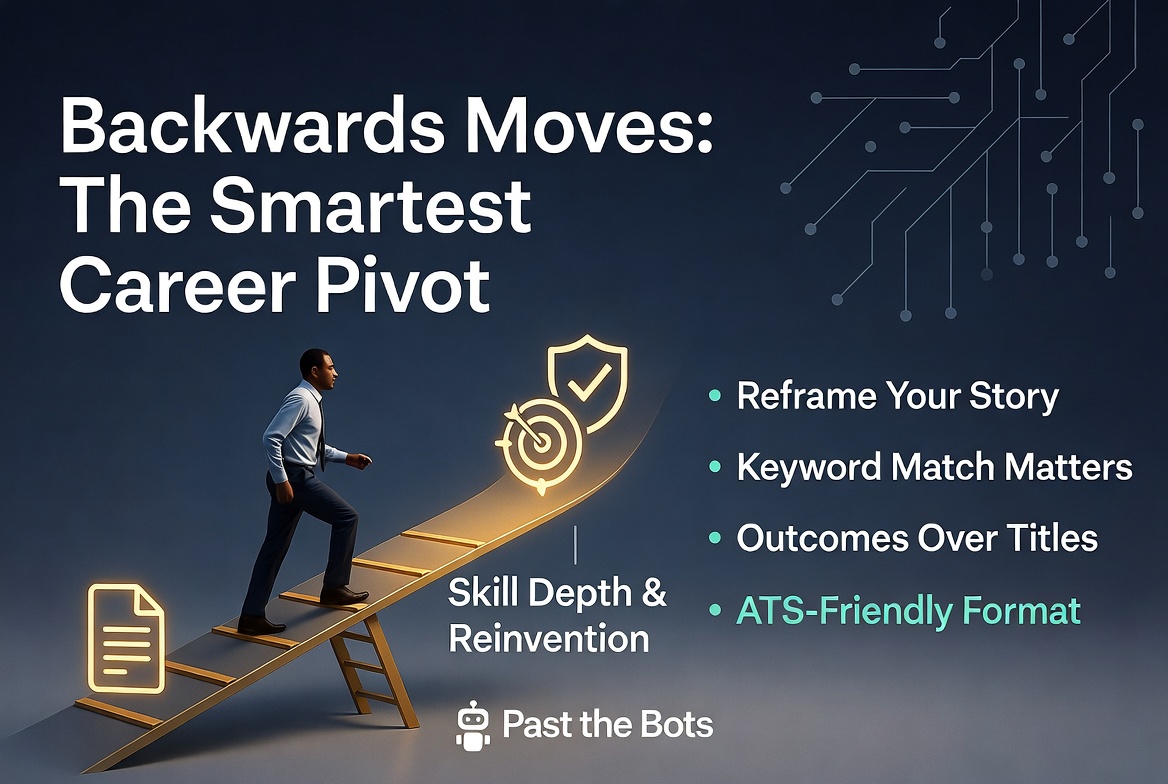 There's a growing conversation in the career world about so-called backwards moves: taking a lower title, shifting industries, or stepping away from a leadership role to go deep on a skill you actually care about. Leadership experts are calling it one of the smartest things you can do for long-term career health. The logic is simple: if you can't reinvent yourself, you get stuck.
But here's the part nobody talks about: your résumé wasn't built for reinvention. It was built to document a straight line upward. And the Applicant Tracking Systems that screen 75% of résumés before a human sees them? They're even less forgiving of anything that looks like a detour.
So how do you actually make a pivot work on paper?
First, Understand Why Pivots Get Filtered Out
ATS software isn't reading your résumé the way a thoughtful recruiter would. It's extracting keywords, matching job titles, and scoring your application against the skills listed in the job description. If you're a Senior Marketing Manager applying for a UX Research role because you've spent three years running user interviews and obsessing over customer behavior, the system doesn't see that story. It sees a title mismatch and a skills gap.
That's the core problem with career pivots and ATS screening: your experience is real, but the way it's packaged doesn't translate.
Reframe Before You Reapply
The fix isn't to pretend you have experience you don't. It's to surface the transferable experience you do have, in language that matches what the new role is actually asking for.
A few practical ways to do that:
- Audit your current résumé against the job description. Look at the skills and keywords in the posting and compare them to what's on your résumé. You'll quickly spot where the language doesn't line up even when the underlying experience does.
- Rewrite bullets around outcomes, not job functions. "Managed a team" is a job function. "Reduced onboarding time by 30% by redesigning the training process" is an outcome that signals capability regardless of your title.
- Lead with a strong summary section. ATS systems parse this near the top of your document. A clear, keyword-rich summary that names the role you're targeting and the relevant skills you bring can bridge a title gap before a human ever reads your bullets.
Tools like the résumé scanner on Past the Bots can show you exactly what an ATS pulls from your document, including which skills it detects, what it misses, and where your formatting might be causing sections to get mangled. That's worth knowing before you hit submit on a role that matters to you.
The Keyword Gap Is a Pivot Gap
When you're changing directions, the keyword match between your résumé and a job description is almost always going to be lower than it would be for a direct applicant. That's expected. The goal isn't to fake a perfect score. The goal is to close the gap on the skills you genuinely have but haven't named in the right language.
For example, if you're a teacher moving into corporate training and development, you have curriculum design, learning objectives, assessment, and stakeholder communication baked into everything you've done. But if your résumé says "developed lesson plans" instead of "designed learning experiences aligned to competency frameworks," an ATS scanning for L&D keywords is going to miss you entirely.
Running a skill-weighted match against the actual job description helps you see exactly which keywords are present, which are missing, and which gaps are likely dealbreakers. You can then make a clear decision: do I actually have this skill under a different name, or is this a real gap I need to address?
Don't Let ATS Formatting Kill Your Pivot Story
Pivot résumés often end up over-designed. People add color, graphics, and creative layouts to signal that they're bringing something different. Unfortunately, those design choices are exactly what causes ATS parsers to misread or skip sections entirely.
A clean, single-column format with standard section headers is still your safest bet for getting through screening. Save the personality for your cover letter and your interviews.
The Bigger Point
Taking a backwards or sideways career step is increasingly seen as a feature, not a bug. It signals self-awareness, adaptability, and the kind of long-term thinking that actually makes people good at their jobs. The challenge is that hiring systems weren't designed with reinvention in mind.
So your job is to translate your real story into language the bots understand, without losing what makes your pivot compelling to the human on the other side. That's a solvable problem. It just requires being deliberate about it.