Why Finding a New Job Is Harder Than Ever (And What You Can Do About It)
June 2, 2026 · 4 min read · Past the Bots
The Job Market Is Not in Your Head
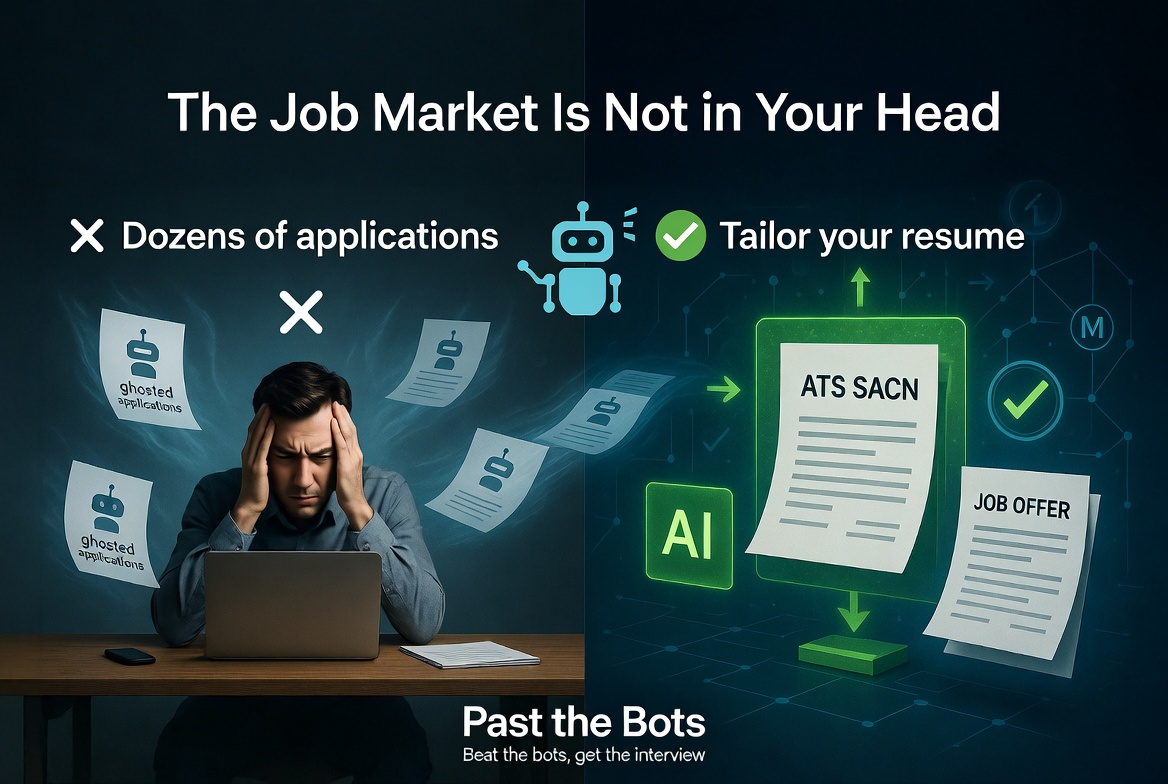
If your job search feels harder than it should, you are not imagining things. Hiring has slowed across a wide range of industries, and even well-qualified candidates are sending out dozens of applications without hearing back. According to recent reporting from CNN, job seekers are facing a convergence of pressures: a cautious hiring environment, longer decision timelines from employers, and fierce competition for the roles that do open up.
That context matters, because the strategies that worked in a hot market no longer cut it. Spraying out the same resume to fifty postings and hoping for the best is not a plan. It is a way to spend months feeling invisible.
So let's talk about what is actually happening, and what you can do differently.
Why Good Candidates Get Filtered Out Before a Human Reads Their Resume
Most mid-size and large employers use an Applicant Tracking System to handle the flood of applications. Before your resume ever lands on a recruiter's desk, software has already parsed it, extracted your information, and scored it against the job description.
The problem is that most resumes are not built for that process. They are built to look good on screen. Those are two very different things.
Here is what tends to go wrong:
- Formatting that breaks parsing. Tables, columns, headers and footers, text boxes, and fancy fonts can scramble an ATS. It may pull your job title into the wrong field, miss your contact information entirely, or fail to read whole sections.
- Missing keywords. ATS tools score your resume against the language in the job description. If the posting says "cross-functional collaboration" and your resume says "worked with multiple teams," you may score lower than a less experienced candidate who mirrored the exact phrasing.
- Knockout gaps. Some roles have hard requirements, like a specific certification or years of experience, that act as automatic filters. If those are missing or buried, you can be screened out before anyone reads your actual qualifications.
None of this is about being unqualified. It is about your resume not speaking the language the software is listening for.
What a Slow Hiring Market Demands From Job Seekers
When employers are being selective, the bar for getting a callback goes up. You cannot afford to lose points on presentation before your experience is even considered. A few things that matter more now than they did two years ago:
Tailoring is not optional anymore. Sending the same document to every job is no longer a viable strategy. Recruiters are reviewing fewer roles and have more time to evaluate each application. A generic resume reads as low effort, and a resume that does not reflect the job description will score poorly with the ATS before it even gets there.
Your contact and skills data need to be clean. ATS tools extract specific fields. If your phone number is in a header or your skills are buried in a styled sidebar, they may not get picked up. Something that small can cost you an interview.
The first filter is automated, but the second is human. Even after clearing the ATS, your resume has maybe six seconds of initial attention from a recruiter. Structure and clarity are not just nice to have.
A More Systematic Approach
The job seekers who are making progress right now are treating their search more like a project and less like a lottery. That means auditing what they are sending out, fixing real problems, and tailoring deliberately rather than broadly.
Past the Bots is built for exactly this. You can upload your resume and see what an ATS actually extracts from it, including whether your name, contact details, job titles, and skills are being read correctly or dropped. The scan flags issues by severity so you know what to fix first.
From there, you can paste in a job description and get a skill-weighted match score that shows you which keywords you have covered, which are missing, and whether there are any knockout gaps that would likely screen you out. The AI tailoring feature rewrites your bullets to better reflect the language of a specific role without inventing experience you do not have.
If your current resume has formatting problems, the ATS-safe rebuild tool converts it to a clean single-column structure that parsers can read reliably.
The Bottom Line
A difficult market means the margin for error on your application is smaller. A resume that would have gotten a callback in 2021 might be getting filtered out today for reasons you cannot see.
Understanding how the screening process works and fixing the problems in your resume is not gaming the system. It is making sure the work you have actually done gets a fair read. That is worth taking seriously.