Why Teens Are Striking Out on Summer Job Applications (And What to Do About It)
June 18, 2026 · 4 min read · Past the Bots
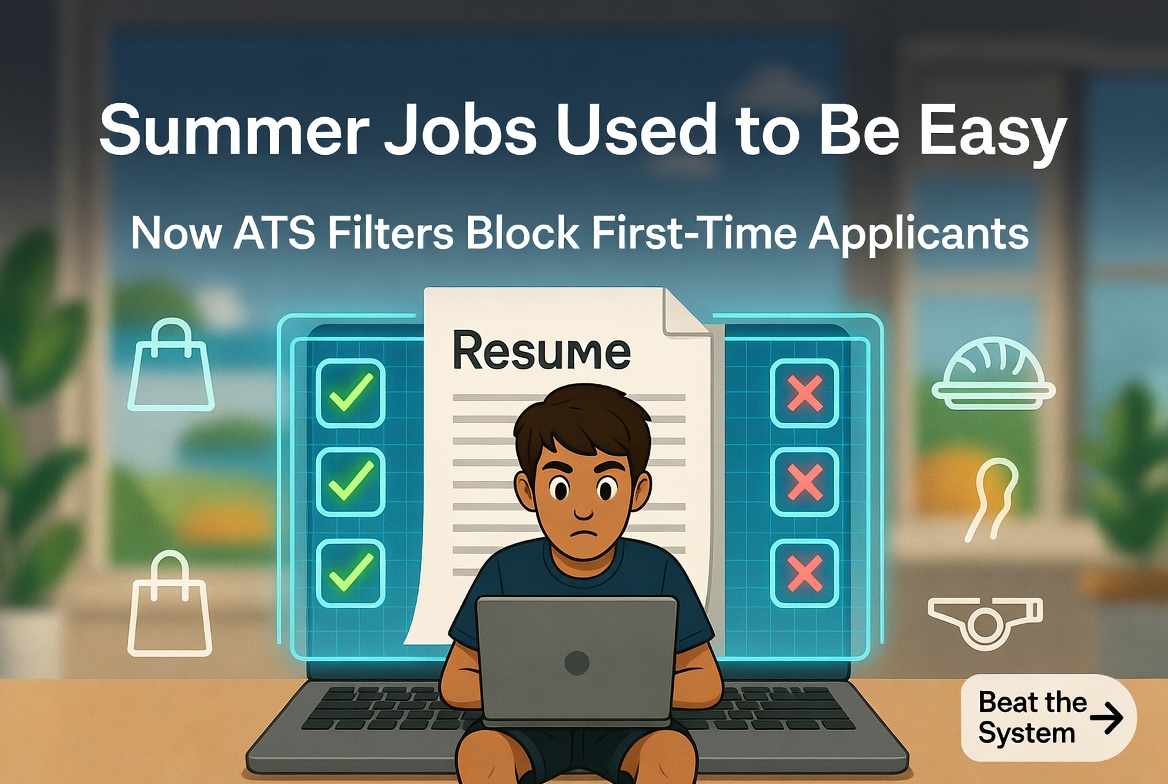 Summer used to feel like a pretty reliable time to pick up a first job. Retailers needed extra hands, restaurants were slammed, and a motivated teenager with open availability had a decent shot at landing something. That's not quite the story right now.
Recent reporting highlights what a lot of young job seekers are already feeling firsthand: even enthusiastic, available teens are sending out dozens of applications and hearing almost nothing back. The culprit isn't always a lack of effort or experience. A big part of the problem is that most mid-size and large employers now route every application through an Applicant Tracking System before a human ever sees it. And those systems are not forgiving of first-time applicants.
The ATS Problem Is Real for Everyone, But Especially for Beginners
Applicant Tracking Systems were built to handle volume, not to give first-timers a fair shot. They parse your resume, extract specific data points like contact info, job titles, skills, and dates, and then score or filter you based on what they find.
For someone with a few years of work history, that process at least has material to work with. For a 16-year-old applying to their first retail job? The system often just finds a blank where "experience" is supposed to be and moves on.
Here's what actually trips up entry-level resumes in ATS screening:
- No recognizable job titles. If your only experience is babysitting, mowing lawns, or helping out at a family business, those don't always parse cleanly as legitimate work history.
- Missing keywords. Job postings for cashiers, hosts, or stock associates use very specific language. If your resume doesn't mirror that language, the match score tanks.
- Formatting issues. Tables, text boxes, graphics, and multi-column layouts break parsers. A lot of free resume templates look polished but read as gibberish to ATS software.
- Thin or missing sections. Systems look for clearly labeled sections like Skills, Education, and Work Experience. If those labels are missing or creatively renamed, content gets lost.
What Teen Applicants Can Actually Do
The good news is that most of these problems are fixable, even when you're starting from scratch.
Start with a clean, single-column resume. This sounds boring, but it's the single most important thing. A plain, well-organized document in a standard font will outperform a beautifully designed one almost every time in ATS parsing. Stick to standard section headers, use real bullet points, and skip the tables.
Use the actual words from the job posting. If a posting says "customer service," your resume should say "customer service," not "helped people" or "assisted shoppers." Read the job description carefully and make sure your skills section and bullet points reflect the language the employer used. This is what a keyword match score is measuring.
Reframe your non-traditional experience. Babysitting is childcare experience. Running a lawn care route is small business operations and customer management. Helping a parent with their shop is inventory, sales, or customer-facing work depending on what you actually did. Write it that way. Don't fabricate anything, but do describe what you did in professional terms.
Apply the tailoring to every job, not just one. A resume you tweaked for a grocery store job may not score well for a lifeguard position or a camp counselor role. Each posting is looking for different keywords. It takes a little extra time to customize, but it meaningfully improves your odds.
A Quick Reality Check on Volume vs. Quality
One thing the current job market reporting keeps surfacing is that teens are applying to a lot of jobs and getting very little response. Sometimes that leads to applying to even more jobs, which can become a cycle of low-quality applications sent quickly rather than a smaller number of well-targeted ones.
If you're a parent, school counselor, or career coach working with young job seekers, this is worth addressing directly. Running a resume through an ATS scanner before submitting can show exactly what a system will extract and flag problems before they become silent rejections. Seeing a concrete list of what's missing, like no skills section found or contact email not detected, is a lot more actionable than just hearing "keep trying."
The Bottom Line
First-time job hunting is hard enough without getting filtered out before a human even reads your name. Understanding how ATS screening works gives younger applicants a real edge, because most of their competition has no idea the problem exists. A clean format, matched keywords, and honest but professional framing of real experience can get a resume through the filter and into actual consideration.
That's the part worth solving first.