Why Your Best Candidates Keep Getting Rejected (And What Wharton's Adam Grant Says to Do About It)
July 2, 2026 · 4 min read · Past the Bots
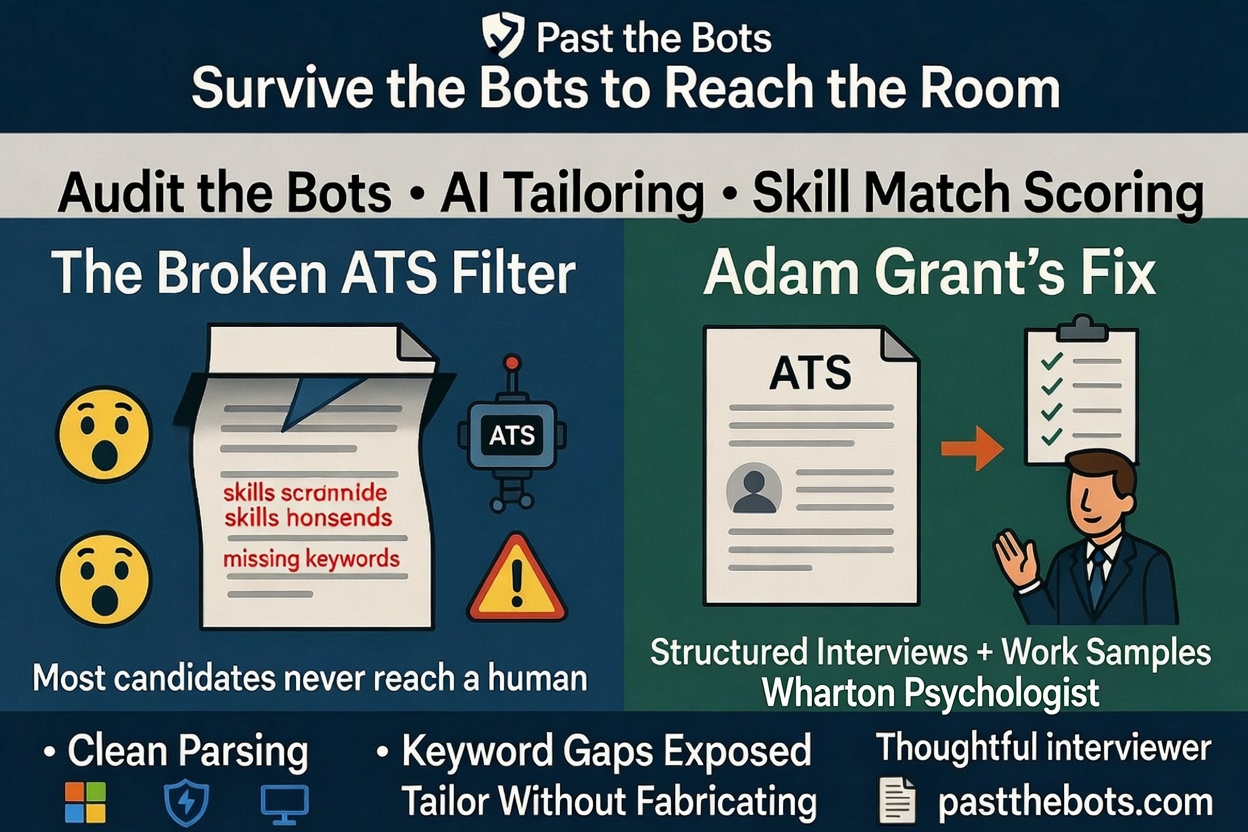 Wharton psychologist and bestselling author Adam Grant recently made a point that should make every recruiter uncomfortable: interviewers are routinely overlooking their best candidates. His fix involves two specific things -- structured interviews and work-sample tests -- that force evaluators to look past first impressions and gut feelings.
That's great advice for hiring teams. But if you're a job seeker, you're probably reading that and thinking: I have to survive the algorithm before I even get to the interview.
Grant is right that human bias is a huge problem late in the hiring process. What often goes undiscussed is the bias baked into the very beginning -- the automated screening that decides whether a human ever sees your resume at all.
The Two Filters You Have to Clear
Most job seekers think of hiring as a single gauntlet. It's actually two separate ones:
- The automated filter -- an Applicant Tracking System (ATS) parses your resume, extracts your skills and experience, and scores you against the job description. If you don't clear this, no human ever reads your resume.
- The human filter -- a recruiter or hiring manager reviews what made it through, decides who to interview, and then (hopefully, per Grant's advice) runs a structured process.
Grant's research focuses on making filter number two fairer. But if filter number one is broken, the most structured interview process in the world won't help you -- because you'll never get the call.
What ATS Parsers Actually Do to Your Resume
Here's the frustrating part: ATS software doesn't read your resume the way a person does. It extracts data into fields -- name, contact info, job titles, dates, skills -- and then matches that data against the job requirements. Formatting that looks clean in Word or Google Docs can completely confuse a parser.
A two-column layout? The parser often reads across both columns simultaneously, turning your skills section into nonsense. Headers like "Where I've Made an Impact" instead of "Experience"? The ATS might not recognize the section at all. Skills buried in a paragraph instead of a list? Possibly missed entirely.
This is exactly what Past the Bots' Audit the Bots tool is built to expose. You upload your resume, and it shows you how different parsers are actually reading it -- what they're extracting correctly, what they're mangling, and what they're skipping. Most people are genuinely shocked when they see it.
The Keyword Gap Problem
Even if your resume parses cleanly, you can still get screened out if you're not matching the right keywords from the job description.
Grant's point about structured interviews is that they force evaluators to assess candidates on the same criteria. ATS matching is already doing something like that -- it's just doing it badly, without context, and without the ability to recognize that "team leadership" and "led cross-functional teams" mean the same thing.
Past the Bots runs a skill-weighted match score when you paste in a job description. It shows you:
- Which skills and keywords from the posting already appear in your resume
- Which ones are missing
- Which gaps are potential knockout criteria (the things that will auto-disqualify you)
Knowing the difference between a "nice to have" keyword you're missing and a hard requirement you're missing is genuinely useful. It tells you where to focus your edits.
Tailoring Without Making Stuff Up
One of the most common mistakes job seekers make when they realize they're missing keywords is to just stuff them into the resume awkwardly -- or worse, claim experience they don't have.
The AI tailoring feature in Past the Bots rewrites your existing bullets to better reflect the language of the job description, without fabricating anything. It works with what you've actually done and surfaces it in terms the ATS and the hiring manager are looking for. That's a meaningful distinction.
What This Means for Recruiters Too
If you're on the recruiting side, Grant's argument should prompt a real question: how many strong candidates are you losing before they ever reach your desk?
Past the Bots has recruiter tooling that lets you see how well a candidate's resume actually maps to your job requirements -- not just the ATS score, but the underlying keyword and skills analysis. It's a way to double-check the filter, not just trust it.
The Bottom Line
Adam Grant is right that structured, criteria-based evaluation catches better candidates. But that process only works on the people who survive automated screening. Make sure your resume is actually getting through -- clean formatting, the right keywords, no parser confusion -- so that when a thoughtful interviewer does run a fair process, you're in the room to benefit from it.