Your Degree Won't Get You Hired Anymore. Here's What Actually Will.
July 6, 2026 · 4 min read · Past the Bots
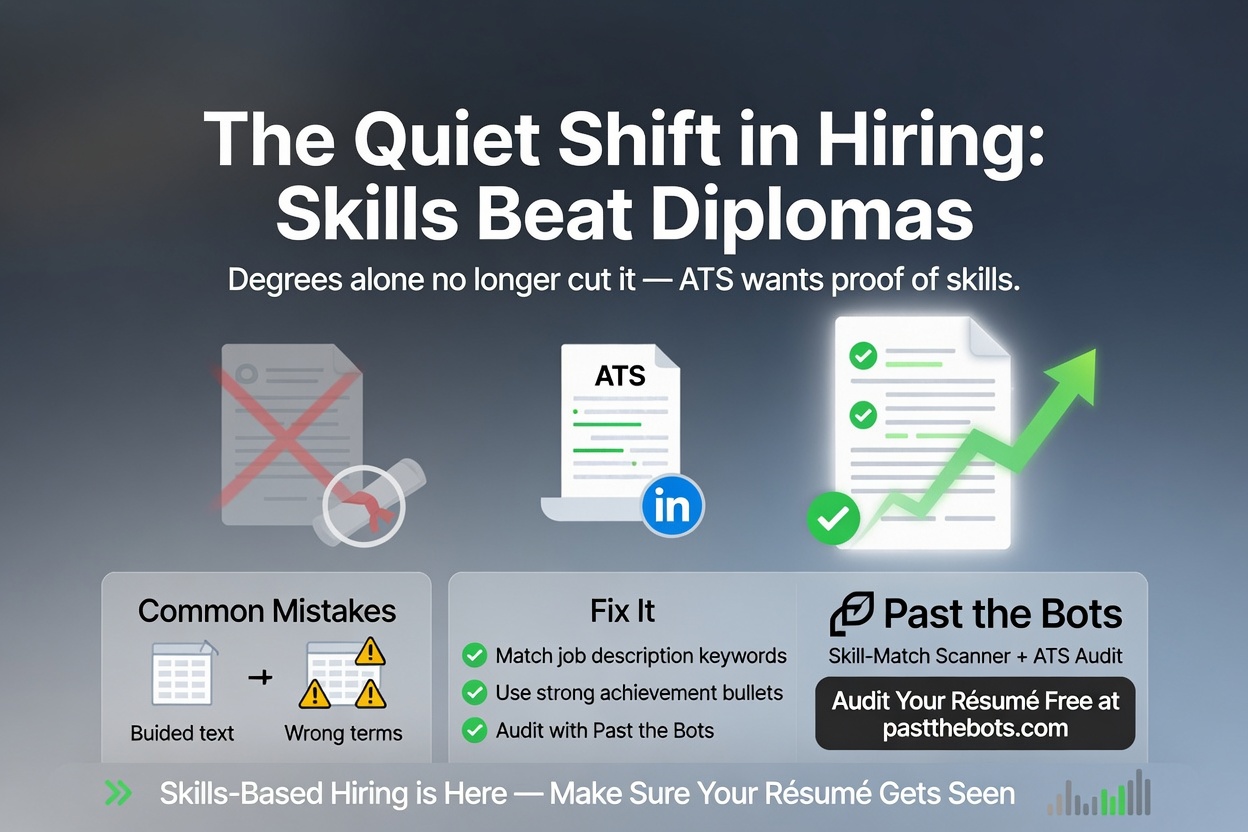 There's a quiet shift happening in hiring, and if you're still leading with your diploma as your main selling point, you might be getting screened out before anyone even glances at your name.
A recent piece from MSN Money highlights what many recruiters are already acting on: degrees alone no longer signal what employers actually want to know. Can you do the job? Do you have the specific skills we need right now? More and more companies, including major employers who used to require a four-year degree for every role, are dropping that requirement entirely and moving toward skills-based hiring.
That's genuinely good news for a lot of people. But it also means the rules for standing out have changed.
What Skills-Based Hiring Actually Means for Your Résumé
When a company says it cares more about skills than credentials, it doesn't mean your résumé suddenly matters less. It means the specific words on your résumé matter more.
Here's why: most companies still use an Applicant Tracking System (ATS) to filter applications before a recruiter sees them. That system isn't reading your résumé the way a person does. It's scanning for keywords, usually pulled directly from the job description, and scoring your application based on how well they match.
If you have the skills but haven't used the right language to describe them, the ATS may flag your résumé as a weak match and bury it.
So the opportunity in skills-based hiring only pays off if your résumé actually surfaces those skills in a way the system can read and credit.
The Problem: Most Résumés Bury the Skills That Matter
A few common mistakes that hurt otherwise qualified candidates:
- Describing responsibilities instead of capabilities. "Managed social media accounts" is a task. "Grew organic Instagram engagement 40% through content calendar planning and A/B testing" shows a skill with evidence.
- Using the wrong terminology. You might call it "client relations" when the job description says "customer success" or "stakeholder management." To an ATS, those can be three different things.
- Hiding skills in a dense paragraph. If your skills are buried in a summary block or scattered through bullet points without clear structure, some parsers will miss them entirely.
- Formatting that breaks parsing. Tables, text boxes, columns, and fancy headers can cause an ATS to scramble or skip whole sections of your résumé.
How to Actually Fix It
Start by treating the job description as a cheat sheet. Read it carefully and pull out the specific skills and tools it mentions repeatedly or emphasizes. Those are your target keywords.
Then audit your résumé against that list. Be honest: do you actually use those exact terms? If you have the skill but call it something different, update your language to match (without misrepresenting anything, obviously).
This is where a tool like Past the Bots can save you a lot of guesswork. The skill-match scanner shows you exactly which keywords from a job description are present on your résumé, which ones are missing, and which gaps might be automatic knockouts. You can see your match score and fix the specific holes before you apply, not after you wonder why you heard nothing back.
The ATS audit feature also shows you what a parser actually extracts from your file: your name, contact info, job titles, skills, and sections. If something is being misread or skipped, you'll see it clearly instead of just hoping for the best.
Skills-Based Hiring Also Means Your Bullet Points Need to Work Harder
If a recruiter is no longer defaulting to "did they go to the right school," they're leaning harder on your actual work history. Your bullets need to show what you did, how you did it, and what it produced.
Weak: Assisted with project coordination across teams.
Stronger: Coordinated deliverables across four cross-functional teams to launch a product update two weeks ahead of schedule.
The second version shows a skill (project coordination), context (cross-functional collaboration), and an outcome (early delivery). That's what hiring managers are scanning for when degrees are off the table.
If you're not sure how to reframe your experience that way, Past the Bots has an AI tailoring tool that rewrites your bullets to fit a specific job, without inventing experience you don't have.
The Bottom Line
Skills-based hiring is a real shift, and it opens doors for people who've been overlooked because of where (or whether) they went to college. But those doors only open if the ATS can actually find your skills in the first place.
Don't let a parsing problem or a keyword mismatch undo qualifications you've genuinely earned. Take ten minutes to audit your résumé against the next job you want. The gap between getting screened out and getting called might be smaller than you think.