69 Applicants per Filled Role (and the AI Application Flood)
October 31, 2026 · 4 min read · Past the Bots
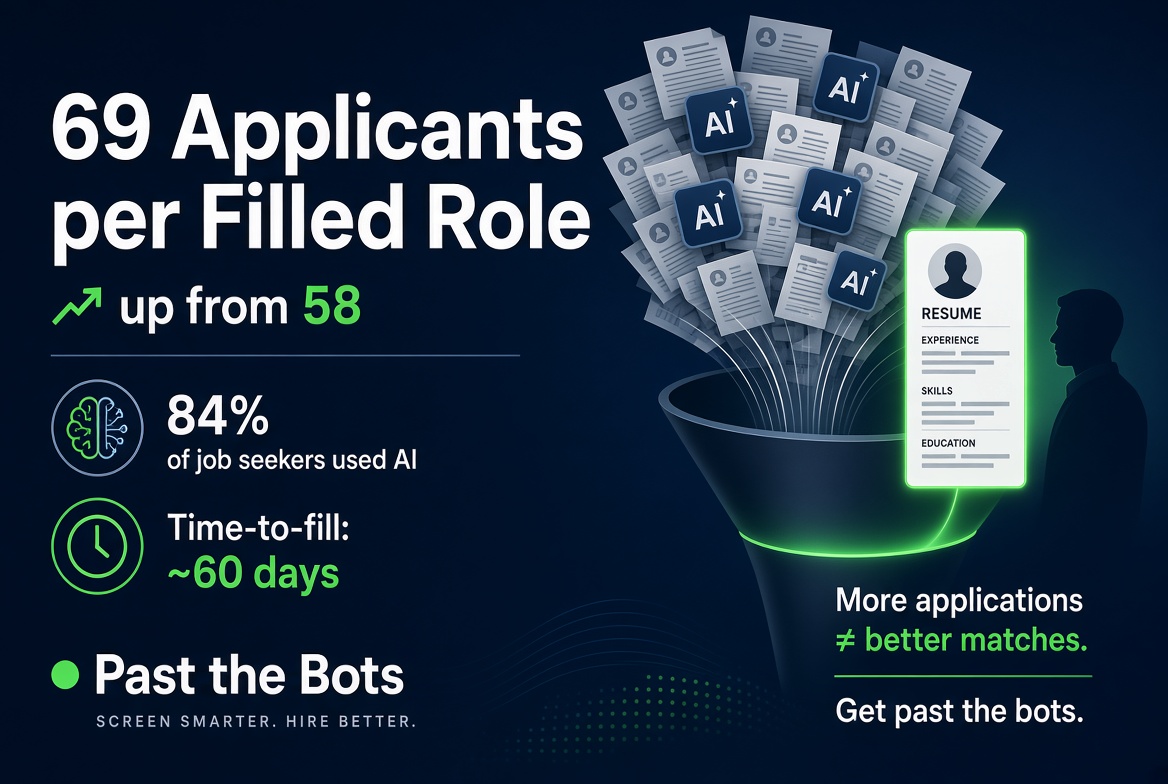 Workday's October 2026 Global Workforce Report landed with a number that should give every job seeker pause: the median filled role now attracts 69 applicants, up from 58 just a year ago. In financial services, competition jumped 27%. In tech and media, it jumped 40%.
And the kicker? 84% of job seekers say they used AI tools in their search. More people, applying faster, to more jobs, with AI-generated résumés and cover letters. The flood is real.
Time-to-fill, meanwhile, barely budged. It's still sitting around 60 days. So the pile of applications is growing, but the number of humans reading them hasn't.
More Applications Is Not the Same as More Chances
Here's the trap a lot of job seekers fall into: they treat a low-friction application process as a reason to apply to everything. AI tools make it easy to blast out 50 applications before lunch. But volume without precision is mostly just noise.
The applicants who actually move forward aren't the ones who applied most. They're the ones whose résumés survived the ATS parse cleanly and came out the other side looking like a strong match to a human recruiter.
That's the part worth focusing on.
What an ATS Actually Does With Your Résumé
Applicant Tracking Systems are not smart readers. They're structured data extractors. When your résumé goes in, the system tries to pull out:
- Your name and contact information
- Job titles and dates
- Skills and keywords
- Education
- Section labels (so it knows what it's looking at)
If your formatting is too complex, those fields get scrambled. A two-column layout might cause your skills to get merged with your job history. A header buried in a Word document's header field might mean your name never gets parsed at all. Fancy graphics and tables are basically invisible.
This is why a clean, single-column résumé still outperforms a beautifully designed one in most ATS environments. It's not about being boring. It's about being readable by a machine that has no design sense whatsoever.
The Keyword Match Problem (and How AI Is Making It Worse)
Here's an irony in the 84% AI adoption number: a lot of AI-assisted résumés are getting worse at keyword matching, not better. Generic AI rewrites often strip out the specific terminology that a particular job description is actually scanning for, replacing it with polished-sounding but vague language.
"Led cross-functional initiatives to drive organizational outcomes" matches almost nothing. "Implemented Salesforce CPQ for a 12-person enterprise sales team" matches a lot.
When you're up against 68 other applicants, the ATS is doing a first pass. It's looking for skill matches, title relevance, and keyword alignment with the job description. If those don't register, you don't reach the human.
The fix is straightforward in theory, even if it takes some work in practice:
- Pull the actual language from the job description. Not synonyms. The exact terms.
- Check what's missing from your résumé against that language before you apply.
- Add relevant keywords in context (inside bullets that describe real work you did, not crammed into a skills list).
Tools like the skill-match scan in Past the Bots can show you exactly which keywords from a job description are present in your résumé, which are missing, and which gaps are likely knockout criteria. It saves the manual comparison work.
The "AI Is Rewriting Jobs" Angle Actually Helps You
The same Workday report made another point worth holding onto: AI is rewriting jobs more than it's cutting them. Roles are evolving, skill requirements are shifting, and companies are hiring for adaptability alongside specific technical knowledge.
That framing is useful because it means your résumé needs to reflect current skills, not just past titles. If you've been upskilling, using new tools, or taking on work that crosses into AI-adjacent territory, that belongs prominently in your résumé right now. Recruiters in fast-moving sectors are scanning for evidence that candidates are keeping pace.
A Simple Pre-Submit Checklist
Before you hit apply on your next role, run through this:
- Single-column layout? No tables, no text boxes, no columns.
- Standard section headers? "Experience," "Skills," "Education" -- not creative variations.
- Contact info in the body of the document, not just in a Word header field.
- Job description keywords reflected in your bullets where they're genuinely accurate?
- No keyword stuffing in a hidden skills list -- put skills in context.
- File format is .docx or a clean PDF (check what the employer specifies).
Ninety seconds of review before each application is worth more than ten additional applications fired off without it.
The Bottom Line
Sixty-nine applicants per role sounds discouraging. But most of those applications are noisy, poorly matched, or failing the parse before a human ever sees them. You don't need to out-volume the competition. You need your résumé to come through the ATS cleanly and look like the right fit when it lands on a recruiter's screen.
That's a solvable problem. It just requires more precision than speed.