AI-Tailored Résumés vs. Generic Ones: What Actually Moves the Needle
September 23, 2026 · 4 min read · Past the Bots
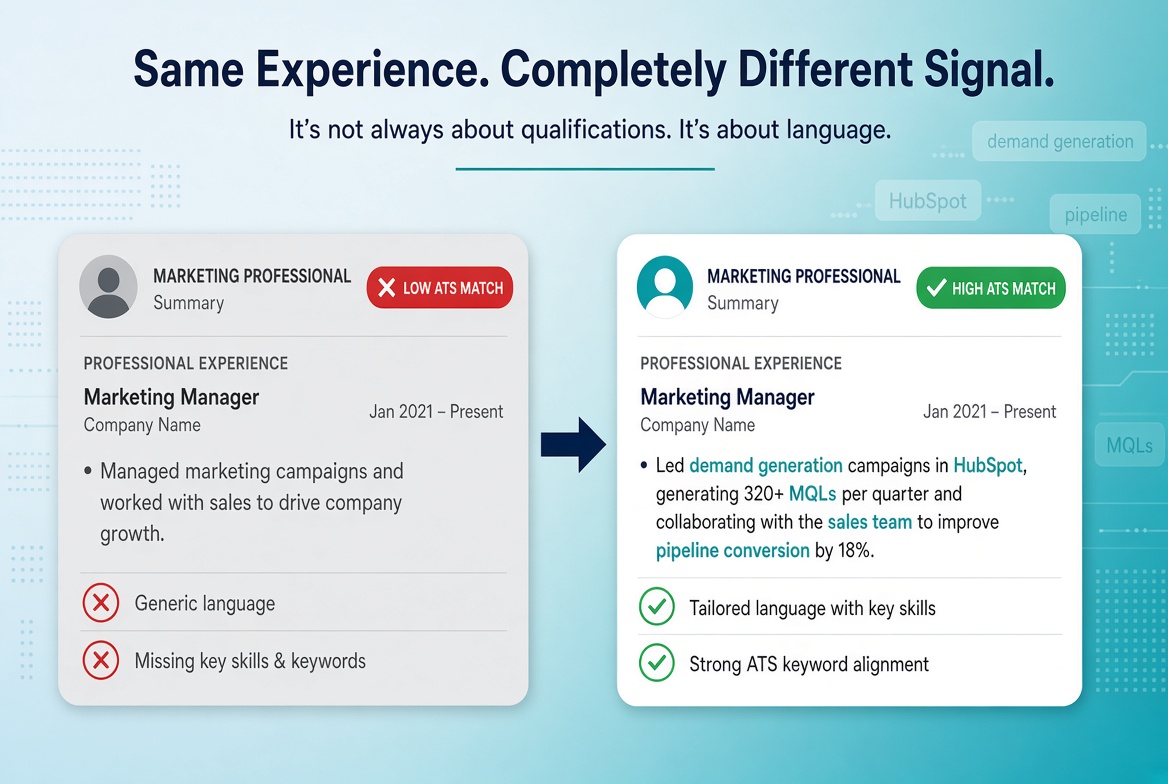 Most job seekers send the same résumé to every opening and wonder why they're not hearing back. It's not always about qualifications. Often, it's about language. Specifically, whether your résumé speaks the same language as the job description and the ATS sitting between you and a human recruiter.
Let's look at what that difference actually looks like in practice.
The Setup: Same Person, Same Experience, Two Very Different Results
Imagine a marketing manager applying for a role at a SaaS company. The job description emphasizes demand generation, HubSpot, pipeline metrics, and cross-functional collaboration. Our candidate has done all of this. But here's their current bullet on the résumé:
Managed marketing campaigns and worked with sales to drive company growth.
That bullet is vague, passive, and completely invisible to an ATS. It won't match any of the keywords the system is scanning for. A recruiter who does see it gets nothing concrete to act on.
Now here's that same bullet after being rewritten against that specific job description:
Led demand generation campaigns in HubSpot, generating 320+ MQLs per quarter and collaborating with the sales team to improve pipeline conversion by 18%.
Same person. Same job history. Completely different signal.
Why the Generic Version Fails
ATS platforms don't read résumés the way humans do. They scan for specific terms, then score your résumé based on how many match what the employer told the system to look for. If you write "drove company growth" but the job description says "pipeline metrics" and "demand generation," the system may score you near zero even if you're the most qualified person who applied.
Generic bullets also fail the human test. Recruiters spend an average of six to ten seconds on an initial résumé scan. Vague language forces them to do interpretive work they don't have time for. Concrete language with numbers and recognizable tools does the work for them.
What AI Tailoring Actually Does (and Doesn't Do)
This is where a lot of people get nervous, and reasonably so. The fear is that AI will invent things, embellish titles, or fabricate accomplishments. That's a legitimate concern with some tools.
Good AI tailoring does something much more specific: it reframes real experience using the vocabulary of the target role. It surfaces accomplishments you buried, swaps vague language for industry-standard terms, and mirrors the job description's phrasing without making anything up.
For example:
- Generic: Helped improve customer retention
- Tailored: Implemented customer success workflows that improved net retention rate by 12% over two quarters
The facts came from the candidate. The language now matches what the hiring team is actually looking for.
When you use the AI tailoring feature in Past the Bots, it rewrites your bullets against the specific job description you paste in. It won't invent a skill you don't have or a number you didn't give it. It works with what's there and makes it legible to both the ATS and the human on the other side.
The Keyword Gap Problem
One thing most job seekers don't realize: ATS systems often weight keywords differently. A job description might mention "project management" five times and "Agile" once. That repetition signals what the employer actually cares about most.
A skill-weighted match score (like the one in Past the Bots) doesn't just tell you which keywords you're missing. It shows you which missing keywords are likely to knock you out of consideration entirely. Those are the ones worth prioritizing when you tailor.
Some quick wins to look for:
- Hard skills and tools: Software names, platforms, and certifications matter more than soft skills to most parsers.
- Job title alignment: If they say "Account Executive" and you say "Sales Rep," consider updating your title language where it's accurate to do so.
- Section headers: ATS systems parse sections by name. "Work History" might not be recognized. "Work Experience" or "Professional Experience" usually is.
A Simple Tailoring Workflow That Works
You don't need to rewrite your entire résumé for every application. Here's a realistic approach:
- Start with a strong base résumé that's ATS-safe in format and has your core accomplishments documented with numbers.
- Paste the job description into a matching tool and identify your top keyword gaps.
- Rewrite two to four bullets in your most relevant role to incorporate those terms naturally.
- Check your score again before you send. Even a few targeted changes can move you from below the threshold to well above it.
The goal isn't to game the system. It's to make sure a qualified application actually gets seen. That's the whole point of tailoring: not to pretend you're someone you're not, but to make sure the system recognizes who you already are.