AI/ML Roles Are Exploding: How to Get Your Résumé Past the Bots for the Hottest Jobs in Tech
October 8, 2026 · 4 min read · Past the Bots
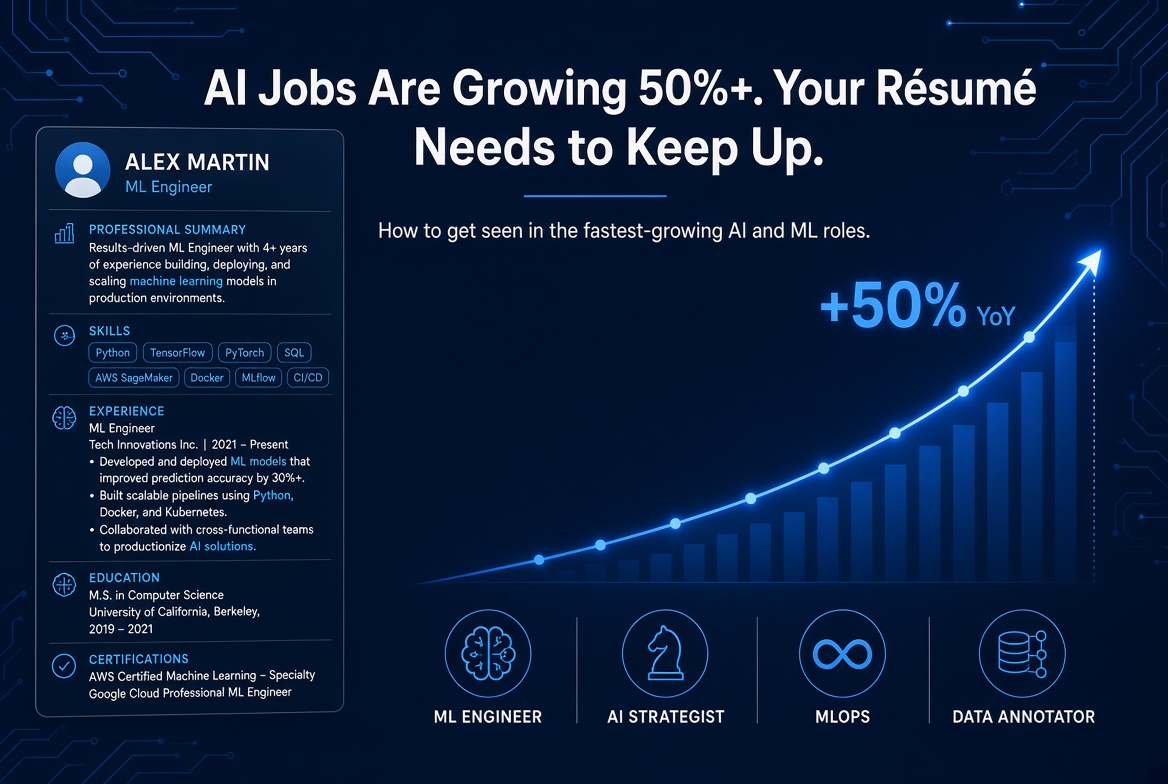 If you've been watching the job market, you already know AI is everywhere. But the hiring numbers make it concrete: AI and ML engineering roles are among the fastest-growing positions on LinkedIn, with job postings growing 50% or more year-over-year in many categories. And it's not just engineers. Data annotators, AI consultants, AI strategists, and ML researchers are all seeing serious demand spikes as companies race to build, deploy, and govern AI systems.
The opportunity is real. But so is the competition. Here's how to make sure your résumé actually gets seen.
Understand What Roles Actually Exist Right Now
The "AI jobs" umbrella covers a lot of ground. Before you start tailoring your résumé, it helps to know which lane you're in:
- ML Engineer -- builds and deploys models in production; strong emphasis on software engineering alongside data science
- AI Research Scientist -- pushes the state of the art; publications and deep math background matter here
- Data Annotator / RLHF Specialist -- the largely invisible workforce that labels training data and scores model outputs; growing fast as companies fine-tune LLMs
- AI Consultant / AI Strategist -- helps organizations figure out where and how to adopt AI; often a hybrid of business and technical skills
- MLOps Engineer -- keeps models healthy in production; monitoring, retraining pipelines, infrastructure
- AI Product Manager -- owns the roadmap for AI-powered features
Each of these roles has its own keyword fingerprint. A generic "AI résumé" won't serve you well across all of them.
Match the Language of the Posting -- Precisely
ATS systems don't read between the lines. If a job description says "retrieval-augmented generation" and your résumé says "RAG pipelines," some parsers won't connect the dots. This is especially common in AI roles because the terminology is evolving so fast.
A few practical moves:
- Mirror exact phrases from the job description in your skills section and bullet points, as long as they accurately describe your experience
- Watch for both spelled-out terms and acronyms ("Large Language Models" and "LLMs") -- use both where it fits naturally
- Don't assume a recruiter or parser knows that "fine-tuning" and "model customization" are the same thing; use the term the employer used
Pasting a job description into a tool like Past the Bots' match scorer will show you exactly which keywords are present, missing, or critical -- so you're not guessing.
The Skills Section Is Doing Heavy Lifting
For AI and ML roles, a well-structured skills section is more important than almost anywhere else. Hiring managers and ATS systems both scan for specific tools and frameworks. Think in layers:
- Languages: Python, R, SQL, sometimes Julia or C++
- Frameworks: PyTorch, TensorFlow, Hugging Face, LangChain, scikit-learn
- Infrastructure and MLOps: Kubernetes, Docker, MLflow, Kubeflow, AWS SageMaker, Vertex AI
- Concepts: transformer architecture, reinforcement learning from human feedback (RLHF), vector databases, model evaluation, bias/fairness testing
Be honest -- only list what you can speak to in an interview. But don't undersell yourself by leaving out tools you've used just because they felt minor.
Your Bullets Need to Show Impact, Not Just Activity
This is where a lot of strong candidates lose ground. "Developed machine learning models" tells a hiring manager almost nothing. Try to answer: what did the model do, how did you measure success, and what changed because of your work?
Before: Developed NLP models for customer service automation
After: Built a fine-tuned BERT classifier that automated tagging for 40% of incoming support tickets, reducing manual review time by 12 hours per week
If you're worried about rewriting bullets to fit a specific role without overstating your experience, AI tailoring tools can help you reshape the framing and language while keeping the facts accurate.
Don't Let Formatting Sink You
AI job postings often attract people with academic or research backgrounds who use CV-style formatting: tables, multi-column layouts, embedded publication lists. These formats tend to break ATS parsers badly. A clean, single-column résumé will almost always outperform a visually complex one at the parsing stage -- even if the complex one looks more impressive as a PDF.
One More Thing: The "AI Governance" Angle
If you work in policy, legal, compliance, or risk management and you've been touching AI governance or responsible AI work, put it front and center right now. Companies are under regulatory pressure and scrambling for people who understand both the technology and the risk landscape. It's a genuinely underserved skill set, and the demand is accelerating.
The market is moving fast. Your résumé needs to keep up.