Apply Kit in Practice: Tailoring to 3–4 Roles in One Sitting Without Losing Your Voice
November 20, 2026 · 4 min read · Past the Bots
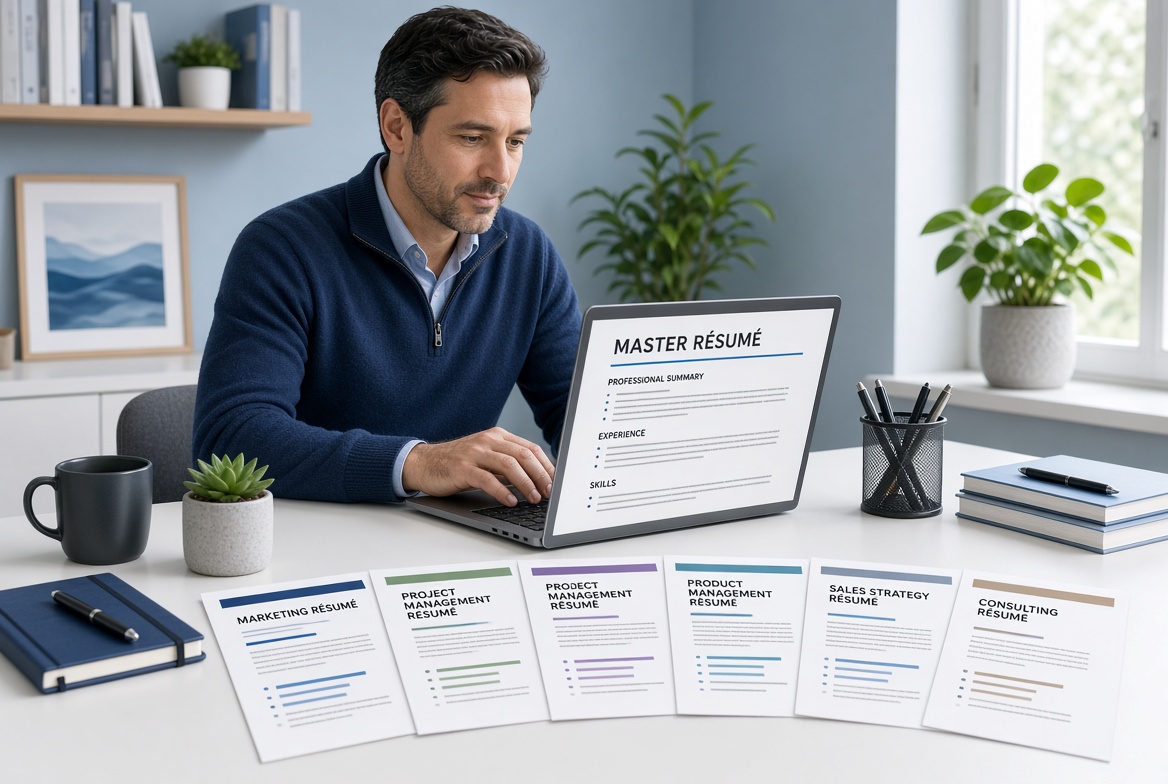 Most job seekers either send the exact same résumé to every role or spend two hours rewriting everything for one application. Neither works well. The first tanks your match scores. The second burns you out after three postings.
There's a better way: batch your tailoring. Here's a workflow you can actually finish in a single sitting.
Start With a Master Résumé, Not a Final One
Before you touch a single job description, build a master résumé that holds everything. Every bullet you've ever been proud of, every skill you've used, every result you can back up with a number. This isn't the document you send anyone. It's your source of truth.
Keep it in a live editor so you can grab pieces quickly. Think of it like a well-organized closet: you're not wearing every item at once, but you know exactly where everything is.
Pick Your 3–4 Roles and Read Them Like a Recruiter
Open the job descriptions side by side and look for two things:
- Required skills and tools (these are non-negotiable keywords for the ATS)
- The actual problem the company wants solved (this tells you which of your bullets to surface)
A product manager role at a fintech startup and a product manager role at a healthcare company might have the same title but want completely different experience up front. Notice that before you start writing.
Paste each JD into a skill-match tool to get a keyword gap report. Past the Bots will show you exactly which terms from the JD are missing from your résumé and flag any knockout gaps, the requirements where silence could get you auto-rejected before a human ever sees your name.
Build a Tailored Version for Each Role (Without Fabricating Anything)
This is where people either cheat or freeze. Don't do either.
For each role, go back to your master résumé and ask: which of my real bullets best reflects what this job is asking for? Then reorder, reword, and re-lead with the right emphasis.
A few practical moves:
- Swap the order of bullets so the most relevant work appears first under each job
- Mirror the language in the JD when it honestly describes what you did (if they say "cross-functional alignment" and you've been doing exactly that, use the phrase)
- Trim bullets that aren't relevant to that specific role, they just dilute your signal
- Adjust your summary to speak directly to what this team needs
What you should never do: invent metrics, claim tools you haven't used, or rewrite your experience so heavily that you couldn't speak to it in an interview. AI tailoring tools can help you sharpen language, but the facts have to be yours.
Past the Bots' tailoring feature rewrites bullets to fit a job description without fabricating experience, which is a useful guardrail when you're moving fast.
Write the Cover Letter While the JD Is Still Fresh
This is the step people skip, and it shows. Cover letters written hours after tailoring a résumé tend to be generic. Write yours immediately after, while you still have the job description open.
Focus on three things:
- The specific problem this team is trying to solve (pull it from the JD or the company's about page)
- One or two concrete things you've done that map to it
- Why you're interested in this company specifically, not just the role category
Keep it under 250 words. Hiring managers are not reading novels.
If you're doing a cold outreach to a recruiter instead of applying through a portal, the same logic applies but make it even shorter. Two or three sentences explaining who you are, what you do, and why you're reaching out to them specifically.
The Human Pass: Don't Let Optimization Kill Your Voice
Here's the trap of batching applications: by version three, your résumé starts sounding like a keyword list with bullet points. The ATS might love it. A human will not.
After you finalize each version, read it out loud. If it sounds like something a bot generated, rewrite the awkward parts in plain English. Your actual voice is a competitive advantage. Use it.
A few things that keep the human pass strong:
- Specific, concrete results beat vague impact language every time ("cut onboarding time from 6 weeks to 3" beats "improved onboarding efficiency")
- Active verbs that reflect how you actually work are more convincing than recycled action words
- Consistent tone across your résumé and cover letter signals that a real person wrote this
One Sitting, Four Strong Applications
Master résumé ready. JDs analyzed. Bullets reordered and sharpened honestly. Cover letters written fresh. Voice intact.
That's it. Four targeted applications, done in a few hours, that will outperform twenty copy-pasted ones sent over the course of a week.