Data Scientist Jobs Are Booming: Here's How to Make Sure Your Résumé Keeps Up
October 2, 2026 · 4 min read · Past the Bots
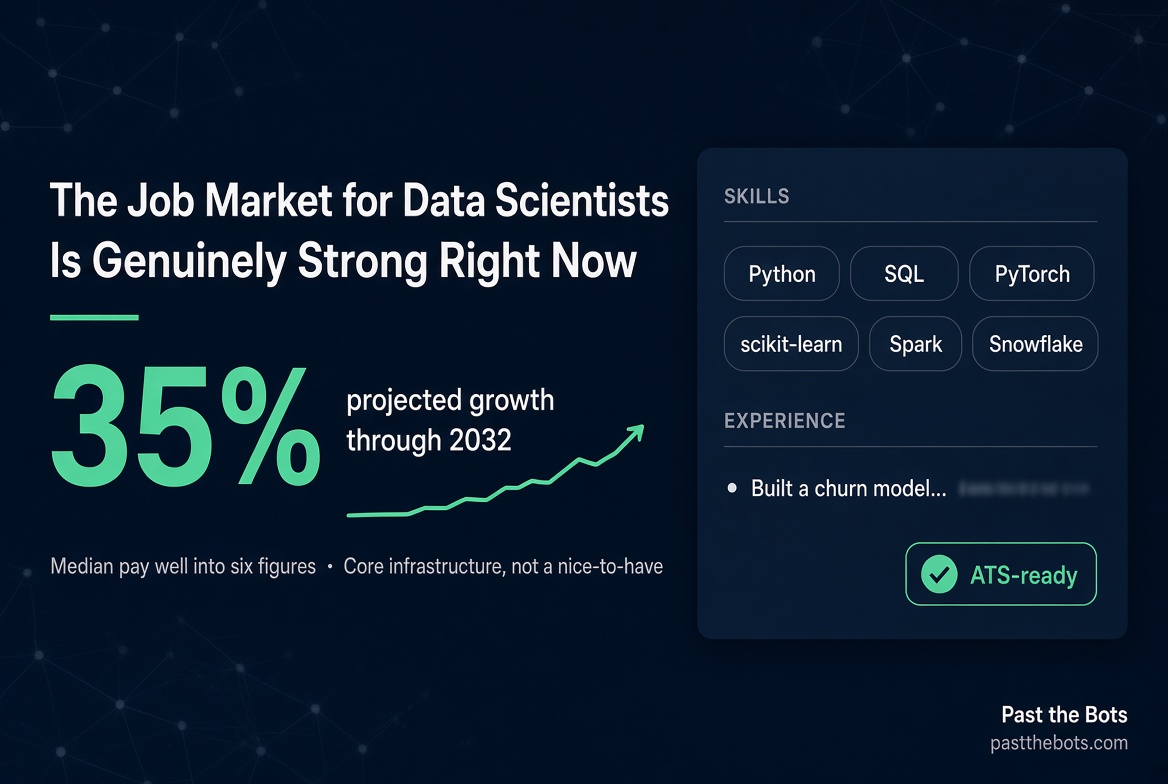
The Job Market for Data Scientists Is Genuinely Strong Right Now
If you're a data scientist or thinking about becoming one, the numbers are encouraging. The Bureau of Labor Statistics projects 35% growth for data science roles through 2032, which is about as fast as it gets in any professional field. Median pay is sitting well into six figures, and organizations across every industry, from healthcare to retail to finance, are treating their data pipelines and machine learning models as core business infrastructure rather than nice-to-haves.
That's the good news. The trickier news is that because the field is growing so fast, hiring teams are flooded with applicants. Many of those applications get filtered by an Applicant Tracking System before a human ever reads them. So even a genuinely strong résumé can disappear into a black hole if it's not set up to communicate your skills clearly to the software doing the first pass.
Here's how to make sure that doesn't happen to you.
Understand What ATS Systems Are Actually Looking For
Most ATS platforms don't read your résumé the way a recruiter does. They parse it into fields, scan for keywords, and try to match what they find against the job description. For data scientists, this means the specific tools and frameworks you list matter a lot.
A few things that commonly trip people up:
- Vague skill descriptions. Writing "experienced with machine learning" is much weaker than listing "scikit-learn, XGBoost, PyTorch" in a dedicated skills section. Parsers look for specific terms.
- Burying technologies inside bullet points only. If your skills section doesn't clearly list Python, SQL, Spark, or whatever the job requires, the parser may miss them even if they appear in your work history.
- Fancy formatting. Tables, text boxes, and multi-column layouts can confuse parsers and cause entire sections to be skipped or scrambled.
Running your résumé through an ATS scanner before you apply is genuinely worth the few minutes it takes. Tools like the one at Past the Bots show you exactly what a parser extracts, including your name, contact info, skills, and section headers, so you can spot problems before a recruiter does.
Match Your Résumé to Each Job Description (Yes, Really)
This is the step most people skip because it feels tedious. But a data science résumé for a role at a healthcare company doing clinical NLP should read differently than one for a fintech startup building real-time fraud detection models.
When you look at a job description, pay attention to:
- The specific stack they mention. If they list dbt, Airflow, and Snowflake, and you've used all three, they should appear clearly in your résumé.
- The framing of the role. Some companies want a data scientist who can own the full ML lifecycle. Others want someone who partners closely with data engineers. Match your bullet points to what they're describing.
- Knockout requirements. If a posting says "must have experience deploying models to production" and your résumé doesn't address that, you're likely getting filtered before anyone reads your name.
A skill-weighted match score, like the one Past the Bots generates when you paste in a job description, can quickly surface which keywords you're hitting and which gaps you need to address.
Write Bullets That Show Business Impact
Data science hiring managers see a lot of résumés that describe what someone did without explaining why it mattered. The format that tends to land well is straightforward: what you did, how you did it, and what changed as a result.
Instead of:
Built a churn prediction model using Python and scikit-learn.
Try:
Built a customer churn prediction model using scikit-learn that identified at-risk accounts 30 days in advance, contributing to a 12% reduction in monthly churn.
You don't need a precise number for every bullet, but the more you can connect your technical work to outcomes the business cared about, the more your résumé reads like the work of someone who understands the full picture.
A Few Quick Wins Before You Apply
If you're actively applying for data science roles right now, here's a short checklist to run through:
- Skills section is explicit and scannable. List languages, frameworks, platforms, and tools by name.
- Résumé is single-column and ATS-safe. No tables, text boxes, headers, or footers with contact info.
- Each application gets at least a light tailoring pass. Swap in relevant keywords from the job description where you legitimately have that experience.
- Your bullets lead with action and end with impact. Metrics are great, but even qualitative outcomes help.
- Contact information is in the body of the document, not just in a header or footer that a parser might ignore.
The job market for data scientists is as strong as it's been in years. A little extra attention to how your résumé communicates your skills to automated systems can make a real difference in how often you hear back.