Everyone's Fibbing a Little: What the Resume Lies Study Means for Your Job Search
September 20, 2026 · 4 min read · Past the Bots
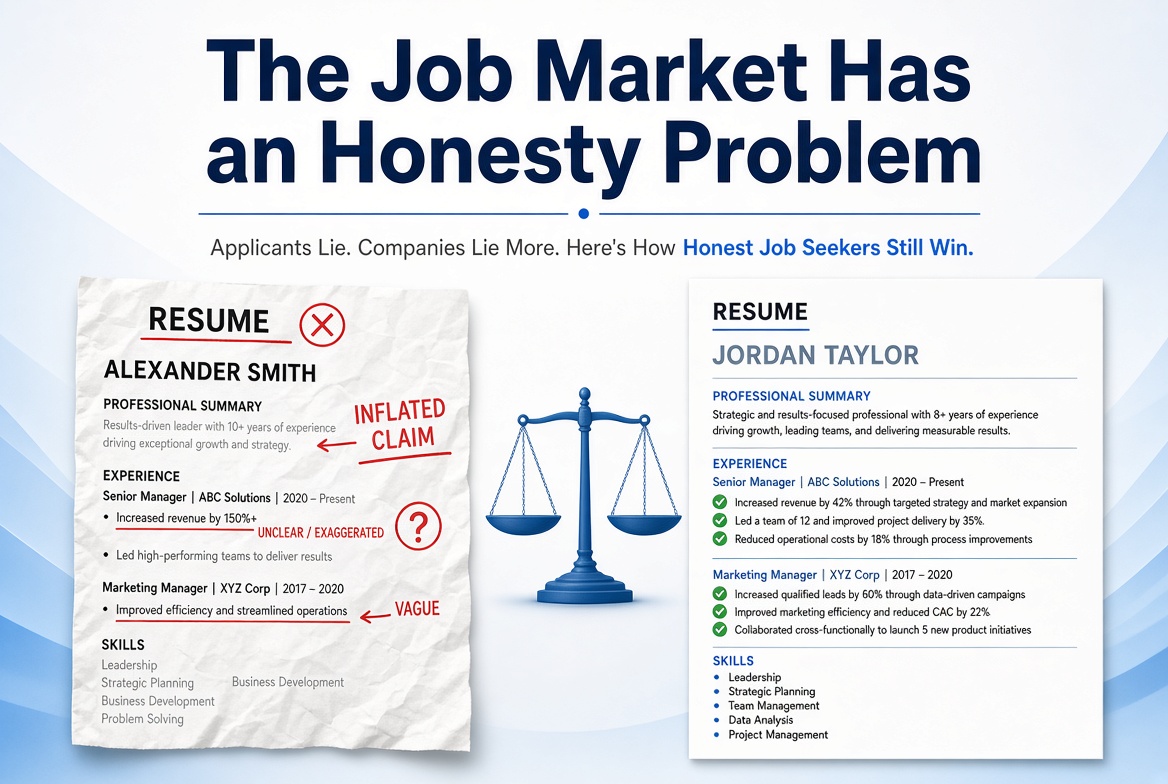 A recent report made the rounds with a headline that's hard to ignore: one in three job applicants admits to lying on their resume. Stretched dates, inflated titles, skills they barely touched. It sounds alarming until you read the next line—hiring companies lie more. Misleading job descriptions, salary ranges that evaporate after the offer, "hybrid" roles that quietly become fully in-office. The job market, it turns out, has a honesty problem on both sides of the table.
So what does an honest job seeker do with that information?
Why People Lie (And Why It Usually Backfires)
Most resume fibs come from the same place: desperation. Applicants feel like the only way to survive the automated screening gauntlet is to game it. They keyword-stuff skills they barely know. They round up a contract gig to look like full-time employment. They add a certification they started but never finished.
The logic is understandable. ATS platforms are blunt instruments. They scan for keywords and spit out a match score, and if you don't hit a certain threshold, a human never even sees your name. Feeling invisible in that system pushes people toward shortcuts.
But lying carries real consequences:
- Background checks catch more than people expect. Employment dates, titles, and degrees are routinely verified.
- Skills get tested in interviews. Claiming advanced SQL when you've run three queries is a fast way to tank a conversation.
- It can follow you. A rescinded offer or a termination for falsified credentials is much harder to explain than a gap year.
The better play is figuring out how to present your actual experience in a way that clears the automated bar. That's a solvable problem.
The Real Issue: Most Honest Resumes Are Badly Formatted
Here's what the lying-on-resumes conversation often misses: a huge chunk of qualified candidates get filtered out not because they lack the skills, but because their resume is formatted in a way that ATS software can't read correctly.
Two-column layouts, tables, headers and footers, fancy graphics—all of these can cause a parser to mangle your contact info, scramble your job history, or skip your skills section entirely. You could be a perfect candidate and the system might extract your name as a jumble of characters, or miss your most relevant role completely.
That's not a lying problem. That's a formatting and presentation problem, and it's fixable.
How to Compete Honestly (and Actually Get Seen)
Instead of embellishing, focus on these concrete moves:
1. Find out what the bots actually see. Before you apply anywhere, run your resume through a parser check. Past the Bots shows you exactly what an ATS extracts from your file—your name, contact details, skills, and work history sections—and flags critical errors, warnings, and things that are fine. Seeing "name not detected" or "skills section missing" before you apply is the kind of feedback that changes outcomes.
2. Match your real skills to the job description's language. If you managed vendor contracts but the job description says "third-party relationship management," the ATS may not connect those two things. You don't need to fabricate anything—you just need to mirror the language. The skill-match tool in Past the Bots shows you which keywords from a job description appear in your resume, which are missing, and which gaps are likely knockout criteria. That tells you exactly what to adjust.
3. Rewrite bullets to reflect impact, not just tasks. "Responsible for managing social media" is weak. "Grew Instagram engagement 40% in six months by shifting to short-form video" is the same experience, told better. AI tailoring can help you reframe your existing bullets to match a specific role—without adding anything that isn't true. The goal is accurate and compelling, not fabricated.
4. Use an ATS-safe format. If you're not sure whether your current resume format is parser-friendly, rebuilding it as a clean single-column document removes the guesswork. It's not glamorous, but it works.
A Note on the Company Side of This
The study's finding that employers mislead candidates more than the reverse is worth sitting with. Phantom job listings, salary ranges that are aspirational at best, job descriptions written for a unicorn who doesn't exist—these aren't just annoying, they waste enormous amounts of job seeker time and energy.
You can't control what a company puts in a posting. But you can control whether your application is presenting you accurately and giving you a real shot at making it to a human reviewer. That's the part worth putting your energy into.
Lying on your resume is a short-term fix with long-term risk. Fixing your formatting, matching your language to the job, and telling your actual story clearly? That's a strategy that holds up.