From 'AI Literacy' to Hands-On AI Skills: What Employers Actually Want Now (and How to Show It)
October 16, 2026 · 4 min read · Past the Bots
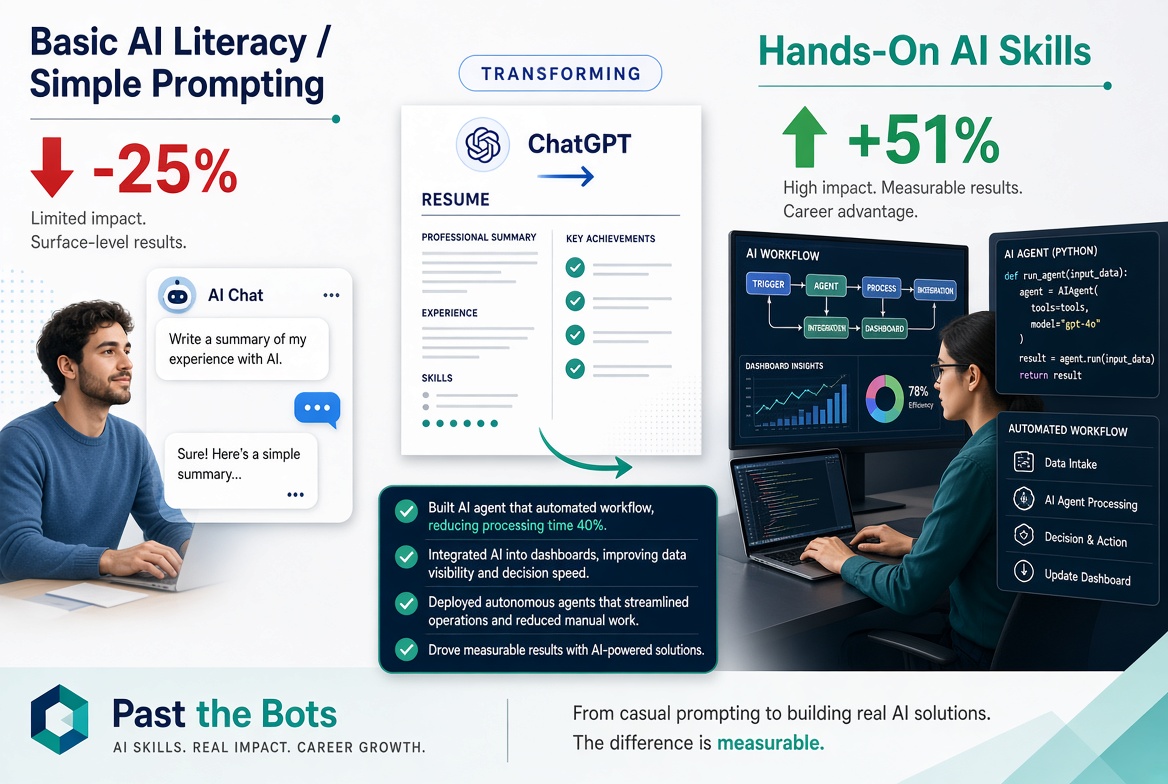 A Workday report tracking hiring demand through mid-2026 told a pretty clear story: interest in basic AI skills, think simple prompting and "I use ChatGPT," peaked in January 2026 and then dropped 25%. Meanwhile, demand for hands-on AI skills like building tools, automating workflows, and AI engineering shot up 51% between September 2025 and July 2026.
The shift makes sense when you think about it. Early adopters got credit just for showing up. Now employers want people who can actually build something, save time, or ship a product with AI involved. The bar moved.
The tricky part? Showing that on a résumé without looking like you keyword-stuffed "AI" seventeen times or, worse, making a recruiter wonder if a bot wrote the whole document.
Why "Proficient in ChatGPT" Doesn't Land Anymore
Listing a tool name with no context is the AI-skills equivalent of writing "Microsoft Office" in 2012. It says you've heard of it. It doesn't say you did anything useful with it.
ATS parsers will extract the keyword. Recruiters will see it. But neither one will score it as a real skill because there's no signal of depth, scope, or outcome attached to it.
The fix isn't to remove AI references. It's to attach them to something real.
What Hands-On AI Skills Actually Look Like on a Résumé
Here's a simple way to think about the spectrum:
- Level 1 (low signal): "Uses AI tools including ChatGPT and Copilot"
- Level 2 (better): "Used Claude to draft and refine customer-facing documentation, cutting revision cycles from 4 rounds to 1"
- Level 3 (strong signal): "Built a Python script with OpenAI API calls to auto-classify 3,000+ monthly support tickets, reducing manual triage time by 6 hours/week"
Levels 2 and 3 describe work. They tell a recruiter what you built or changed, and they give a hiring manager something to ask about in an interview. Level 1 is just a badge.
For most non-engineering roles, Level 2 is completely achievable and genuinely competitive. You don't need to be writing API calls to show meaningful AI skill. You do need to show outcomes.
How to Write AI Bullet Points That Don't Raise Red Flags
Recruiters are increasingly skeptical of résumés that feel AI-generated. The irony of showing AI skills is that you have to do it in a way that still sounds human and specific.
A few things that help:
Be specific about the tool and the task. "Used Perplexity to research competitive pricing across 12 markets" is more credible than "leveraged AI for market research."
Anchor to a real number or change. Time saved, error rate reduced, output volume increased. Even rough numbers work better than vague improvement language.
Name the problem, not just the solution. "Our team was spending two days a week manually formatting reports, so I built a no-code Zapier workflow with an AI step that cut it to 20 minutes" tells a story. That's memorable.
Skip the jargon pile. "Implemented generative AI solutions leveraging LLMs" reads as padding. Say what you actually did.
Getting the Keywords Right Without Stuffing Them
Here's the other side of this: ATS systems do parse for AI-related terms, and you want to show up in the right searches. The goal is threading the needle between parseable and human-readable.
Terms that are worth including naturally, when accurate:
- Specific tools (OpenAI API, Copilot, Claude, Gemini, Midjourney, etc.)
- Specific tasks (prompt engineering, workflow automation, AI-assisted analysis, fine-tuning)
- Adjacent technical skills (Python, Zapier, n8n, no-code tools, data pipelines)
If you're unsure which terms are actually appearing in your target job descriptions, paste a few into a skill-match tool like the one in Past the Bots. It'll show you what keywords are weighted highest in the JD versus what's actually on your résumé, so you can close real gaps instead of guessing.
One Practical Exercise Before You Update Your Résumé
Go through your last 6 to 12 months of work and ask: where did AI actually touch my output? That might be writing, research, coding, design, data analysis, customer communication, internal tooling, or scheduling.
For each one, write one sentence: what the problem was, what you built or did, and what changed as a result.
That's your raw material. From there, you can shape it into résumé bullets that are honest, specific, and interesting to both a parser and an actual human being on a hiring committee.
The employers hiring right now aren't looking for people who know AI exists. They're looking for people who made it do something. Show that, and you're already ahead of most applicants who stopped at level one.