How to Pivot Careers in Healthcare (Without Starting Over From Scratch)
August 3, 2026 · 4 min read · Past the Bots
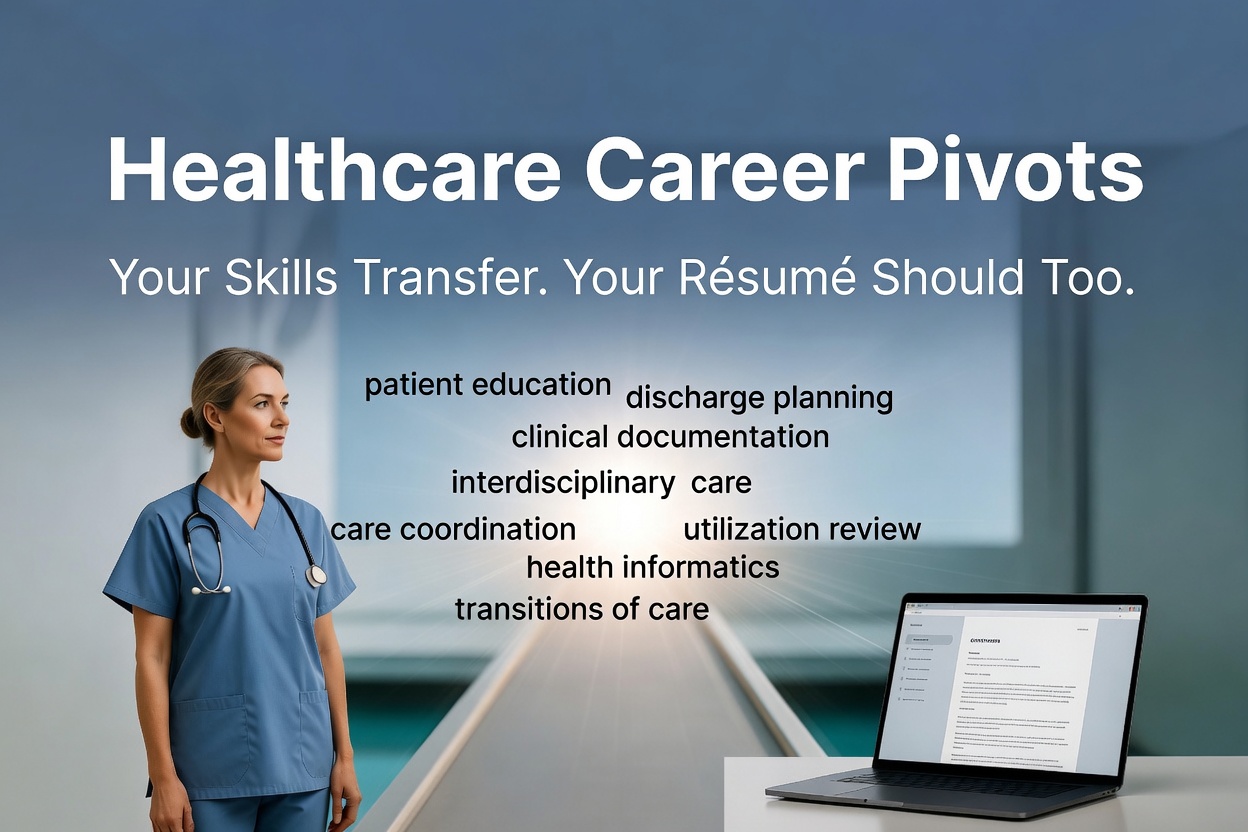 Healthcare is one of the few industries where a career pivot doesn't have to mean going back to school for another four years. A medical coder can move into clinical documentation improvement. A bedside nurse can transition into case management, informatics, or pharma sales. A billing specialist can land a role in healthcare administration. The skills transfer. The résumé often doesn't.
That gap between what you've done and what a hiring system reads is exactly where most pivots stall out.
Why Healthcare Pivots Get Stuck in the ATS
Applicant Tracking Systems are blunt instruments. They scan for keywords, section headers, and credential strings that match the job description. If you're moving from one healthcare role to another, your résumé might be packed with real, relevant experience that a parser quietly ignores because the terminology doesn't line up.
For example, a nurse transitioning into a care coordination role has deep experience with discharge planning, patient education, and cross-functional communication. But if the job posting uses phrases like "utilization review," "transitions of care," or "community health navigation" and those words don't appear in your résumé, the ATS may score you low before a human ever looks at your file.
This isn't about lying or padding. It's about translation.
Step One: Know What the ATS Actually Sees
Before you start rewriting anything, it helps to understand how your current résumé is being read. Parsers don't see your résumé the way a person does. They're extracting chunks of text and trying to categorize them. Headers that are too creative, columns that break up the text flow, tables, or graphics can all cause a parser to misread or skip sections entirely.
The Audit the Bots tool on Past the Bots shows you exactly what different parsers pull from your file: your name, contact info, job titles, dates, skills, and section content. If a parser is misreading your "Core Competencies" section as body text, or dropping your most recent job title, you'll see it right there. That's the kind of invisible problem that can tank an application before it gets anywhere.
Step Two: Match the Language of the Role You're Moving Into
Once you know your résumé is being read correctly, the next step is making sure it's saying the right things for your target role, not just your previous one.
Paste a job description for the role you want into the skill match tool and you'll see:
- Which keywords and skills from the posting already appear in your résumé
- Which ones are missing but likely part of your background
- Any knockout gaps (required credentials or qualifications you genuinely don't have)
For a healthcare pivot, this is especially useful because clinical and administrative roles often use different vocabulary for overlapping concepts. "Patient advocacy" in nursing might be "member support" in health insurance. "Interdisciplinary rounding" might map to "cross-functional collaboration" in a health tech role. The match tool helps you spot those gaps so you can close them intentionally.
Step Three: Rewrite Bullets That Speak to the New Role
This is where most people get stuck. They know they need to update their résumé, but they either don't change enough (just swapping job titles) or they overcorrect and start fabricating responsibilities they didn't actually have.
The AI tailoring feature in Past the Bots rewrites your bullet points to align with a specific job description, using your existing experience as the foundation. It does not invent credentials or make up achievements. It takes what you actually did and frames it in the language the new role cares about.
For a healthcare pivot, that might look like:
- Reframing clinical documentation experience to highlight accuracy, compliance, and audit readiness for a coding or CDI role
- Pulling out patient education work and repositioning it toward health literacy and community outreach language
- Highlighting cross-department coordination to speak to care management or operations roles
Step Four: Make Sure the Format Doesn't Work Against You
A lot of healthcare professionals use résumé templates with two columns, clinical skills tables, or headers formatted as text boxes. These look clean to a human but are often invisible to a parser.
If your résumé is getting rejected at high rates and you can't figure out why, an ATS-safe single-column rebuild is worth doing. It strips away the formatting complexity and makes sure every line of your résumé is readable by every system.
The Pivot Is Possible
Healthcare workers have more transferable skills than almost any other profession. The obstacle usually isn't experience, it's visibility. When the ATS can't read your résumé, or can't connect your background to the role, you get filtered out before anyone sees what you're actually capable of.
Fix the read. Match the language. Let the experience speak for itself.