How to Pivot Industries Without Losing All Your Keywords
August 5, 2026 · 4 min read · Past the Bots
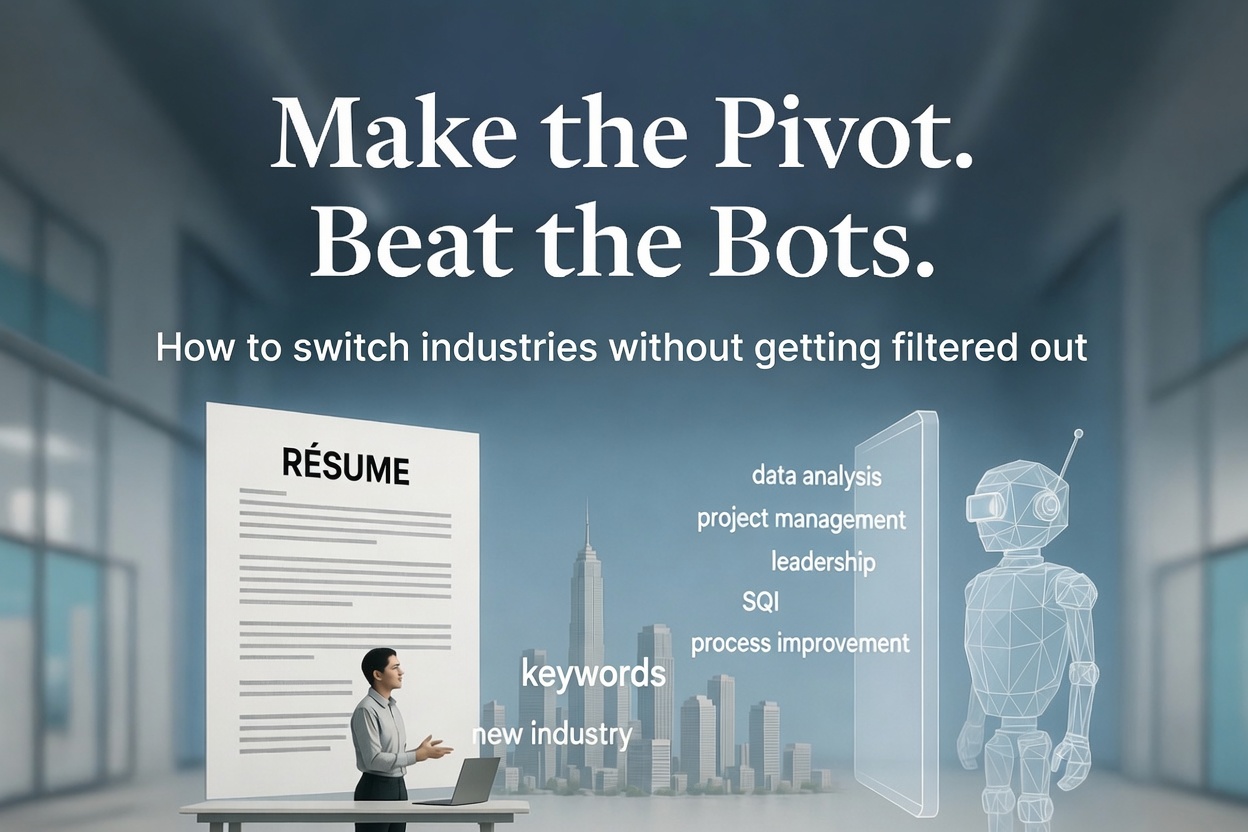 Switching industries is one of the most exciting and terrifying things you can do in your career. You know you have transferable skills. Your future employer probably knows it too, somewhere deep down. The problem is the ATS standing between you and that hiring manager has no idea, and it's not going to give you the benefit of the doubt.
Here's how to make your pivot without letting the bots filter you out before a human ever sees your name.
Understand What's Actually Transferable (and What Isn't)
Before you touch your résumé, get honest about two categories:
- Hard skills that cross industries -- data analysis, project management, budget oversight, SQL, Python, compliance, customer relationship management. These travel well.
- Skills that need a bridge -- industry-specific tools, certifications, or domain knowledge the new field genuinely requires.
The first category is your foundation. The second is your homework list.
A lot of career changers undersell the first category because they describe their experience in the language of their old industry. A marketing analyst moving into healthcare operations might not realize that "cohort analysis" and "KPI dashboards" are just as relevant to hospital administration as they were to e-commerce. The vocabulary is different; the skill is the same.
Remap Your Language to the New Industry
This is where ATS screening gets tricky for career changers. Applicant tracking systems match keywords, not concepts. If the job description says "patient throughput metrics" and your résumé says "funnel conversion rates," the system may not connect those dots even if you could do the work in your sleep.
The fix is deliberate translation. Pull up the job description you're targeting and look for the specific nouns the industry uses. Then audit your existing bullets and ask: am I describing this same skill in a way this system will recognize?
You don't have to fabricate anything. If you managed a team of eight people, you managed a team of eight people regardless of the industry. But if the target field calls that "cross-functional team leadership" instead of "department supervision," use their language.
The skill-match feature in Past the Bots is genuinely useful here -- paste in the job description and it'll show you which keywords are present in your résumé, which are missing, and which gaps are likely to be knockout factors. That gives you a concrete list to work from instead of guessing.
Fill the Real Gaps With Targeted Credentials
Some gaps are vocabulary problems. Others are actual knowledge gaps. Be honest about which is which, because recruiters and hiring managers will figure it out in the interview if not before.
For real gaps, here are some efficient ways to bridge them without going back to school for two years:
Project management and operations pivots:
- Google Project Management Certificate (Coursera, about six months part-time)
- PMP certification if you have the experience hours
- Lean Six Sigma Yellow or Green Belt for process-heavy roles
Data and analytics pivots:
- Google Data Analytics Certificate (Coursera)
- IBM Data Analyst Professional Certificate
- Tableau and Power BI have their own free learning paths and certifications
Tech and product pivots:
- CompTIA A+ or Security+ for IT roles
- AWS Cloud Practitioner for cloud-adjacent roles
- Product School's free certifications for product management
Healthcare and life sciences pivots:
- CPHIMS for health informatics
- Coursera's Healthcare Organization Operations specialization
- HIPAA compliance training (often free and highly valued)
Finance and fintech pivots:
- CFA Level 1 for investment roles
- CFP coursework for financial planning
- Coursera's Financial Markets course from Yale (free to audit)
Once you earn these, list them prominently. Don't bury a relevant certification at the bottom of your résumé under a wall of old job history. If the cert is what bridges your gap, it deserves real estate near the top.
Structure Your Résumé for a Pivot
Standard chronological résumés are built for people staying in their lane. If you're crossing lanes, consider leading with a skills-based summary section that front-loads your transferable abilities and the new-industry language you've mapped.
Then let your work history support it with specific, achievement-oriented bullets. Numbers help a lot here. "Reduced processing time by 30%" reads as competence regardless of what industry you were in when you did it.
Also worth checking: make sure your résumé is formatted in a way ATS systems can actually parse. Multi-column layouts, tables, and graphics often get scrambled by parsers, which means your carefully chosen keywords never get read at all. A clean, single-column format is your safest bet when you're already fighting an uphill perception battle.
The Bottom Line
A career pivot doesn't require you to erase your past. It requires you to translate it, fill the genuine gaps honestly, and present everything in a format the bots can read and the humans will find compelling. Do those three things, and you're not starting over. You're starting with an advantage most entry-level candidates don't have.