Job Description Matching: Why Keyword Stuffing Still Fails
September 21, 2026 · 4 min read · Past the Bots
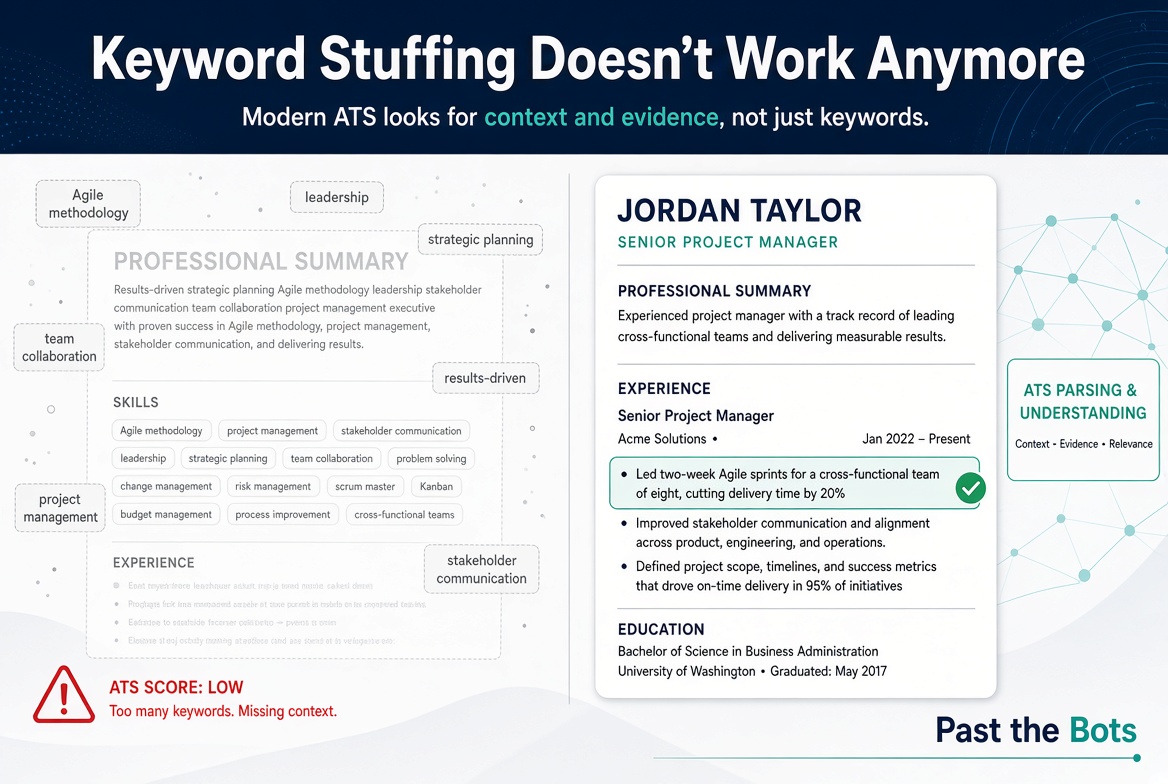 You've probably heard the advice a hundred times: sprinkle the right keywords throughout your résumé and the ATS will wave you through. So job seekers started copying job descriptions almost word for word, pasting in skills they barely touched, and hoping for the best.
Here's the problem: it doesn't really work anymore, and it was never a great strategy to begin with.
What Keyword Stuffing Actually Looks Like
Let's be specific. Imagine a job description asking for "project management," "stakeholder communication," and "Agile methodology." A keyword-stuffer drops all three phrases into their résumé summary, maybe again in a skills list, and calls it done. No context. No results. No evidence.
An older, simpler ATS might tick those boxes and pass the résumé along. But a lot has changed.
Modern parsing engines don't just scan for exact strings. They look at context, frequency, placement, and relationships between skills. A résumé that says "Agile methodology" once in a dumped skills list reads very differently from one that says "Led two-week Agile sprints for a cross-functional team of eight, cutting delivery time by 20%." One is a claim. The other is evidence.
And on the human side, recruiters who eventually open that résumé will notice immediately when the skills listed don't show up anywhere meaningful in your actual experience.
The Difference Between a Keyword Match and a Real Match
A genuine job description match goes several layers deeper than a word count.
Semantic alignment means the system understands that "managed budgets" and "P&L ownership" are related concepts, even if the exact phrase from the job description doesn't appear in your résumé. It also means recognizing that listing "Microsoft Excel" when a job asks for "financial modeling" is only a partial signal, not a strong match.
Weighted scoring matters too. Not every keyword in a job description carries the same weight. A posting for a data analyst role might mention "communication skills" and "SQL" in the same breath, but SQL is clearly the higher-stakes requirement. A smart match report separates those out rather than treating them as equals.
Knockout gaps are the requirements that will get you filtered out immediately, regardless of everything else on your résumé. Things like required certifications, specific years of experience, or a particular tool that's listed as mandatory. These deserve their own category, separate from "nice to have" misses.
What a Strong Match Report Actually Shows You
When you run a résumé against a job description in Past the Bots, you're not just getting a percentage score. You're getting a breakdown that tells you what to do next.
Here's what a useful match report surfaces:
- Matched keywords with context -- which terms appeared, where they appeared, and whether they're backed up by real bullet points or just floating in a skills list
- Missing keywords -- split into high-priority gaps (things central to the role) and lower-priority gaps ("nice to have" language you could reasonably add if it's accurate)
- Knockout gaps -- flagged separately so you know immediately if there's a dealbreaker mismatch before you even apply
- A weighted match score -- not just "you matched 14 out of 30 keywords" but a score that reflects which keywords actually matter for that specific role
That last point is important. A 70% keyword match where you're missing all the technical requirements is worse than a 55% match where you've nailed the core skills and are just light on some supporting language.
How to Actually Improve Your Match
Once you know what's missing, the fix isn't to copy and paste. It's to look at your real experience and ask: have I done this, and have I described it clearly?
A few practical moves:
- Mirror the job's language where it's accurate. If you called it "client relations" on your résumé but the job says "stakeholder management," and you genuinely did that work, update the phrasing.
- Bury nothing important in a skills list. If SQL is central to the role, it needs to show up in your bullet points doing actual work, not just listed under "Technical Skills."
- Cut bullets that add noise but no signal. A bloated résumé that matches 30 keywords weakly is worse than a focused one that matches 18 keywords with strong evidence.
- Don't add skills you don't have. Beyond the ethical issue, it tends to backfire in interviews and reference checks.
The goal is a résumé that reads as genuinely qualified, not one that's been engineered to game a system. The systems are catching up. The humans reviewing your résumé already figured it out a long time ago.