Job Hunt Pass & Subscription Value: When Free Tools Aren't Enough
August 22, 2026 · 4 min read · Past the Bots
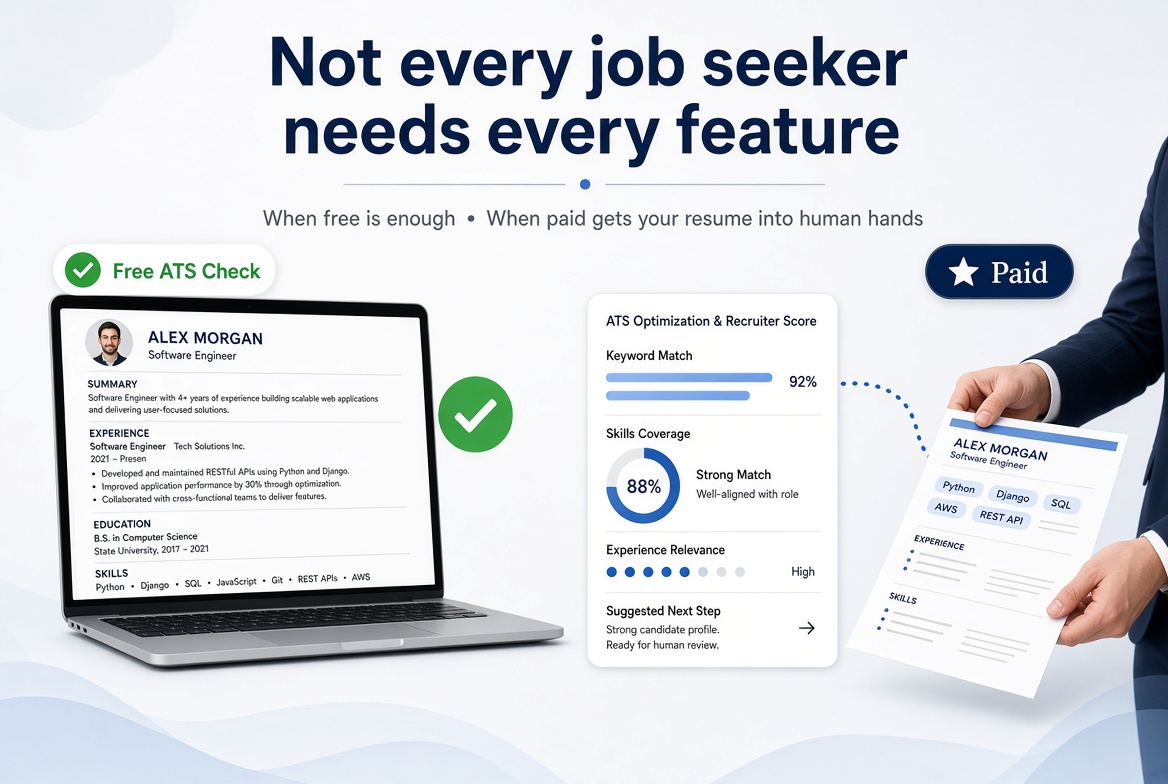 Not every job seeker needs every feature. That's just the truth. If you're casually exploring the market or only applying to a handful of roles, a free ATS check can tell you plenty. But there are real situations where a paid tier stops being an "extra" and starts being the thing that gets your resume into a human's hands.
Here's an honest breakdown.
When the Free Tier Is Genuinely Enough
Free tools do real work. A basic ATS scan that extracts your name, contact info, sections, and skills tells you whether a parser can actually read your resume. That matters more than most people realize.
You're probably fine with free if:
- You already have a clean, single-column resume with standard section headings
- You're applying to a small number of roles in the same field
- You just want a sanity check before submitting one specific application
- You're a recruiter doing a quick gut-check on a candidate's file format
If you run a scan and everything comes back green, great. You've confirmed your formatting isn't the problem. Sometimes that's exactly what you needed to know.
Where Free Tools Hit a Wall
Here's where things get honest. Most free ATS checkers give you a score. What they don't give you is a clear reason why the score is what it is, or a practical path to fixing it.
You might see "72% match" without knowing which missing keywords are actually dealbreakers versus which ones are nice-to-haves. You might get a vague warning about formatting without understanding what the parser is misreading and why.
The gap shows up fast when:
- You're applying to roles across multiple industries or pivoting careers
- You keep getting screened out despite feeling qualified on paper
- Your resume has tables, columns, text boxes, or a designed header
- You're in a competitive field where keyword precision actually moves the needle
That last point is worth sitting with. In fields like tech, healthcare, finance, or project management, ATS systems are often filtering hundreds of applications. A resume that's 70% matched on keywords may not survive long enough for a human to read it.
The Features That Actually Change Outcomes
When you're in active, serious job search mode, a few specific capabilities shift from "nice to have" to "genuinely useful."
Skill-weighted match scoring against the job description. Not just "here are missing keywords" but a breakdown of what's critical versus supplemental. Knowing that you're missing a knockout requirement is different from knowing you didn't mention a soft skill. That distinction saves you from chasing the wrong fixes.
AI tailoring that rewrites bullets without fabricating experience. This one matters because rewriting bullets yourself, every time, for every application, is exhausting and easy to get wrong. The value isn't that AI does it for you. The value is that it does it in a way that's honest, specific, and aligned to what that particular employer is actually scanning for.
An ATS-safe rebuild. If your resume has formatting issues baked in, a fresh single-column structure that parses cleanly can be the difference between getting through and getting filtered. This is especially true for people whose resumes were designed to look impressive on screen but confuse a parser entirely.
Cover letter and recruiter outreach generation. These feel like bonuses until you're 40 applications in and staring at a blank message field at 11pm. Having a starting point that's tailored to the role and doesn't sound like a template is worth more than it seems.
A Practical Way to Think About It
Here's a simple framing: if you're applying to fewer than five roles and your resume is already clean, use the free tools. Get your confirmation, move on.
If you're in an active job search, applying regularly, or stuck in a situation where you're qualified but not getting callbacks, the math changes. The cost of a month's subscription is almost certainly less than the cost of one extra week of unemployment, or one more round of applications that don't convert.
For career coaches and recruiters, the calculation is different again. If you're reviewing resumes for clients or candidates regularly, the ability to quickly show someone exactly what an ATS extracts from their file, with specific callouts, is a concrete thing you can deliver in a session.
The Bottom Line
Free is great for a quick check. Paid is worth it when you're serious, stuck, or sending volume. The goal of any tool in this space should be to help you spend less time guessing and more time in interviews. Choose the level that matches where you actually are in your search right now, and don't pay for more than you need.
But don't undersell yourself either. If your resume is disappearing into the void, that's worth solving properly.