LinkedIn Hiring Assistant 2 and the Rise of Recruiter-Side AI Agents
October 23, 2026 · 4 min read · Past the Bots
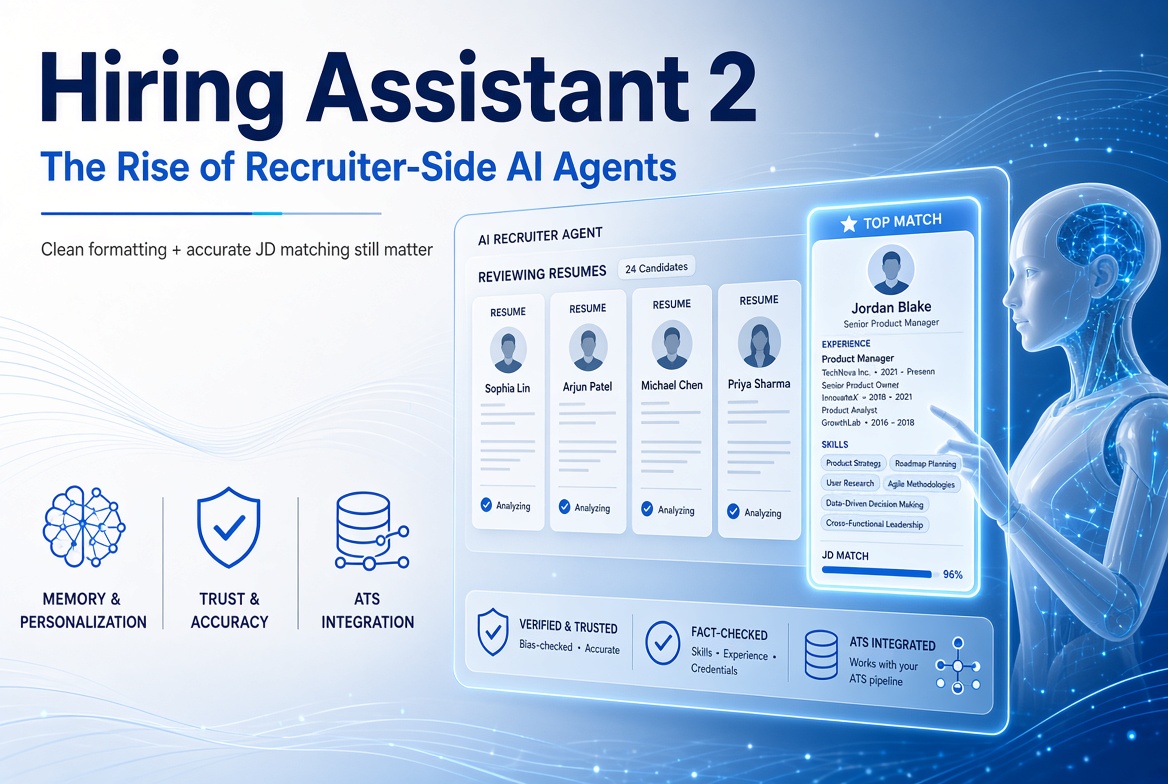 LinkedIn quietly rolled out a major upgrade to its AI recruiting tool in late September, and it's worth paying attention to if you're actively job searching right now.
Hiring Assistant 2 isn't just a smarter chatbot for recruiters. It remembers how specific recruiters and companies have hired in the past, it verifies candidate signals, and it integrates more deeply with applicant tracking systems. LinkedIn says recruiters are 4 times more likely to reach out to candidates the tool surfaces. That's not a small number.
So what does this mean for you as a job seeker? Let's break it down.
The Market Context Makes This More Important, Not Less
Here's the uncomfortable backdrop: global hiring is down roughly 30% compared to pre-pandemic levels, while the average number of applications per job seeker is up about 30%. More people are applying to more jobs, and fewer roles are open.
When you combine that with smarter AI on the recruiter side, the screening layer gets tighter. You're not just competing with other candidates anymore. You're competing for the attention of an AI agent that has learned what a specific recruiter at a specific company tends to value.
That's actually useful information, because it tells you exactly where to focus your energy.
What Hiring Assistant 2 Actually Does
A few things about this upgrade are worth understanding:
- It has memory. The tool learns from past hiring decisions at a company and for a specific recruiter. If a hiring manager at a company consistently skips candidates without cloud certifications listed prominently, the AI starts factoring that in.
- It adds trust and verification signals. LinkedIn is building in ways to surface candidates with verified skills, employment history, and credentials. Unverified or vague claims carry less weight.
- It integrates with ATS platforms. This means the AI isn't just looking at your LinkedIn profile in isolation. It's pulling data from across the hiring workflow, including how your résumé is parsed when you apply directly.
The upshot is that the system is getting more personalized to each company's hiring patterns, not less. Generic applications are going to get filtered out faster.
Clean Formatting Still Matters (Maybe More Than Ever)
Here's something people get wrong: they assume that because AI agents are smarter, formatting quirks won't matter as much. The opposite is closer to the truth.
Smarter AI systems are better at reading well-structured data, but they're also better at catching inconsistencies, gaps, and red flags in messy résumés. If your résumé has two-column layouts, text boxes, or headers that don't follow standard conventions, parsers can still scramble your contact info, skills, and job titles before the AI ever gets a chance to evaluate you fairly.
A résumé that doesn't parse cleanly is a résumé that doesn't exist in the system. The AI can't surface what it can't read.
Tools like the Audit the Bots scan exist precisely for this reason: to show you exactly what different parsers extract from your file before you hit submit. If your name or a key skill isn't showing up correctly, you want to know that before you apply to 30 jobs.
Accurate JD Matching Is Your Best Defense
Because Hiring Assistant 2 is trained on how individual companies have hired before, keyword matching has become more precise, not less. It's not just scanning for the word "project management" anymore. It's learning which skills and combinations of experience have led to successful hires at that company.
The practical implication: your résumé needs to match the actual job description accurately and specifically. Not stuffed with keywords, but genuinely reflective of the skills and experience you have that are relevant to the role.
A few things that help:
- Mirror the language in the job description. If they say "cross-functional collaboration" and you wrote "worked with multiple teams," you may be describing the same thing but the AI won't necessarily connect them.
- Don't leave out skills you actually have. Many people undersell themselves by listing a skill once in a buried bullet when it should be in their skills section and reinforced throughout their experience.
- Watch for knockout gaps. Some requirements are filters, not preferences. If a job requires a specific certification and you don't have it, no amount of polishing will change the outcome.
A skill-weighted match score against the job description, like the one built into Past the Bots, helps you see exactly where you're aligned and where you're leaving points on the table before you apply.
The Bigger Picture
Recruiter-side AI agents getting smarter is actually good news for candidates who put in the work. The more personalized these systems become, the more they reward genuine fit over volume applying. A well-tailored, cleanly formatted résumé that accurately reflects your experience and matches the job description is going to outperform a generic one more reliably than ever.
The game hasn't changed. It's just being played faster and with higher stakes. Make sure your résumé can keep up.