Middle Management Is Evolving Fast — Here's How to Make Sure Your Résumé Keeps Up
July 20, 2026 · 4 min read · Past the Bots
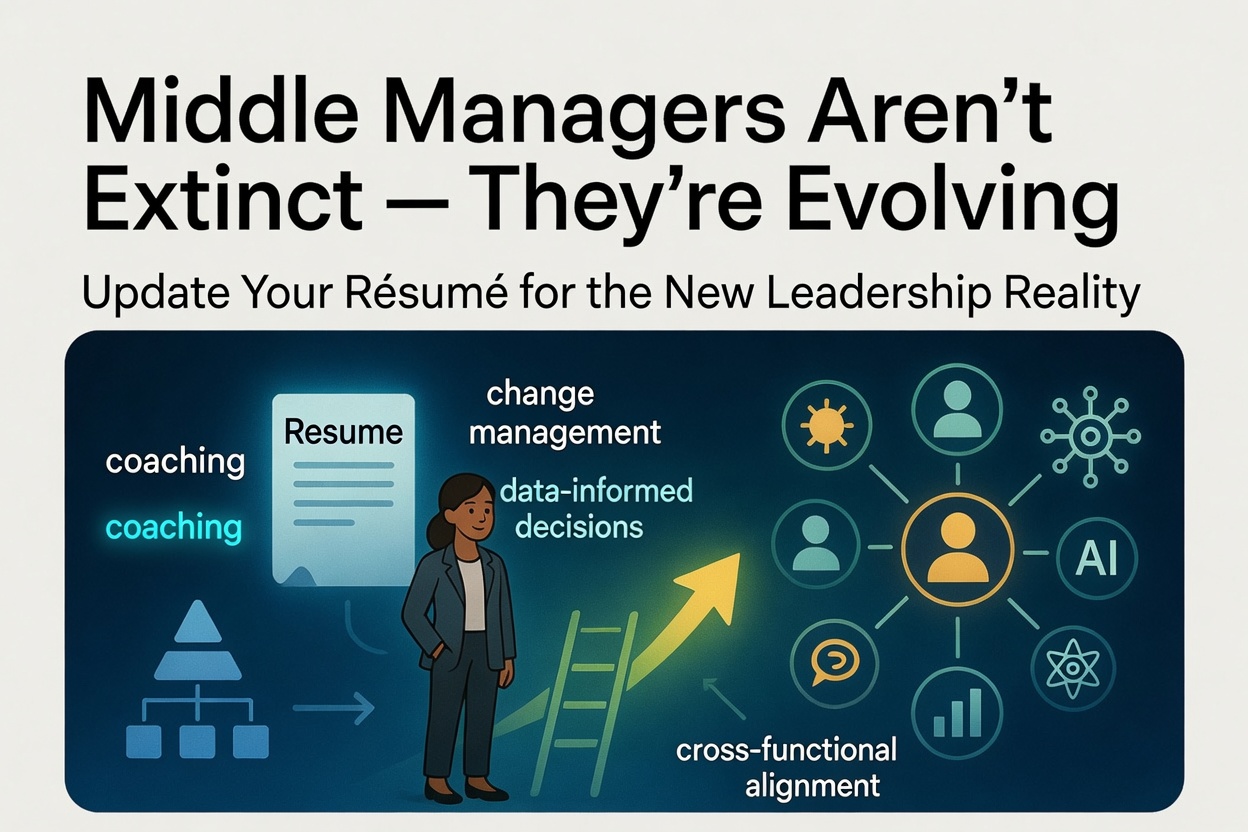 If you've been reading the headlines, you might have seen the wave of stories about middle managers getting squeezed out. Layoffs at big tech companies, flatter org charts, AI automating coordination tasks — it sounds grim. But a closer look tells a more interesting story.
According to recent reporting, middle managers aren't actually going extinct. They're evolving. The managers who are thriving aren't the ones who just relay information up and down the chain. They're the ones who coach teams, drive execution, translate strategy into action, and make decisions that AI tools simply can't make on their own. The role is becoming more human, not less relevant.
The problem? Most middle manager résumés haven't caught up to that shift. And that's where a lot of good candidates get stuck.
The Gap Between What You Do and What Your Résumé Says
Here's a scenario that plays out constantly: an experienced manager applies for a Director of Operations or Senior Team Lead role. They have exactly the right background. But their résumé still reads like a job description from 2015 — full of phrases like "oversaw daily operations" and "responsible for team performance."
An ATS sees that résumé and may not surface it at all, because the keywords don't match what the hiring team is actually looking for today. And even if it does get through, a recruiter scanning it won't immediately see the strategic, coaching-forward leader the company needs.
The language of middle management has changed. Hiring managers now want to see things like:
- Cross-functional alignment and stakeholder communication
- Coaching and developing individual contributors (not just managing them)
- Data-informed decision-making and operational metrics
- Change management and organizational agility
- AI tool adoption and helping teams work with new technology
If those phrases aren't in your résumé, you may be invisible to the systems screening applications before a human ever sees your name.
Why ATS Matching Matters More for Managers Than You'd Think
There's a common assumption that management-level roles are mostly filled through networking, and screening tools aren't as big a factor. That's partially true — relationships matter a lot at this level. But most companies, even when they have an internal referral, still require candidates to apply through their ATS. Your résumé gets parsed and scored regardless.
Running your résumé through an ATS checker before you apply gives you a concrete look at what the system actually sees. You might discover that your contact info isn't being parsed correctly, that your skills section is buried in a format the parser can't read, or that the job description you're targeting uses "people development" where your résumé says "staff training" — close enough in meaning, but not close enough for a keyword match.
The skill-weighted match score is especially useful here. When you paste a job description and compare it against your résumé, you get a clear view of matched keywords, missing terms, and any knockout gaps — the must-have qualifications that are completely absent from your document. For a management role, knockout gaps often include specific methodologies (Agile, OKRs, Six Sigma), tools (Salesforce, Workday, specific analytics platforms), or leadership competencies the company lists as required.
Tailoring Without Faking It
One thing managers tell us all the time: "I don't want to just stuff keywords in. I actually did this work, I just don't know how to say it in a way that lands."
That's exactly the right instinct. Keyword stuffing is easy to spot and it backfires. What actually works is rewriting your bullet points to accurately reflect your experience using the language the job description uses. If you coached six direct reports through a major product pivot, that's change management. If you built a dashboard to track team KPIs and presented it to the VP of Sales, that's data-informed leadership and executive communication.
AI-assisted tailoring can help you find that language without putting words in your mouth or inflating what you've done. The goal is precision and relevance, not fabrication.
The Bottom Line for Middle Managers Job Searching Right Now
The managers who are going to win the next round of hiring are the ones who can clearly demonstrate the evolved version of the role: strategic thinking, people development, cross-functional collaboration, and comfort with AI and data tools.
Your experience is probably already there. The question is whether your résumé communicates it in a way that both the ATS and the hiring manager will recognize immediately.
Before your next application, take 20 minutes to actually audit what your résumé is saying. Check what a parser extracts. Compare it to the job description. Fix the gaps that are costing you interviews. The middle management role is evolving into something more powerful — make sure your résumé is evolving with it.